Welcome to LookChem.com Sign In|Join Free
  • or

Encyclopedia

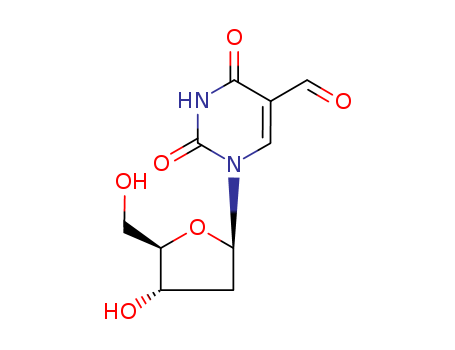
5-Formyl-2'-deoxyuridine

Base Information
  • Chemical Name:5-Formyl-2'-deoxyuridine
  • CAS No.:4494-26-2
  • Molecular Formula:C10H12 N2 O6
  • Molecular Weight:256.215
  • Hs Code.:
  • Nikkaji Number:J70.312E
  • ChEMBL ID:CHEMBL379296
  • Mol file:4494-26-2.mol
5-Formyl-2'-deoxyuridine

Synonyms:2'-deoxy-5-formyluridine;5-FdU;5-formyl-2'-deoxyuridine;5-formyldeoxyuridine

Suppliers and Price of 5-Formyl-2'-deoxyuridine
Supply Marketing:
Business phase:
The product has achieved commercial mass production*data from LookChem market partment
Manufacturers and distributors:
  • Manufacture/Brand
  • Chemicals and raw materials
  • Packaging
  • price
  • TRC
  • 1-((2R,4S,5R)-4-Hydroxy-5-(hydroxymethyl)tetrahydrofuran-2-yl)-2,4-dioxo-1,2,3,4-tetrahydropyrimidine-5-carbaldehyde
  • 25mg
  • $ 100.00
  • Crysdot
  • 1-((2R,4S,5R)-4-Hydroxy-5-(hydroxymethyl)tetrahydrofuran-2-yl)-2,4-dioxo-1,2,3,4-tetrahydropyrimidine-5-carbaldehyde 95+%
  • 250mg
  • $ 253.00
  • Crysdot
  • 1-((2R,4S,5R)-4-Hydroxy-5-(hydroxymethyl)tetrahydrofuran-2-yl)-2,4-dioxo-1,2,3,4-tetrahydropyrimidine-5-carbaldehyde 95+%
  • 100mg
  • $ 158.00
  • Crysdot
  • 1-((2R,4S,5R)-4-Hydroxy-5-(hydroxymethyl)tetrahydrofuran-2-yl)-2,4-dioxo-1,2,3,4-tetrahydropyrimidine-5-carbaldehyde 95+%
  • 1g
  • $ 632.00
  • Chemenu
  • 1-((2R,4S,5R)-4-hydroxy-5-(hydroxymethyl)tetrahydrofuran-2-yl)-2,4-dioxo-1,2,3,4-tetrahydropyrimidine-5-carbaldehyde 95%
  • 1g
  • $ 597.00
  • Biosynth Carbosynth
  • 2'-Deoxy-5-formyluridine
  • 50 mg
  • $ 110.00
  • Biosynth Carbosynth
  • 2'-Deoxy-5-formyluridine
  • 25 mg
  • $ 75.00
  • Biosynth Carbosynth
  • 2'-Deoxy-5-formyluridine
  • 10 mg
  • $ 45.00
  • Biosynth Carbosynth
  • 2'-Deoxy-5-formyluridine
  • 250 mg
  • $ 250.00
  • Biosynth Carbosynth
  • 2'-Deoxy-5-formyluridine
  • 100 mg
  • $ 160.00
Total 30 raw suppliers
Chemical Property of 5-Formyl-2'-deoxyuridine
Chemical Property:
  • Boiling Point:°Cat760mmHg 
  • PKA:8.23±0.10(Predicted) 
  • Flash Point:°C 
  • PSA:121.62000 
  • Density:1.67g/cm3 
  • LogP:-2.01020 
  • Storage Temp.:under inert gas (nitrogen or Argon) at 2-8°C 
  • Solubility.:DMSO (Slightly), Methanol (Slightly, Sonicated), Water (Slightly, Sonicated) 
  • XLogP3:-1.9
  • Hydrogen Bond Donor Count:3
  • Hydrogen Bond Acceptor Count:6
  • Rotatable Bond Count:3
  • Exact Mass:256.06953611
  • Heavy Atom Count:18
  • Complexity:421
Purity/Quality:

99%, *data from raw suppliers

1-((2R,4S,5R)-4-Hydroxy-5-(hydroxymethyl)tetrahydrofuran-2-yl)-2,4-dioxo-1,2,3,4-tetrahydropyrimidine-5-carbaldehyde *data from reagent suppliers

Safty Information:
  • Pictogram(s):  
  • Hazard Codes: 
MSDS Files:

SDS file from LookChem

Useful:
  • Canonical SMILES:C1C(C(OC1N2C=C(C(=O)NC2=O)C=O)CO)O
  • Isomeric SMILES:C1[C@@H]([C@H](O[C@H]1N2C=C(C(=O)NC2=O)C=O)CO)O
  • General Description 5-Formyl-2'-deoxyuridine (5-FormdUrd) is an oxidative damage product derived from thymine in DNA, formed via one-electron oxidation of the thymine radical cation. This process involves deprotonation of the thymine methyl group followed by reaction with molecular oxygen (O2), analogous to the formation of 5-hydroxymethyl-2'-deoxyuridine (5-HMdUrd). The study highlights that thymine, despite its higher oxidation potential compared to adenine, is a major site of oxidative damage in guanine-deficient DNA sequences, with 5-FormdUrd representing one of the key reaction products. The findings underscore the role of thymine radical cation reactivity, rather than stability, in determining oxidative damage pathways.
Technology Process of 5-Formyl-2'-deoxyuridine

There total 28 articles about 5-Formyl-2'-deoxyuridine which guide to synthetic route it. The literature collected by LookChem mainly comes from the sharing of users and the free literature resources found by Internet computing technology. We keep the original model of the professional version of literature to make it easier and faster for users to retrieve and use. At the same time, we analyze and calculate the most feasible synthesis route with the highest yield for your reference as below:

synthetic route:
Guidance literature:
With acetic acid; at 50 ℃; for 16h;
DOI:10.1248/cpb.42.2231
Guidance literature:
With triethylamine; In methanol; water; at 20 ℃; for 2h;
DOI:10.1007/s11171-005-0076-7
Guidance literature:
With pyridine; pyridine hydrogenfluoride; In ethyl acetate; at 20 ℃; for 62h;
DOI:10.1021/ja403229y
Refernces

Selective one-electron oxidation of duplex DNA oligomers: Reaction at thymines

10.1039/b717437c

The research investigates the one-electron oxidation of DNA duplex oligomers that do not contain guanine, focusing on the reactions at thymine bases. The purpose is to understand the mechanisms and products of oxidation in DNA sequences lacking guanine, which is typically the most reactive base in DNA oxidation. The study uses anthraquinone (AQ) as a photosensitizer linked to DNA oligomers to generate radical cations upon UVA irradiation. The key findings are that thymine, despite having a higher oxidation potential than adenine, is the primary site of oxidation reactions, leading to products such as thymidine glycols, 5-(hydroxymethyl)-2'-deoxyuridine, and 5-formyl-2'-deoxyuridine. 5-Hydroxymethyl-2'-deoxyuridine (5-HMdUrd) is formed through the reaction of the thymine radical cation with molecular oxygen (O2) after the initial deprotonation of the thymine methyl group. This process involves the formation of a transient 5-(2'-deoxyuridinyl)methyl radical, which is subsequently trapped by O2. 5-Formyl-2'-deoxyuridine (5-FormdUrd) is another product formed from the reaction of the thymine radical cation. Similar to 5-HMdUrd, its formation involves the initial deprotonation of the thymine methyl group, followed by reaction with molecular oxygen (O2). The research concludes that the reactivity of the thymine radical cation, rather than its stability, determines the oxidation products. The study also proposes a mechanism involving proton loss from the thymine methyl group or addition of H2O/O2 across the thymine double bond, which can initiate tandem reactions converting both thymines in a TT step to oxidation products. This work has implications for understanding oxidative damage in genomic DNA, particularly in sequences with few guanines.


Post a RFQ

Enter 15 to 2000 letters.Word count: 0 letters

Attach files(File Format: Jpeg, Jpg, Gif, Png, PDF, PPT, Zip, Rar,Word or Excel Maximum File Size: 3MB)

1 Customer Service

What can I do for you?
Get Best Price

Get Best Price for 4494-26-2