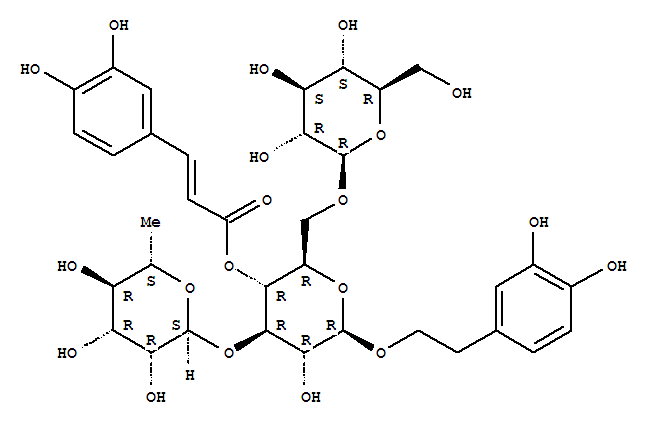
Chemical Property of Echinacoside
Chemical Property:
- Appearance/Colour:yellowish-brown
- Boiling Point:1062.7 °C at 760 mmHg
- PKA:8.43±0.20(Predicted)
- Flash Point:327.8 °C
- PSA:324.44000
- Density:1.66 g/cm3
- LogP:-3.19170
- Storage Temp.:2-8°C
- XLogP3:-2.1
- Hydrogen Bond Donor Count:12
- Hydrogen Bond Acceptor Count:20
- Rotatable Bond Count:14
- Exact Mass:786.25824385
- Heavy Atom Count:55
- Complexity:1230
- Purity/Quality:
-
≥98% *data from raw suppliers
Purpureaside C *data from reagent suppliers
Safty Information:
- Pictogram(s):
- Hazard Codes:
- Safety Statements:
24/25
- MSDS Files:
-
SDS file from LookChem
Useful:
- Canonical SMILES:CC1C(C(C(C(O1)OC2C(C(OC(C2OC(=O)C=CC3=CC(=C(C=C3)O)O)COC4C(C(C(C(O4)CO)O)O)O)OCCC5=CC(=C(C=C5)O)O)O)O)O)O
- Isomeric SMILES:C[C@H]1[C@@H]([C@H]([C@H]([C@@H](O1)O[C@@H]2[C@H]([C@@H](O[C@@H]([C@H]2OC(=O)/C=C/C3=CC(=C(C=C3)O)O)CO[C@H]4[C@@H]([C@H]([C@@H]([C@H](O4)CO)O)O)O)OCCC5=CC(=C(C=C5)O)O)O)O)O)O
-
Description
Echinacoside is a phenylethanoid glycoside that has been found in Echinacea and has diverse biological activities. It scavenges 2,2-diphenyl-1-picrylhydrazyl (DPPH; ) radicals (EC50 = 6.6 μM in a cell-free assay). Echinacoside (10 μg/ml) inhibits hydrogen peroxide-induced production of reactive oxygen species (ROS) and apoptosis in PC12 cells. It reduces increases in plasma alanine aminotransferase (ALT), TNF-α, IL-1β, IL-16, and IL-10 levels and hepatocyte apoptosis induced by LPS/D-galactosamine in a mouse model of acute liver injury when administered at a dose of 60 mg/kg. Echinacoside (20 mg/kg per day for 15 days) prevents loss of dopaminergic neurons in the substantia nigra pars compacta and decreases in striatal dopamine and 3,4-dihydroxyphenylacetic acid (DOPAC) levels in a mouse model of MPTP-induced Parkinson''s disease. It also improves motor performance in the rotarod test in the same model.
-
Uses
Echinacoside Ethanolate is a caffeic acid glycoside, known for its neuroprotective, antiinflammatory and anti-oxidative activities. Also an anti[proliferative towards hypoxia influenced pulmonary artery smooth muscle cells.