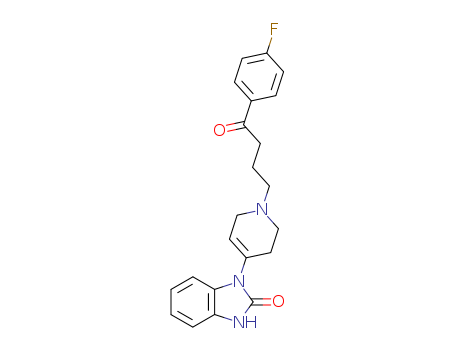
Chemical Property of Droperidol
Chemical Property:
- Appearance/Colour:Pale yellow solid
- Melting Point:148-149 °C
- Refractive Index:1.613
- PKA:7.64(at 25℃)
- PSA:58.10000
- Density:1.269 g/cm3
- LogP:3.61630
- Storage Temp.:2-8°C
- Solubility.:Practically insoluble in water, freely soluble in dimethylformamide and in methylene chloride, sparingly soluble in ethanol (96 per cent).
- Water Solubility.:4.1mg/L(30 oC)
- XLogP3:3.5
- Hydrogen Bond Donor Count:1
- Hydrogen Bond Acceptor Count:4
- Rotatable Bond Count:6
- Exact Mass:379.16960512
- Heavy Atom Count:28
- Complexity:615
- Purity/Quality:
-
99% *data from raw suppliers
Droperidol *data from reagent suppliers
Safty Information:
- Pictogram(s):
 Xn
Xn
- Hazard Codes:Xn
- Statements:
22
- Safety Statements:
36
- MSDS Files:
-
SDS file from LookChem
Total 1 MSDS from other Authors
Useful:
- Canonical SMILES:C1CN(CC=C1N2C3=CC=CC=C3NC2=O)CCCC(=O)C4=CC=C(C=C4)F
- Recent ClinicalTrials:Low-dose Droperidol for Prevention of Postoperative Delirium in Elderly Patients After Non-cardiac Surgery
- Recent EU Clinical Trials:à compléter
- Recent NIPH Clinical Trials:Efficacy of pentazocine on pruritus during cesarean section due to spinal anesthesia-added opioids.
-
Description
D roperidol is a butyrophenone that has potent antidopaminergic (D2)
activity and mild α2-blocking actions. It produces sedation and anxiolysis and
is an effective antiemetic. A dverse effects include
vasodilatation and hypotension, and at higher doses, dystonic reactions can
occur. D roperidol was used for premedication and in neuroleptanaesthesia
until reports of death from long QT syndrome led to its withdrawal in 2001. It
has recently been reintroduced and licenced at lower doses for prevention of
postoperative nausea and vomiting. D roperidol has an onset of 3–10 min
after i.v. injection and duration of action of 6–12h. It undergoes hepatic
metabolism, but approximately 10% of the drug is excreted unchanged in the
urine.
-
Uses
A D1, D2 dopamine receptor antagonist; butyrophenone antipsychotic and anti-emetic. H2 antihistamine A D1DR and D2DR inhibitor. The neuroleptic droperidol possesses antipsychotic, sedative, and antishock action. It poten�tiates the action of drugs for narcosis. In psychiatric practice, droperidol is used for psy�chomotor excitement and hallucinations. The principal use of this drug lies in anesthesiology
for neuroleptanalgesia in combination with fentanyl. It is used in premedication as well as in
surgical operations and post-operational circumstances.
-
Therapeutic Function
Tranquilizer
-
Clinical Use
#N/A
-
Drug interactions
Potentially hazardous interactions with other drugsAnaesthetics: enhanced hypotensive effect; effects of
thiopental enhanced.Analgesics: increased risk of ventricular arrhythmias
with methadone; increased risk of convulsions with
tramadol; enhanced hypotensive and sedative effects
with opioids.Anti-arrhythmics increased risk of ventricular
arrhythmias with anti-arrhythmics that prolong
the QT interval, e.g. procainamide, disopyramide,
dronedarone and amiodarone - avoid.Antibacterials: increased risk of ventricular
arrhythmias with moxifloxacin and macrolides -
avoid; increased risk of ventricular arrhythmias with
delamanid.Antidepressants: increased risk of ventricular
arrhythmias with fluoxetine, fluvoxamine, sertraline
or tricyclics - avoid; possible increased risk of
convulsions with vortioxetine.Antiepileptics: convulsive threshold lowered.Antimalarials: avoid with artemether/lumefantrine
and piperaquine with artenimol; increased risk
of ventricular arrhythmias with chloroquine,
hydroxychloroquine or quinine - avoid.Antipsychotics: increased risk of ventricular
arrhythmias with amisulpride, pimozide, sulpiride,
phenothiazines that prolong QT interval or
haloperidol - avoid; possibly increased risk of
ventricular arrhythmias with risperidone.Antivirals: concentration possibly increased with ritonavirAnxiolytics and hypnotics: increased sedative effects.Atomoxetine: increased risk of ventricular
arrhythmias.Beta-blockers: enhanced hypotensive effect;
increased risk of ventricular arrhythmias with sotalol
- avoid.Cytotoxics: increased risk of ventricular arrhythmias
with arsenic trioxide and possibly ceritinib.Desferrioxamine: avoid concomitant use.Diuretics: enhanced hypotensive effect.Hormone antagonists: increased risk of ventricular
arrhythmias with tamoxifen - avoid.Lithium: increased risk of extrapyramidal side effects
and possibly neurotoxicity.Pentamidine: increased risk of ventricular
arrhythmias - avoid.Tacrolimus: increased risk of ventricular arrhythmias
- avoid.