Welcome to LookChem.com Sign In|Join Free
  • or

Encyclopedia

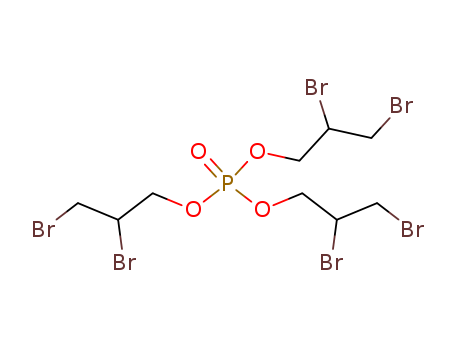
Tris(2,3-dibromopropyl) phosphate

Base Information
  • Chemical Name:Tris(2,3-dibromopropyl) phosphate
  • CAS No.:126-72-7
  • Deprecated CAS:1867-14-7,55962-48-6,68112-30-1,1228931-66-5,1228931-66-5,55962-48-6,68112-30-1
  • Molecular Formula:C9H15 Br6 O4 P
  • Molecular Weight:697.613
  • Hs Code.:29191000
  • European Community (EC) Number:204-799-9
  • ICSC Number:0433
  • NSC Number:3240
  • UN Number:3082
  • UNII:X7O89N7ZY0
  • DSSTox Substance ID:DTXSID5021413
  • Nikkaji Number:J3.622F
  • Wikipedia:Tris(2,3-dibromopropyl)_phosphate
  • Wikidata:Q2443865
  • NCI Thesaurus Code:C44460
  • ChEMBL ID:CHEMBL1904600
  • Mol file:126-72-7.mol
Tris(2,3-dibromopropyl) phosphate

Synonyms:TDBPP;Tris (flame retardant);tris(2,3-dibromopropyl)phosphate

Suppliers and Price of Tris(2,3-dibromopropyl) phosphate
Supply Marketing:
Business phase:
The product has achieved commercial mass production*data from LookChem market partment
Manufacturers and distributors:
  • Manufacture/Brand
  • Chemicals and raw materials
  • Packaging
  • price
  • TRC
  • Tris(2,3-dibromopropyl) phosphate
  • 250mg
  • $ 155.00
  • Sigma-Aldrich
  • Tris(2,3-dibromopropyl) phosphate analytical standard
  • 442833
  • $ 76.70
  • Medical Isotopes, Inc.
  • Tris(2,3-dibromopropyl) phosphate
  • 2.5 g
  • $ 2000.00
  • American Custom Chemicals Corporation
  • Tris(2,3-dibromopropyl) phosphate 95.00%
  • 250MG
  • $ 292.95
Total 5 raw suppliers
Chemical Property of Tris(2,3-dibromopropyl) phosphate
Chemical Property:
  • Vapor Pressure:2.78E-07mmHg at 25°C 
  • Melting Point:5.5°C 
  • Boiling Point:544.2°Cat760mmHg 
  • Flash Point:282.9°C 
  • PSA:54.57000 
  • Density:2.321g/cm3 
  • LogP:5.61950 
  • Storage Temp.:room temp 
  • Water Solubility.:8mg/L(24 oC) 
  • XLogP3:4.3
  • Hydrogen Bond Donor Count:0
  • Hydrogen Bond Acceptor Count:4
  • Rotatable Bond Count:12
  • Exact Mass:697.57467
  • Heavy Atom Count:20
  • Complexity:255
  • Transport DOT Label:Class 9
Purity/Quality:

98%min *data from raw suppliers

Tris(2,3-dibromopropyl) phosphate *data from reagent suppliers

Safty Information:
  • Pictogram(s):  
  • Hazard Codes:T,N 
  • Statements: 45-22-38-51/53 
  • Safety Statements: 53-26-37-61 
MSDS Files:

SDS file from LookChem

Useful:
  • Chemical Classes:Other Classes -> Organophosphates, Other
  • Canonical SMILES:C(C(CBr)Br)OP(=O)(OCC(CBr)Br)OCC(CBr)Br
  • Inhalation Risk:Evaporation at 20 °C is negligible; a harmful concentration of airborne particles can, however, be reached quickly when dispersed.
  • Effects of Long Term Exposure:This substance is probably carcinogenic to humans.
  • Uses Tris(2,3-dibromopropyl) Phosphate is a flame retardant that has previously shown to be a mutagen and carcinogen in experimental animals. Tris(2,3-dibromopropyl) Phosphate is widely used in pastics an d textiles. Flame retardant for plastics and synthetic fibers. Formerly used in children's sleepwear.
Technology Process of Tris(2,3-dibromopropyl) phosphate

There total 1 articles about Tris(2,3-dibromopropyl) phosphate which guide to synthetic route it. The literature collected by LookChem mainly comes from the sharing of users and the free literature resources found by Internet computing technology. We keep the original model of the professional version of literature to make it easier and faster for users to retrieve and use. At the same time, we analyze and calculate the most feasible synthesis route with the highest yield for your reference as below:

synthetic route:
Guidance literature:
Triallylphosphat, Bromierung;
Refernces

Preparation of (+)- and (-)-2,3-Dibromo-1-propanols

10.1021/je00030a033

The research focused on the preparation and purification of enantiomers of 2,3-dibromo-1-propanol, a mutagenic metabolite of the potent mutagen, carcinogen, and nephrotoxin tris(2,3-dibromopropyl) phosphate. The purpose of the study was to determine the influence of stereochemistry on the toxic properties of 2,3-dibromopropanols and their phosphate esters, as oxidations by cytochrome P-450 are often stereoselective. The researchers synthesized the optical isomers by diazotization of the diastereomeric d-tartrate salts of 2,3-dibromopropylamine, yielding products that contained approximately 13% of the secondary alcohol 1,3-dibromo-2-propanol. The primary and secondary alcohols were separated using column chromatography on silica gel or preparative GLC, and their structures were distinguished using NMR and mass spectrometry. The optical isomers were obtained and will be used to examine possible stereoselective differences in mutagenic potency. Chemicals used in the process included allylamine, d-tartaric acid, concentrated HBr, bromine, NaOH, NaNO2, H2SO4, and various solvents such as methanol, hexane, benzene, and ether for chromatography and extraction.

Post a RFQ

Enter 15 to 2000 letters.Word count: 0 letters

Attach files(File Format: Jpeg, Jpg, Gif, Png, PDF, PPT, Zip, Rar,Word or Excel Maximum File Size: 3MB)

1 Customer Service

What can I do for you?
Get Best Price

Get Best Price for 126-72-7