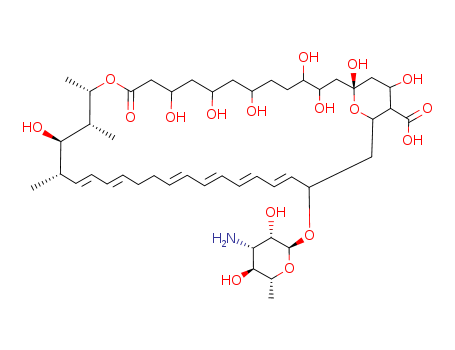
Chemical Property of Nystatin, European Pharmacopoeia (EP) Reference Standard
Chemical Property:
- Appearance/Colour:COA
- Vapor Pressure:1.6E-07mmHg at 25°C
- Melting Point:>155°C (dec.)
- Refractive Index:1.503
- Boiling Point:1132.1 °C at 760 mmHg
- PKA:pKa 5.72(MeOH/2-methoxyethanol/
H2O) (Uncertain);8.64 (Uncertain)
- Flash Point:638.5 °C
- PSA:327.45000
- Density:1.31 g/cm3
- LogP:1.47860
- Storage Temp.:−20°C
- Solubility.:H2O: insoluble
- Water Solubility.:0.36g/L(24 oC)
- XLogP3:-0.2
- Hydrogen Bond Donor Count:12
- Hydrogen Bond Acceptor Count:18
- Rotatable Bond Count:3
- Exact Mass:925.50349992
- Heavy Atom Count:65
- Complexity:1620
- Purity/Quality:
-
99.0%Min *data from raw suppliers
Nystatin *data from reagent suppliers
Safty Information:
- Pictogram(s):
 F,
F, C
C
- Hazard Codes:F,C
- Statements:
11-34
- Safety Statements:
22-24/25-45-36/37/39-26-16
- MSDS Files:
-
SDS file from LookChem
Useful:
- Drug Classes:Antifungal Agents
- Canonical SMILES:CC1C=CC=CCCC=CC=CC=CC=CC(CC2C(C(CC(O2)(CC(C(CCC(CC(CC(CC(=O)OC(C(C1O)C)C)O)O)O)O)O)O)O)C(=O)O)OC3C(C(C(C(O3)C)O)N)O
- Isomeric SMILES:C[C@H]1/C=C/C=C/CC/C=C/C=C/C=C/C=C/[C@@H](C[C@H]2[C@@H]([C@H](C[C@](O2)(C[C@H]([C@@H](CC[C@H](C[C@H](C[C@H](CC(=O)O[C@H]([C@H]([C@@H]1O)C)C)O)O)O)O)O)O)O)C(=O)O)O[C@H]3[C@H]([C@H]([C@@H]([C@H](O3)C)O)N)O
- Recent ClinicalTrials:A Study of the Safety and Tolerability of ASP7317 in Senior Adults Who Are Losing Their Clear, Sharp Central Vision Due to Geographic Atrophy Secondary to Dry Age-related Macular Degeneration
- Recent EU Clinical Trials:Chlorhexidine and nystatin in the treatment of oral candidosis - a pilot study
- Recent NIPH Clinical Trials:Prophylactic use of hydrocortisone containing mouthwash in the prevention of mTOR inhibitor-associated stomatitis
-
Uses
Antifungal;Performs membrane ionophores Nystatin is polyene antifungal containing a conjugated tetraene and a diene, isolated as a complex of three components A1, A2 and A3 from Streptomyces noursei and first reported in 1950. Nystatin, like most polyene antifungals, binds to sterols in the fungal cell membrane leading to formation of ion channels in the wall, ion imbalance and cell death. Nystatin is an established bioprobe and widely-used antifungal reagent with over 4,000 literature citations. Polyene antifungal antibiotic complex containing 3 biologically active components, A1, A2, A3. Increases the permeability of the cell membrane of sensitive fungi by binding to sterols. Cell culture tested. Growth promotant.
Nystatin A1 is shown.
-
Indications
Nystatin (Mycostatin) is a polyene antifungal drug with
a ring structure similar to that of amphotericin B and a
mechanism of action identical to that of amphotericin
B. Too toxic for systemic use, nystatin is limited to the
topical treatment of superficial infections caused by
C. albicans. Infections commonly treated by this drug
include oral candidiasis (thrush), mild esophageal candidiasis,
and vaginitis.
-
Therapeutic Function
Antifungal
-
Clinical Use
Nystatin, the first clinically useful polyene antifungal antibiotic, is a conjugated tetraene isolated from cultures of the bacterium
Streptomyces noursei in 1951. Nystatin is an effective topical antifungal against a wide variety of organisms and is available in
a variety of creams and ointments. Nystatin is too toxic to be used systemically, but because very little drug is absorbed
following oral administration, it may be administered by mouth to treat fungal infections of the mouth and gastrointestinal tract.
-
Drug interactions
Potentially hazardous interactions with other drugs
None known