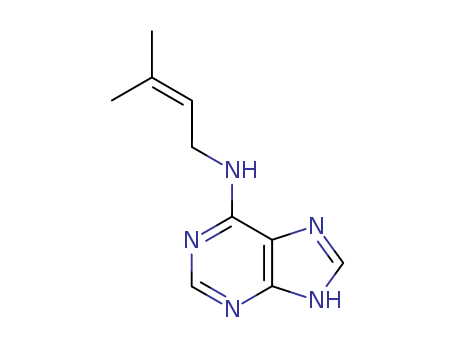
Chemical Property of N-(3-Methylbut-2-EN-1-YL)-9H-purin-6-amine
Chemical Property:
- Vapor Pressure:0.000352mmHg at 25°C
- Melting Point:218-220 °C
- Refractive Index:1.659
- Boiling Point:477.144 °C at 760 mmHg
- PKA:9.36±0.20(Predicted)
- Flash Point:242.368 °C
- PSA:66.49000
- Density:1.267 g/cm3
- LogP:1.80400
- Storage Temp.:−20°C
- Solubility.:DMF (Slightly), Methanol (Slightly)
- XLogP3:2.1
- Hydrogen Bond Donor Count:2
- Hydrogen Bond Acceptor Count:4
- Rotatable Bond Count:3
- Exact Mass:203.11709544
- Heavy Atom Count:15
- Complexity:236
- Purity/Quality:
-
≥98% *data from raw suppliers
N6-(2-Isopentenyl)adenine *data from reagent suppliers
Safty Information:
- Pictogram(s):
- Hazard Codes:
- MSDS Files:
-
SDS file from LookChem
Useful:
- Chemical Classes:Biological Agents -> Nucleic Acids and Derivatives
- Canonical SMILES:CC(=CCNC1=NC=NC2=C1NC=N2)C
-
Uses
N6-(2-Isopentenyl)adenine can be used in biological study for cytokinins stimulated expression of stress-related proteins and transcripts in Arabidopsis thaliana with isopentenyltransferase overexpression. 6-(γ,γ-Dimethylallylamino)purine (2iP) is a bacteria-derived riboside cytokinin used to grow plant tissues such as tobacco and soybean callus. 2iP is a precursor of the cytokinin Zeatin. 2iP has been used in Schenk and Hildebrandt medium to support in vitro propagation of microshoot cultures from shoot tips of Genista plants.
-
Description
A purine alkaloid, this base was first isolated from the leaves of Gleditsia
triacanthus L., and subsequently discovered in Chidlowia sanguinea and Holar_x0002_rhena floribunda (G. Don.) Dur. et Schinz. The free alkaloid forms colourless
crystals and yields crystalline salts and derivatives, e.g. the hydrochloride, m.p.
218-9°C; hydrobromide, m.p. 215-6°C; sulphate, two salts are formed with
m.p. 175-6°C and 216-7°C respectively depending upon the amount of acid
used in their preparation; picrate, m.p. 246-7°C (dec.); picrolonate, m.p.
229-231 0 C; methiodide, m.p. 227-9°C and the N-benzyl derivative, m.p.
150°C. Oxidation of the alkaloid with KMn04 gives 7-(2:3-dihydroxy-3-methyl�butyl)-6-aminopurine which, on periodate oxidation, furnishes 7-(formylmethyl)-
6-aminopurine and Me2CO. Heating the base with Ba(OHh gives one mole each
of NH3, C02 and 4-N-(r:r-dimethylallyl)-N-amino-imidazole-5-carboxamide.