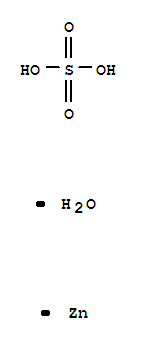
Chemical Property of Sulfuric acid;ZINC;hydrate
Chemical Property:
- Appearance/Colour:white powder or granules
- Vapor Pressure:3.35E-05mmHg at 25°C
- Melting Point:decomposes at 238℃ [KIR84]
- Boiling Point:330 °C at 760 mmHg
- PSA:97.87000
- Density:1.005 g/mL at 25°C
- LogP:-0.32400
- Solubility.:water: soluble(lit.)
- Water Solubility.:Soluble in water and alcohol.
- Hydrogen Bond Donor Count:3
- Hydrogen Bond Acceptor Count:5
- Rotatable Bond Count:0
- Exact Mass:179.907086
- Heavy Atom Count:7
- Complexity:81.3
- Purity/Quality:
-
99% ,98%,Electron Grade , *data from raw suppliers
Zinc Sulfate Monohydrate *data from reagent suppliers
Safty Information:
- Pictogram(s):
 Xn,
Xn,  N
N
- Hazard Codes:Xn,N
- Statements:
22-41-50/53
- Safety Statements:
22-26-39-46-60-61
- MSDS Files:
-
SDS file from LookChem
Total 1 MSDS from other Authors
Useful:
- Canonical SMILES:O.OS(=O)(=O)O.[Zn]
-
Description
Zinc Sulfate Monohydrate is a crucial chemical compound existing in the form of colorless orthorhombic crystals or white powder. Chemically, it is soluble in water, slightly soluble in alcohol, and insoluble in acetone. Due to its deliquescent nature, it requires protection from moisture during transportation and storage.
-
Mechanism of Action
It acts as a zinc salt and plays a pivotal role in various biological processes, serving as a component of enzymes, proteins, and ribose in animals. Zinc sulfate monohydrate participates in carbohydrate and lipid metabolism and catalyzes pyruvate interconversion with lactic acid to promote growth.
-
Used in Agriculture, Industry, and Medicine
Zinc Sulfate Monohydrate finds applications across multiple industries. In agriculture, it serves as a fertilizer and feed additive, aiding in plant growth and animal nutrition.[1] Industrially, it is utilized in electroplating, flotation processes, and as a preventive measure against fruit tree diseases. Additionally, it is employed in the treatment of circulating cooling water.[3] Furthermore, in medicine, Zinc Sulfate Monohydrate is incorporated into formulations as a dietary supplement, particularly in nano-sized formulations, to overcome barriers in absorption processes. It plays a crucial role in maintaining normal physiological conditions and preventing deficiencies associated with anorexia, infection, growth failure, and impaired wound healing. Additionally, it has been studied for its potential effects on dairy cows, with supplementation impacting milk yield, feed intake, and overall health. [2]
-
References
[1] Effects of foliar application of zinc sulfate and zinc nanoparticles in coffee (Coffea arabica L.) plants
DOI 10.1016/j.plaphy.2018.12.005
[2] Long-Term Feeding of High Zinc Sulfate Diets to Lactating and Gestating Dairy Cows
DOI 10.3168/jds.S0022-0302(89)79260-2
[3] Fabrication and Characterizations of Hot-Melt Extruded Nanocomposites Based on Zinc Sulfate Monohydrate and Soluplus
DOI 10.3390/app7090902