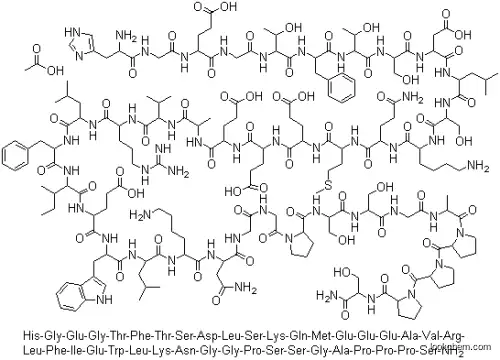
Chemical Property of Exenatide acetate
Chemical Property:
- PSA:1812.35000
- LogP:-2.07850
- Storage Temp.:Refrigerator, under inert atmosphere
- Solubility.:Acetonitrile (Slightly), Water (Slightly)
- Purity/Quality:
-
99% *data from raw suppliers
ExenatideAcetate *data from reagent suppliers
Safty Information:
- Pictogram(s):
- Hazard Codes:
- MSDS Files:
-
SDS file from LookChem
Useful:
-
Uses
A 39-amino acid peptide originally isolated from the salivary glands of the Gila monster (Heloderma suspectum), differs from exendin-3 only in two positions close to the N-terminus. Application of exenatide causes an increase in acinar cAMP without stimulating amylase release. As an incretin mimetic, exenatide acts as agonist of the glucagon-like peptide-1 (GLP-1) receptor. As GLP-1, though with prolonged activity, exenatide augments the postprandial production of insulin and suppresses secretion of glucagon. For this reason, exenatide has found use as a medication of diabetes II. Application of exenatide acetate causes an increase in acinar cAMP without stimulating amylase release. As an incretin mimetic, exenatide acetate acts as agonist of the glucagon-like peptide-1 (GLP-1) receptor. As GLP-1, though with prolonged activity, exenatide acetate augments the postprandial production of insulin and suppresses secretion of glucagon. For this reason, exenatide acetate has found use as a medication of diabetes II.
-
Clinical Use
39-peptide known as an incretin mimetic;
an agonist of glucagon-like peptide-1,
used adjunctively in type II diabetes
mellitus.
-
Drug interactions
Potentially hazardous interactions with other drugs
Anticoagulants: possibly enhances anticoagulant
effect of warfarin.
Other nephrotoxins: avoid concomitant use.