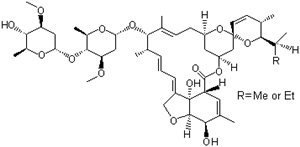
Chemical Property of Abamectin
Chemical Property:
- Appearance/Colour:white powder
- Vapor Pressure:0mmHg at 25°C
- Melting Point:0-155 °C
- Refractive Index:1.571
- Boiling Point:940.912 °C at 760 mmHg
- Flash Point:268.073 °C
- PSA:170.06000
- Density:1.244 g/cm3
- LogP:5.62500
- Storage Temp.:2-8°C
- Solubility.:Soluble in DMSO
- Water Solubility.:0.007-0.01 mg l-1 (20 °C)
- Hydrogen Bond Donor Count:6
- Hydrogen Bond Acceptor Count:28
- Rotatable Bond Count:15
- Exact Mass:1731.97211870
- Heavy Atom Count:123
- Complexity:3430
- Purity/Quality:
-
98.0%min *data from raw suppliers
Avermectin B1 *data from reagent suppliers
Safty Information:
- Pictogram(s):
 T+,
T+, N
N
- Hazard Codes:T+,N
- Statements:
20-28-50
- Safety Statements:
36/37/39-45-60-61
- MSDS Files:
-
SDS file from LookChem
Useful:
- Canonical SMILES:CCC(C)C1C(C=CC2(O1)CC3CC(O2)CC=C(C(C(C=CC=C4COC5C4(C(C=C(C5O)C)C(=O)O3)O)C)OC6CC(C(C(O6)C)OC7CC(C(C(O7)C)O)OC)OC)C)C.CC1C=CC=C2COC3C2(C(C=C(C3O)C)C(=O)OC4CC(CC=C(C1OC5CC(C(C(O5)C)OC6CC(C(C(O6)C)O)OC)OC)C)OC7(C4)C=CC(C(O7)C(C)C)C)O
- Isomeric SMILES:CCC(C)[C@@H]1[C@H](C=C[C@@]2(O1)C[C@@H]3C[C@H](O2)C/C=C(/[C@H]([C@H](/C=C/C=C/4\CO[C@H]5[C@@]4([C@@H](C=C([C@H]5O)C)C(=O)O3)O)C)O[C@H]6C[C@@H]([C@H]([C@@H](O6)C)O[C@H]7C[C@@H]([C@H]([C@@H](O7)C)O)OC)OC)\C)C.C[C@H]1/C=C/C=C/2\CO[C@H]3[C@@]2([C@@H](C=C([C@H]3O)C)C(=O)O[C@H]4C[C@@H](C/C=C(/[C@H]1O[C@H]5C[C@@H]([C@H]([C@@H](O5)C)O[C@H]6C[C@@H]([C@H]([C@@H](O6)C)O)OC)OC)\C)O[C@]7(C4)C=C[C@@H]([C@H](O7)C(C)C)C)O
-
Chemical Composition and Family
Abamectin belongs to the avermectin family of compounds. It is composed of a mixture of avermectins B1a (80%) and B1b (20%).
-
Properties and Usage
Abamectin is widely used as an acaricide, insecticide, and nematicide in agriculture and fisheries. It acts by binding to glutamate or GABA receptors, leading to cell membrane hyperpolarization and inhibition of neurotransmission, ultimately causing paralysis in target organisms.
-
Nematicidal Properties
Abamectin is registered as a non-fumigant nematicide and is widely used as a soil treatment against nematode diseases in cash crops.
-
Mechanism of Action
Abamectin acts on both glutamate-gated chloride channels (GluCls) and 纬-aminobutyric acid (GABA)-gated chloride channels in arthropods, leading to paralysis of the target organisms.
-
Production and Application
Avermectins, including abamectin, are produced from the fermentation products of the soil-dwelling actinomycete Streptomyces avermitilis. Abamectin is extensively used in agriculture and horticulture to control pests on various crops and ornamentals, making it the first widely used avermectin insecticide for agricultural pest control.
-
Toxicity and Environmental Impact
Abamectin poses a risk to aquatic species and other non-target organisms. Although it has a short half-life and is not found in high concentrations in freshwater, it can still interfere with the reproduction and survival of aquatic organisms.