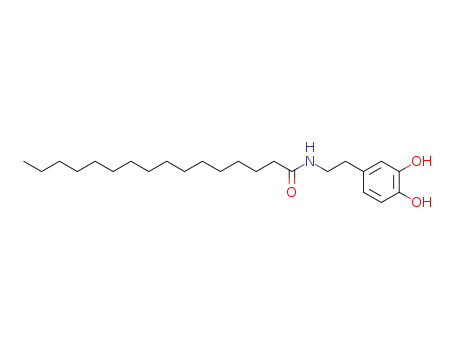
Chemical Property of N-[2-(3,4-Dihydroxyphenyl)ethyl]hexadecanamide
Chemical Property:
- Vapor Pressure:1.7E-14mmHg at 25°C
- Refractive Index:1.514
- Boiling Point:589.5 °C at 760 mmHg
- Flash Point:310.3 °C
- PSA:69.56000
- Density:1.006 g/cm3
- LogP:6.62870
- Storage Temp.:Store at +4°C
- XLogP3:6.6
- Hydrogen Bond Donor Count:3
- Hydrogen Bond Acceptor Count:3
- Rotatable Bond Count:17
- Exact Mass:391.30864417
- Heavy Atom Count:28
- Complexity:375
- Purity/Quality:
-
99% *data from raw suppliers
PALDA *data from reagent suppliers
Safty Information:
- Pictogram(s):
- Hazard Codes:
- MSDS Files:
-
SDS file from LookChem
Useful:
- Canonical SMILES:CCCCCCCCCCCCCCCC(=O)NCCC1=CC(=C(C=C1)O)O
-
Description
Several different fatty acyl dopamine analogs, such as N-arachidonoyl dopamine (NADA), N-oleoyl dopamine (ODA) and N-palmitoyl dopamine (PALDA), have been isolated and characterized from bovine brain. Structurally, PALDA is the amide of palmitic acid and dopamine and is therefore a “hybrid” analog which incorporates components of both the anandamide-like and dopamine neurotransmitter pathways. Unlike NADA and ODA, PALDA is nearly inactive as a vanilloid receptor 1 (VR1) ligand and fails to elicit hyperalgesic or nocifensive responses in vivo. However, PALDA exhibits an “entourage” effect at concentrations of 0.1-10 μM by potentiating the VR1-mediated effects of NADA and anandamide.
-
Uses
PALDA is an endogenous fatty acid dopamide.