Welcome to LookChem.com Sign In|Join Free
  • or

Encyclopedia

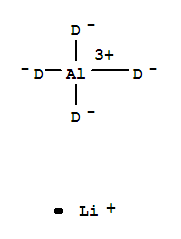
Lithium aluminum deuteride

Base Information
  • Chemical Name:Lithium aluminum deuteride
  • CAS No.:14128-54-2
  • Molecular Formula:AlD4Li
  • Molecular Weight:41.98
  • Hs Code.:28459000
  • European Community (EC) Number:237-980-6
  • Mol file:14128-54-2.mol
Lithium aluminum deuteride

Synonyms:LiAlD4;LiAlH4;lithium aluminum deuteride;lithium aluminum hydride

Suppliers and Price of Lithium aluminum deuteride
Supply Marketing:
Business phase:
The product has achieved commercial mass production*data from LookChem market partment
Manufacturers and distributors:
  • Manufacture/Brand
  • Chemicals and raw materials
  • Packaging
  • price
  • Strem Chemicals
  • Lithium aluminum deuteride, 98% isotopic purity
  • 5g
  • $ 992.00
  • Strem Chemicals
  • Lithium aluminum deuteride, 98% isotopic purity
  • 1g
  • $ 248.00
  • Medical Isotopes, Inc.
  • Lithiumaluminumdeuteride 95%
  • 1 g
  • $ 228.00
  • Chemenu
  • LithiumAluminiumDeuteride 95%+
  • 10g
  • $ 1196.00
Total 118 raw suppliers
Chemical Property of Lithium aluminum deuteride
Chemical Property:
  • Appearance/Colour:solid 
  • Melting Point:125 °C(lit.) 
  • Flash Point:<−30 °F  
  • PSA:0.00000 
  • Density:0.736 
  • LogP:0.45000 
  • Storage Temp.:water-free area 
  • Sensitive.:air sensitive, moisture sensitiv 
  • Water Solubility.:soluble ether, tetrahydrofuran [HAW93] 
  • Hydrogen Bond Donor Count:0
  • Hydrogen Bond Acceptor Count:1
  • Rotatable Bond Count:0
  • Exact Mass:42.0539490
  • Heavy Atom Count:2
  • Complexity:0
Purity/Quality:

99% *data from raw suppliers

Lithium aluminum deuteride, 98% isotopic purity *data from reagent suppliers

Safty Information:
  • Pictogram(s): HighlyF+,CorrosiveC,Flammable
  • Hazard Codes:F+,C,F 
  • Statements: 15-40-34-20/21/22-19-14-12-11-35 
  • Safety Statements: 45-36/37/39-36-26-16-7/8-43-24/25 
MSDS Files:

SDS file from LookChem

Useful:
  • Chemical Classes:Metals -> Metal Hydrides
  • Canonical SMILES:[Li+].[AlH4-]
  • Isomeric SMILES:[2H][Al-]([2H])([2H])[2H].[Li+]
  • General Description Lithium aluminum deuteride (LiAlD4) is a deuterated variant of lithium aluminum hydride (LiAlH4), commonly used as a reducing agent in organic and inorganic synthesis, particularly in the preparation of deuterated compounds. It plays a crucial role in isotopic labeling, such as in the asymmetric synthesis of deuterated glutamic acids, where it facilitates the introduction of deuterium into target molecules with high enantioselectivity. Its applications extend to the synthesis of deuterated ceramides for structural studies in lipid membranes, demonstrating its utility in both biochemical and analytical chemistry contexts.
Refernces

Synthesis of specific deuterated derivatives of the long chained stratum corneum lipids [EOS] and [EOP] and characterization using neutron scattering

10.1002/jlcr.3504

The study focuses on the synthesis and characterization of specific deuterated derivatives of long-chain ceramides [EOS] and [EOP] found in the stratum corneum lipids, which are essential components of the skin's barrier function. The researchers replaced linoleic acid with a palmitic acid branched with a methyl group and introduced deuteration in the branched and terminal methyl groups to create these derivatives. The synthesized ceramides were then prepared for neutron scattering investigations. The chemicals used in the study included various fatty acids, deuterated compounds, and ceramide precursors, such as 6-bromohexanoic acid ethyl ester, malonic acid ethyl ester, and lithium aluminum deuteride. These chemicals served the purpose of creating the branched and deuterated fatty acids, which were then used to synthesize the ceramides [EOS] and [EOP]. The synthesized deuterated ceramides are valuable tools for investigating the influence of these long-chain ceramide species on the nanostructure of stratum corneum lipid model membranes, as they can be detected in the lipid model membranes and help to understand their structural role in the skin's barrier.

Assymetric synthesis of (2S,3R)- and (2S,3S)-[2-13C;3-2H] glutamic acid

10.1016/j.tetlet.2009.01.062

The research aims to develop a synthetic route for these specific isotopically labeled glutamic acids with high enantioselectivity for metabolic analysis. The study employs key chemicals such as [2-13C] glycine, β-alanine, lithium aluminum deuteride (LiAlD4), and the (S,S)-Et-DuPHOS-Rh catalyst. The synthesis involves the preparation of a stable isotope-labeled dehydroornithine derivative through the Horner–Wadsworth–Emmons reaction, followed by asymmetric hydrogenation or deuteration using the (S,S)-Et-DuPHOS-Rh catalyst. Ruthenium-catalyzed oxidation is then used to convert the intermediate to the target glutamic acids. The enantiopurity of the final products is confirmed to be 99% ee by HPLC analysis. The research concludes that the asymmetric synthesis of (2S,3R)- and (2S,3S)-[2-13C;3-2H] glutamic acids has been successfully achieved with high enantioselectivity, and modifications to this procedure for synthesizing other labeled amino acids are underway.

Post a RFQ

Enter 15 to 2000 letters.Word count: 0 letters

Attach files(File Format: Jpeg, Jpg, Gif, Png, PDF, PPT, Zip, Rar,Word or Excel Maximum File Size: 3MB)

1 Customer Service

What can I do for you?
Get Best Price

Get Best Price for 14128-54-2
