10.1016/S0040-4020(01)90086-9
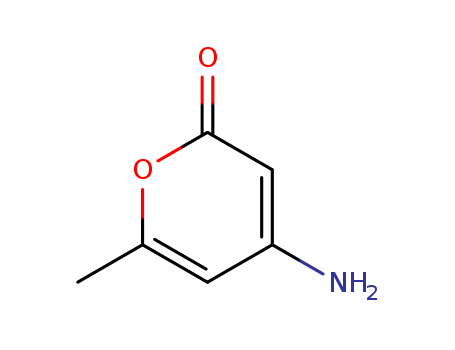
The research focuses on the synthesis of bis(4-amino-6-methyl-2-oxo-2H-pyran-3-yl)arylmethanes (1). The key starting material is 4-amino-6-methyl-2H-pyran-2-one (10), which is synthesized from 4-hydroxy-6-methyl-2H-pyran-2-one (2) through a series of reactions. The researchers initially attempted to synthesize the target compounds by reacting arylbis(4-hydroxy-6-methyl-2-oxo-2H-pyran-3-yl)methanes (2) with ammonia, but this led to the formation of arylbis(4-hydroxy-6-methyl-2-oxo-2H-pyran-3-yl)methanes (4) instead. To overcome this, they explored the use of a good leaving group at the C-4 position and eventually found that using 4-amino-6-methyl-2H-pyran-2-one (10) as a starting material was a feasible alternative. The synthesis involved condensation of 10 with various aromatic aldehydes under catalysis by p-toluenesulfonic acid in toluene, yielding the desired bis(4-amino-6-methyl-2-oxo-2H-pyran-3-yl)arylmethanes (1). The study also involved the synthesis of several intermediate compounds, such as 4-azido-6-methyl-2H-pyran-2-one (12) and 1-(6-methyl-2-oxo-2H-pyran-4-yl)imidazole (14), using different reagents and conditions. The compounds were characterized by spectroscopic and analytical data, providing insights into their structures and properties.