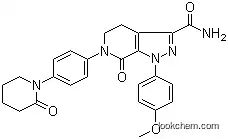
Chemical Property of Apixaban
Chemical Property:
- Appearance/Colour:white powder
- Vapor Pressure:0mmHg at 25°C
- Refractive Index:1.705
- Boiling Point:770.468 °C at 760 mmHg
- PKA:15.01±0.20(Predicted)
- Flash Point:419.764 °C
- PSA:110.76000
- Density:1.421 g/cm3
- LogP:3.52990
- Storage Temp.:Refrigerator
- Solubility.:DMSO (Slightly, Heated), Methanol (Slightly)
- XLogP3:2.2
- Hydrogen Bond Donor Count:1
- Hydrogen Bond Acceptor Count:5
- Rotatable Bond Count:5
- Exact Mass:459.19065430
- Heavy Atom Count:34
- Complexity:777
- Purity/Quality:
-
98% ,99% , *data from raw suppliers
Apixaban *data from reagent suppliers
Safty Information:
- Pictogram(s):
- Hazard Codes:
- MSDS Files:
-
SDS file from LookChem
Useful:
- Drug Classes:Antithrombotic Agents
- Canonical SMILES:COC1=CC=C(C=C1)N2C3=C(CCN(C3=O)C4=CC=C(C=C4)N5CCCCC5=O)C(=N2)C(=O)N
- Recent ClinicalTrials:Study to Gather Information About the Safety of Oral Anticoagulation Drugs and How Well These Drugs Work in Real World for Patients With Non-valvular Atrial Fibrillation (Irregularly Heart Beats Which is Not Caused by a Heart Valve Problem)
- Recent EU Clinical Trials:A single dose of apixaban for the prevention of thrombotic events in the context of long-distance flights
- Recent NIPH Clinical Trials:Noac for Desimplanted IHD Patients Complicated with Atrial Fibrillation
-
Drug Interactions
1.A double inhibitor of strong CYP3A4 and P-gp increases apixaban’s blood levels: decrease Eliquis dosage to 2.5mg or avoid simultaneous usage.
2.A inductor of strong CYP3A4 and P-gp can decrease apixaban’s blood levels: avoid simultaneous usage.
-
Description
Eliquis (apixaban), a direct inhibitor of factor Xa (FXa), was approved by
the European Commission on May 18, 2011 for prevention of venous thromboembolic
events (VTE) in adult patients who have undergone elective hip or
knee replacement surgery.
The discovery of apixaban was the culmination of a succession of novel and innovative medicinal
chemistry discoveries starting with the identification of nonpeptide
leads, rational drug design using computer-aided and X-ray
crystallographic information, and the building of drug-like properties
through the systematic replacement of basic groups with neutral
moieties. Apixaban arose from modifications to razaxaban by constraining a pyrazole amide to form a
bicyclic pyrazolo-pyridinone scaffold. Optimization of the P1 group
resulted in the identification of the nonbasic methoxy phenyl group,
while a P4 piperidinone improved the balance of potency and
pharmacokinetics with low Vdss. The synthesis of apixaban begins with
the generation of a hydrazone of 4-methoxyaniline which is then used in
a 3+2 cycloaddition with a dihydropiperidinone to form a bicyclic
pyrazolo-pyridinone scaffold. The distal piperidinone group is installed
using an Ullmann coupling reaction followed by aminolysis of an ethyl
ester on the pyrazole ring to complete the synthesis of apixaban. Apixaban is an orally bioavailable, selective inhibitor of both free and prothrombinase-bound factor Xa (Kis = 0.8 nM). In vivo, apixaban has antithrombotic effects in a rabbit model of venous thrombosis. Apixaban (357.5 mg) also prevents thrombus formation without inducing adverse bleeding events in a porcine model of aortic heterotopic valve replacement. Formulations containing apixaban have been used to prevent blood clot formation in patients with atrial fibrillation.
-
Uses
Apixaban is a highly selective, reversible inhibitor of Factor Xa with Ki of 0.08 nM and 0.17 nM in human and rabbit, respectively.
-
Clinical Use
Apixaban is an oral anticoagulant with highly selective inhibition
of factor Xa. It was approved by the European Medicines
Agency (EMA) for the treatment of venous thromboembolic events
and first marketed in Germany under the brand name Eliquis in
June 2011. Apixaban was co-developed by Bristol-Myers Squibb
and Pfizer and represents the first approved drug for this indication
since warfarin over 50 years ago.
-
Drug interactions
Potentially hazardous interactions with other drugs
Analgesics: increased risk of haemorrhage with IV
diclofenac and ketorolac - avoid.
Antibacterials: avoid with clarithromycin and
telithromycin; concentration possibly reduced by
rifampicin - avoid if treating DVT/PE.
Anticoagulants: increased risk of haemorrhage with
other anticoagulants - avoid.
Antidepressants: concentration possibly reduced by
St John’s wort - avoid if treating DVT/PE.
Antiepileptics: concentration possibly reduced
by carbamazepine, fosphenytoin, phenobarbital,
phenytoin and primidone - avoid if treating DVT/
PE with carbamazepine.
Antifungals: concentration increased by ketoconazole
- avoid; avoid with itraconazole, posaconazole and
voriconazole.
Antivirals: avoid with atazanavir, boceprevir,
darunavir, fosamprenavir, indinavir, lopinavir,
ritonavir, saquinavir, telaprevir and tipranavir.
Cobicistat: avoid concomitant use.