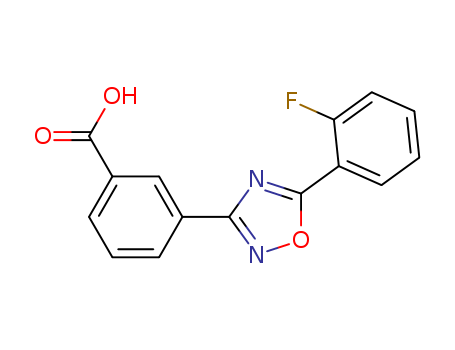
Chemical Property of Ataluren
Chemical Property:
- Vapor Pressure:5.75E-11mmHg at 25°C
- Refractive Index:1.603
- Boiling Point:503.7 °C at 760 mmHg
- PKA:3.58±0.10(Predicted)
- Flash Point:258.4 °C
- PSA:76.22000
- Density:1.379 g/cm3
- LogP:3.24090
- Storage Temp.:Refrigerator
- Solubility.:DMSO (Slightly)
- XLogP3:3.1
- Hydrogen Bond Donor Count:1
- Hydrogen Bond Acceptor Count:6
- Rotatable Bond Count:3
- Exact Mass:284.05972032
- Heavy Atom Count:21
- Complexity:382
- Purity/Quality:
-
99% *data from raw suppliers
PTC-124 - CAS 775304-57-9 - Calbiochem *data from reagent suppliers
Safty Information:
- Pictogram(s):
- Hazard Codes:
- MSDS Files:
-
SDS file from LookChem
Useful:
- Canonical SMILES:C1=CC=C(C(=C1)C2=NC(=NO2)C3=CC(=CC=C3)C(=O)O)F
- Recent ClinicalTrials:Ataluren for Nonsense Mutation in CDKL5 and Dravet Syndrome
- Recent EU Clinical Trials:Study of pembrolizumab combined with ataluren in Patients with metastatic pMMR and dMMR colorectal cancer adenocarcinomas or metastatic dMMR endometrial carcinoma: the ATAPEMBRO study.
- Recent NIPH Clinical Trials:An Open-label, Long-Term study of Ataluren in Nonsense Mutation Duchenne Muscular Dystrophy
-
Description
Ataluren (PTC124) selectively induces ribosomal read-through of premature but not normal termination codons, with EC50 of 0.1 μM in HEK293 cells, may provide treatment for genetic disorders caused by nonsense mutations (e.g. CF caused by CFTR nonsense mutation). Phase 3. Ataluren is a drug marketed under the trade name Translarna?
which was developed by PTC Therapeutics and approved by the
European Union in May 2014 for the treatment of Duchenne’s muscular
dystrophy (DMD) and potentially other genetic disorders.
Ataluren renders ribosomes less sensitive to premature stop or
‘read-through’ codons, which are thought to be beneficial in diseases
such as DMD and cystic fibrosis. Nonsense mutations create a premature termination of mRNA translation and have been implicated in various genetic disorders, including muscular dystrophy and cystic fibrosis. PTC-124 is a nonaminoglycoside that has been reported to selectively induce ribosomes to read through premature nonsense stop signals on mRNA, thus allowing the production of full length, functional proteins. In a mouse model of cystic fibrosis caused by nonsense mutations, PTC-124 treatment (60 mg/kg s.c. injection or 0.3-0.9 mg/ml orally) has been shown to restore cystic fibrosis transmembrane conductance regulator (CFTR) protein expression and function. The target activity of PTC-124 was initially evaluated by firefly luciferase reporter cell-based nonsense codon assay (IC50 = 7 nM); however, subsequent assessments using a Renilla reniformis luciferase reporter have failed to produce nonsense codon suppression activity. Thus, while PTC-124 is in clinical testing in patients with nonsense mutations within the CFTR or dystrophin genes, controversy surrounds its exact mechanism of action.
-
Uses
Nonsense mutations create a premature termination of mRNA translation and have been implicated in various genetic disorders, including muscular dystrophy and cystic fibrosis. PTC-124 is a nonaminoglycoside that has been reported to selectively induce ribosomes to read through premature nonsense stop signals on mRNA, thus allowing the production of full-length, functional proteins. In a mouse model of cystic fibrosis caused by nonsense mutations, PTC-124 treatment (60 mg/kg s.c. injection or 0.3-0.9 mg/ml orally) has been shown to restore cystic fibrosis transmembrane conductance regulator (CFTR) protein expression and function. The target activity of PTC-124 was initially evaluated by firefly luciferase reporter cell-based nonsense codon assay (IC50 = 7 nM); however, subsequent assessments using a Renilla reniformis luciferase reporter have failed to produce nonsense codon suppression activity. Thus, while PTC-124 is in clinical testing in patients with nonsense mutations within the CFTR or dystrophin genes, controversy surrounds its exact mechanism of action.[Cayman Chemical] PTC-124 is a nonaminoglycoside that has been reported to induce ribosomes to read through premature nonsense stop signals on mRNA, allowing the production of full-length functional proteins,