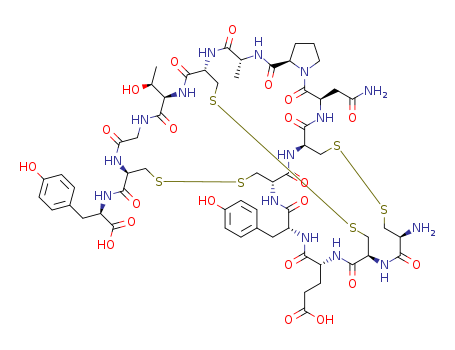
Chemical Property of Linaclotide
Chemical Property:
- Boiling Point:2045.0±65.0 °C(Predicted)
- PKA:3.05±0.10(Predicted)
- PSA:725.71000
- Density:1.60
- LogP:-0.59300
- Storage Temp.:Hygroscopic, Refrigerator, under inert atmosphere
- Solubility.:DMSO (Slightly, Heated), Methanol ((Slightly, Heated)), Water (Slightly, Heated)
- XLogP3:-6.8
- Hydrogen Bond Donor Count:19
- Hydrogen Bond Acceptor Count:28
- Rotatable Bond Count:13
- Exact Mass:1525.3899216
- Heavy Atom Count:101
- Complexity:3030
- Purity/Quality:
-
99% ,99.9%, *data from raw suppliers
Linaclotide *data from reagent suppliers
Safty Information:
- Pictogram(s):
- Hazard Codes:
- MSDS Files:
-
SDS file from LookChem
Useful:
- Drug Classes:Gastrointestinal Agents
- Canonical SMILES:CC1C(=O)NC2CSSCC3C(=O)NC(C(=O)NC(C(=O)NC(CSSCC(NC(=O)CNC(=O)C(NC2=O)C(C)O)C(=O)NC(CC4=CC=C(C=C4)O)C(=O)O)C(=O)NC(CSSCC(C(=O)N3)N)C(=O)NC(C(=O)N5CCCC5C(=O)N1)CC(=O)N)CC6=CC=C(C=C6)O)CCC(=O)O
- Isomeric SMILES:C[C@H]1C(=O)N[C@H]2CSSC[C@H]3C(=O)N[C@H](C(=O)N[C@H](C(=O)N[C@@H](CSSC[C@H](NC(=O)CNC(=O)[C@@H](NC2=O)[C@@H](C)O)C(=O)N[C@@H](CC4=CC=C(C=C4)O)C(=O)O)C(=O)N[C@@H](CSSC[C@@H](C(=O)N3)N)C(=O)N[C@H](C(=O)N5CCC[C@H]5C(=O)N1)CC(=O)N)CC6=CC=C(C=C6)O)CCC(=O)O
- Recent ClinicalTrials:A Study to Assess Adverse Events and Change in Symptoms With Linaclotide Versus Placebo in Pediatric Subjects, Ages 2 to 5 Years, With Functional Constipation
- Recent EU Clinical Trials:A Phase 3, Open-label, Long-term Safety Study of Oral Linaclotide Administered to Pediatric Participants with Functional Constipation (FC) or Irritable Bowel Syndrome with Constipation (IBS-C)
- Recent NIPH Clinical Trials:Multicenter study to evaluate the efficacy of 1L Ascorbic acid PEG plus linaclotide for bowel preparation
-
Description
In August 2012, the US FDA approved linaclotide (also referred to as
MD-1100), a first-in-class, orally administered 14-amino acid peptide as a
therapy for patients suffering from chronic idiopathic constipation (CIC) and irritable bowel syndrome with constipation (IBS-C).
Linaclotide and its active metabolite MM-419447, which results from the
cleavage of the C-terminal tyrosine residue by carboxypeptidase A, mimic
the actions of the endogenous intestinal peptides guanylin (15 amino acids) and uroguanylin (16 amino acids) by activating guanylyl cyclase C (GC-C) on the intestinal epithelium. Activation of GC-C leads to increased intra- and extracellular levels of cGMP and activation of the CFTR ion channel, resulting in increased levels of HCO3-, Cl-, and water in the intestinal lumen and accelerated gastrointestinal transit. Based on an in vitro assaymeasuring the accumulation of cGMP in T84 cell exposed to an agonist, the EC50 of linaclotide at pH 7.0 was 99±17.5 nM. In preclinical studies in mice using the transit of activated charcoal as ameasure of efficacy, linaclotide at 100 μg/kg significantly accelerated transit compared to wild-type mice treated with charcoal only or
GC-Cnullmice treatedwith and without linaclotide.118 Efficacy was also seen
in rats treatedwith linaclotide atdoses of 5, 10, and 20 μg/kg. Linaclotide has been synthesized using conventional solid-phase peptide technology.
-
Uses
Linaclotide is a guanylate cyclase-C agonist currently being studied in Phase 3 trials for the treatment of irritable bowel syndrome with constipation.