Welcome to LookChem.com Sign In|Join Free
  • or

Encyclopedia

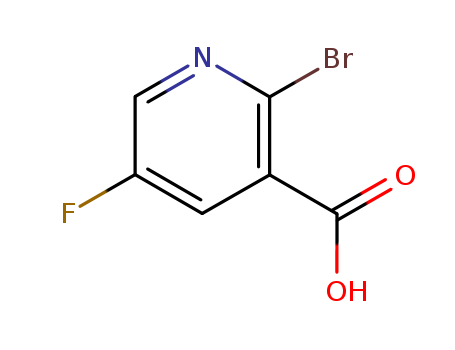
2-Bromo-5-fluoro-nicotinic acid

Base Information
  • Chemical Name:2-Bromo-5-fluoro-nicotinic acid
  • CAS No.:38186-89-9
  • Molecular Formula:C6H3BrFNO2
  • Molecular Weight:220
  • Hs Code.:2933399090
  • DSSTox Substance ID:DTXSID50697606
  • Wikidata:Q72456492
  • Mol file:38186-89-9.mol
2-Bromo-5-fluoro-nicotinic acid

Synonyms:38186-89-9;2-Bromo-5-fluoro-nicotinic acid;2-BROMO-5-FLUORONICOTINIC ACID;2-BROMO-5-FLUOROPYRIDINE-3-CARBOXYLIC ACID;2-bromo-5-fluoro-3-pyridinecarboxylic acid;DTXSID50697606;MFCD11870208;AKOS016013067;AB64987;CS-16625;CS-0101645;FT-0736757;A824044;J-508364

Suppliers and Price of 2-Bromo-5-fluoro-nicotinic acid
Supply Marketing:
Business phase:
The product has achieved commercial mass production*data from LookChem market partment
Manufacturers and distributors:
  • Manufacture/Brand
  • Chemicals and raw materials
  • Packaging
  • price
  • TRC
  • 2-Bromo-5-fluoropyridine-3-carboxylicAcid
  • 100mg
  • $ 155.00
  • Matrix Scientific
  • 2-Bromo-5-fluoro-nicotinic acid 95%
  • 5g
  • $ 3700.00
  • Frontier Specialty Chemicals
  • 2-Bromo-5-fluoropyridine-3-carboxylicacid 95%
  • 250mg
  • $ 90.00
  • Frontier Specialty Chemicals
  • 2-Bromo-5-fluoropyridine-3-carboxylicacid 95%
  • 1g
  • $ 270.00
  • Crysdot
  • 2-Bromo-5-fluoronicotinicacid 95+%
  • 1g
  • $ 715.00
  • Crysdot
  • 2-Bromo-5-fluoronicotinicacid 95+%
  • 250mg
  • $ 225.00
  • ChemScene
  • 2-Bromo-5-fluoronicotinicacid
  • 250mg
  • $ 190.00
  • ChemScene
  • 2-Bromo-5-fluoronicotinicacid
  • 100mg
  • $ 115.00
  • Chemenu
  • 2-Bromo-5-fluoro-nicotinicacid 95%
  • 1g
  • $ 542.00
  • Biosynth Carbosynth
  • 2-Bromo-5-fluoro-3-pyridinecarboxylic acid
  • 250 mg
  • $ 450.00
Total 26 raw suppliers
Chemical Property of 2-Bromo-5-fluoro-nicotinic acid
Chemical Property:
  • Vapor Pressure:0.0002mmHg at 25°C 
  • Boiling Point:314.3°C at 760 mmHg 
  • PKA:1.78±0.10(Predicted) 
  • Flash Point:143.9°C 
  • PSA:50.19000 
  • Density:1.903g/cm3 
  • LogP:1.68140 
  • Storage Temp.:under inert gas (nitrogen or Argon) at 2-8°C 
  • XLogP3:1.5
  • Hydrogen Bond Donor Count:1
  • Hydrogen Bond Acceptor Count:4
  • Rotatable Bond Count:1
  • Exact Mass:218.93312
  • Heavy Atom Count:11
  • Complexity:167
Purity/Quality:

97% *data from raw suppliers

2-Bromo-5-fluoropyridine-3-carboxylicAcid *data from reagent suppliers

Safty Information:
  • Pictogram(s):  
  • Hazard Codes: 
MSDS Files:

SDS file from LookChem

Useful:
  • Canonical SMILES:C1=C(C=NC(=C1C(=O)O)Br)F
  • General Description 2-Bromo-5-fluoronicotinic acid (also known as 2-bromo-5-fluoro-3-pyridinecarboxylic acid) is synthesized through the oxidation of corresponding dihalo-3-picolines, as demonstrated in the study. 2-BROMO-5-FLUORO-3-PYRIDINECARBOXYLIC ACID serves as a key intermediate in the preparation of further derivatives, such as amines, through dissolving-metal reduction and subsequent reactions like diazotization and thermal decomposition. Its structural and spectral properties are relevant for applications in organic synthesis, particularly in the development of heterocyclic compounds.
Technology Process of 2-Bromo-5-fluoro-nicotinic acid

There total 1 articles about 2-Bromo-5-fluoro-nicotinic acid which guide to synthetic route it. The literature collected by LookChem mainly comes from the sharing of users and the free literature resources found by Internet computing technology. We keep the original model of the professional version of literature to make it easier and faster for users to retrieve and use. At the same time, we analyze and calculate the most feasible synthesis route with the highest yield for your reference as below:

synthetic route:
Guidance literature:
/BRN= 386425/, KMnO4;
DOI:10.1021/je60055a035
Guidance literature:
With bis-triphenylphosphine-palladium(II) chloride; copper(l) iodide; Inert atmosphere;
DOI:10.1016/j.bmc.2020.115819
Refernces

Some 2,5- and 5,6-Dihalonicotinic Acids and Their Precursors. II" and "Bithiazole Derivatives

10.1021/je60055a035

The study focuses on the synthesis and spectral data of certain chemical compounds. The first part of the study, conducted by Frank L. Setliff and Gary O. Rankin, involves the preparation of 2-chloro- and 2-bromo-5-fluoronicotinic acid and 6-chloro- and 6-bromo-5-fluoronicotinic acid through the oxidation of corresponding dihalo-3-picolines. The dihalo-3-picolines serve as precursors for the acids. The study also includes the preparation of amines Ie and If through dissolving-metal reduction, and the subsequent diazotization and thermal decomposition to produce other compounds. The second part of the study, conducted by George Y. Sarkis and Subhi Al-Azawe, involves the synthesis of nine bithiazole derivatives by the interaction of rubeanic acid with various α-haloketones. The study provides experimental and spectral data for these compounds. The chemicals involved, such as nicotinic acid, dihalo-3-picolines, rubeanic acid, and α-haloketones, play crucial roles in the synthesis processes and the formation of the target compounds.

Post a RFQ

Enter 15 to 2000 letters.Word count: 0 letters

Attach files(File Format: Jpeg, Jpg, Gif, Png, PDF, PPT, Zip, Rar,Word or Excel Maximum File Size: 3MB)

1 Customer Service

What can I do for you?
Get Best Price

Get Best Price for 38186-89-9