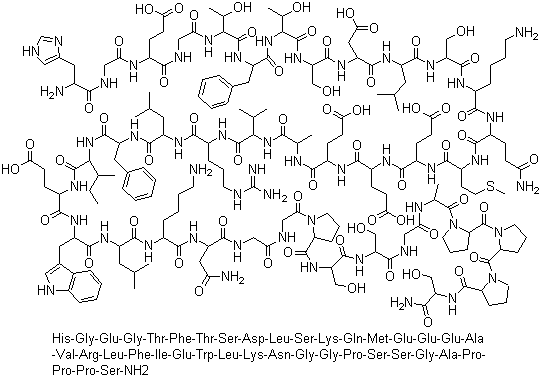
Chemical Property of Byetta
Chemical Property:
- PSA:1775.05000
- LogP:-2.16940
- Storage Temp.:−20°C
- Solubility.:≥145 mg/mL in DMSO; insoluble in EtOH; ≥52 mg/mL in H2O with gentle warming
- XLogP3:-21
- Hydrogen Bond Donor Count:58
- Hydrogen Bond Acceptor Count:66
- Rotatable Bond Count:135
- Exact Mass:4185.0306624
- Heavy Atom Count:295
- Complexity:10300
- Purity/Quality:
-
99%, *data from raw suppliers
Exendin 4 *data from reagent suppliers
Safty Information:
- Pictogram(s):
- Hazard Codes:
- MSDS Files:
-
SDS file from LookChem
Total 1 MSDS from other Authors
Useful:
- Drug Classes:Antidiabetic Agents
- Canonical SMILES:CCC(C)C(C(=O)NC(CCC(=O)O)C(=O)NC(CC1=CNC2=CC=CC=C21)C(=O)NC(CC(C)C)C(=O)NC(CCCCN)C(=O)NC(CC(=O)N)C(=O)NCC(=O)NCC(=O)N3CCCC3C(=O)NC(CO)C(=O)NC(CO)C(=O)NCC(=O)NC(C)C(=O)N4CCCC4C(=O)N5CCCC5C(=O)N6CCCC6C(=O)NC(CO)C(=O)N)NC(=O)C(CC7=CC=CC=C7)NC(=O)C(CC(C)C)NC(=O)C(CCCNC(=N)N)NC(=O)C(C(C)C)NC(=O)C(C)NC(=O)C(CCC(=O)O)NC(=O)C(CCC(=O)O)NC(=O)C(CCC(=O)O)NC(=O)C(CCSC)NC(=O)C(CCC(=O)N)NC(=O)C(CCCCN)NC(=O)C(CO)NC(=O)C(CC(C)C)NC(=O)C(CC(=O)O)NC(=O)C(CO)NC(=O)C(C(C)O)NC(=O)C(CC8=CC=CC=C8)NC(=O)C(C(C)O)NC(=O)CNC(=O)C(CCC(=O)O)NC(=O)CNC(=O)C(CC9=CNC=N9)N
- Recent ClinicalTrials:Diabetes Islet Preservation Immune Treatment
- Recent EU Clinical Trials:A Phase III randomised, placebo-controlled, double-blind, multi-centre, clinical trial to determine the efficacy and safety of Presendin in idiopathic intracranial hypertension
- Recent NIPH Clinical Trials:Effects of exenatide on gastric emptying in Japanese patients with type 2 diabetes
-
Uses
Exendin-4 can activate the GLP-1 receptor, the receptor can increase cAMP levels of pancreatic acinar cells in intracellular , but it has no effect on VIP receptor. Exendin-4 has been used as incretin mimetics for the treatment in HepG2 cells to exclude the influence of auxiliary material. It has also been used as an r (GLP-1R) agonist to exclude interference from auxiliary material. Antidiabetic.
-
Description
Exenatide is the first drug in a new class of anti-diabetics known as the incretin
mimetics, and it is indicated as adjunctive therapy to improve glycemic control in
patients with type 2 diabetes who are taking metformin, a sulfonylurea, or both, but
have not achieved adequate glycemic control. Exenatide is a functional analog of the
human incretin Glucagon-Like Peptide-1 (GLP-1). GLP-1 is naturally released from
cells in the GI tract in response to food intake and acts on its receptor on b-cells to
potentiate glucose-stimulated insulin secretion. Exenatide is a long-acting agonist at
the GLP-1 receptor. It is a synthetic version of a 39-amino acid peptide found in the
salivary secretions of the Gila monster lizard.also moderates peak serum glucagon levels during hyperglycemic periods following
meals, but does not interfere with glucagon release in response to hypoglycemia. The
dosing regimen for exenatide is 5 or 10 mg twice daily, administered as a subcutaneous
injection within an hour before morning and evening meals. Following subcutaneous
administration, peak plasma concentrations of exenatide are reached in
2.1 h, and the plasma pharmacokinetic profile is dose proportional. The most common adverse
events reported with exenatide include nausea, vomiting, diarrhea, feeling jittery,
dizziness, headache, and dyspepsia.