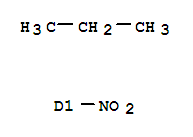
Base Information
- Chemical Name:Propane, nitro-
- CAS No.:25322-01-4
- Molecular Formula:C3H7 N O2
- Molecular Weight:89.09
- Hs Code.:2904209090
- Mol file:25322-01-4.mol
Synonyms:Nitropropane
Synonyms:Nitropropane
99% *data from raw suppliers
 Xn:Harmful;
The research focuses on the development of a novel C2-symmetric Schiff-base ligand derived from tridentate-Schiff-base, which is applied to the asymmetric Michael addition of nitroalkanes to 2-enoyl-pyridine N-oxides. This ligand, when combined with scandium(III) or copper(II) complexes, catalyzes the reaction with unprecedented levels of diastereoselectivity and enantioselectivity. The study explores the reaction using various nitroalkanes and 2-enoyl-pyridine N-oxides, achieving high yields and stereoselectivities. The researchers also demonstrate the synthetic utility of this method by converting the optically active adduct to a biologically active dihydro-2H-pyrrol 4a, an analogue of nicotine. Analyses include the determination of yields, enantiomeric excess (ee) by HPLC on a chiral stationary phase, and diastereomeric ratios (d.r.) by 1H NMR spectroscopy. The research also investigates the reaction mechanism, revealing a negative nonlinear effect in the catalysis by scandium, and proposes a transition-state model based on spectroscopic experiments and product configuration analysis.

What can I do for you?
Get Best Price

Total 8 Pictures about this product