Welcome to LookChem.com Sign In|Join Free
  • or

Encyclopedia

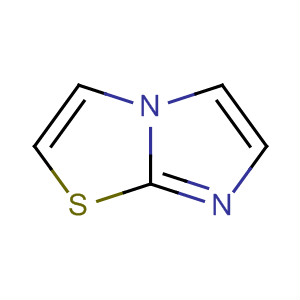
Imidazo[2,1-b]thiazole

Base Information
  • Chemical Name:Imidazo[2,1-b]thiazole
  • CAS No.:251-97-8
  • Molecular Formula:C5H4N2S
  • Molecular Weight:124.1637
  • Hs Code.:2934100090
  • European Community (EC) Number:826-502-7
  • DSSTox Substance ID:DTXSID40355728
  • Nikkaji Number:J149.947E
  • Wikidata:Q82134777
  • Mol file:251-97-8.mol
Imidazo[2,1-b]thiazole

Synonyms:imidazo(2,1-b)thiazole

Suppliers and Price of Imidazo[2,1-b]thiazole
Supply Marketing:
Business phase:
The product has achieved commercial mass production*data from LookChem market partment
Manufacturers and distributors:
  • Manufacture/Brand
  • Chemicals and raw materials
  • Packaging
  • price
  • Matrix Scientific
  • Imidazo[2,1-b][1,3]thiazole
  • 1g
  • $ 432.00
  • Matrix Scientific
  • Imidazo[2,1-b][1,3]thiazole
  • 5g
  • $ 1206.00
  • Matrix Scientific
  • Imidazo[2,1-b][1,3]thiazole
  • 10g
  • $ 1602.00
  • American Custom Chemicals Corporation
  • IMIDAZO[2,1-B]THIAZOLE 95.00%
  • 1G
  • $ 1280.66
  • AK Scientific
  • Imidazo[2,1-b]thiazole
  • 10g
  • $ 2212.00
  • AK Scientific
  • Imidazo[2,1-b]thiazole
  • 5g
  • $ 1678.00
  • AK Scientific
  • Imidazo[2,1-b]thiazole
  • 1g
  • $ 633.00
Total 15 raw suppliers
Chemical Property of Imidazo[2,1-b]thiazole
Chemical Property:
  • PSA:45.54000 
  • Density:1.44 g/cm3 
  • LogP:1.39580 
  • XLogP3:1.9
  • Hydrogen Bond Donor Count:0
  • Hydrogen Bond Acceptor Count:2
  • Rotatable Bond Count:0
  • Exact Mass:124.00951931
  • Heavy Atom Count:8
  • Complexity:96.4
Purity/Quality:

97% *data from raw suppliers

Imidazo[2,1-b][1,3]thiazole *data from reagent suppliers

Safty Information:
  • Pictogram(s):  
  • Hazard Codes: 
MSDS Files:

SDS file from LookChem

Useful:
  • Canonical SMILES:C1=CN2C=CSC2=N1
  • General Description Imidazo[2,1-b]thiazole is a heterocyclic compound that can be synthesized efficiently through a visible light-driven, catalyst-free method in an eco-friendly EtOH:H2O solvent system. This approach leverages radical intermediates generated from phenacyl bromide and N-phenylthiourea, which cyclize to form the target structure without requiring additional catalysts or harsh conditions. The process aligns with green chemistry principles by minimizing waste, reducing energy consumption, and avoiding toxic reagents, while achieving high yields and rapid reaction times.
Technology Process of Imidazo[2,1-b]thiazole

There total 7 articles about Imidazo[2,1-b]thiazole which guide to synthetic route it. The literature collected by LookChem mainly comes from the sharing of users and the free literature resources found by Internet computing technology. We keep the original model of the professional version of literature to make it easier and faster for users to retrieve and use. At the same time, we analyze and calculate the most feasible synthesis route with the highest yield for your reference as below:

synthetic route:
Guidance literature:
With sodium carbonate; Yield given. Multistep reaction; 1.) 130 deg C, 20 mm Hg, 2 h, 2.) CHCl3, 20 deg C, 20 min;
Guidance literature:
Multi-step reaction with 2 steps
1: aq. HCl
2: (heating)
With hydrogenchloride;
DOI:10.1007/BF00478394
Guidance literature:
With sulfuric acid;
Refernces

Visible light triggered, catalyst free approach for the synthesis of thiazoles and imidazo[2,1-: B] thiazoles in EtOH:H2O green medium

10.1039/c6ra05385h

The study presents a visible light promoted, catalyst-free synthesis of thiazoles and imidazo[2,1-b]thiazoles in an EtOH:H2O green medium. The key chemicals involved are phenacyl bromide, N-phenylthiourea, and 2-aminothiazole. Phenacyl bromide serves as a reactant that undergoes homolytic fission of its C-Br bond under visible light, generating a free radical. N-phenylthiourea also forms a free radical through the homolytic fission of its S-H bond. These radicals combine to form intermediate compounds, which further react to produce the desired thiazoles and imidazo[2,1-b]thiazoles via cyclization and removal of a water molecule. The use of visible light provides the activation energy needed for the reaction, eliminating the need for catalysts or photosensitizers. The EtOH:H2O solvent system enhances the solubility of the reactants and stabilizes the transition states, contributing to the eco-efficiency and high yield of the products. This method is notable for its cost-effectiveness, short reaction time, and alignment with green chemistry principles.


Post a RFQ

Enter 15 to 2000 letters.Word count: 0 letters

Attach files(File Format: Jpeg, Jpg, Gif, Png, PDF, PPT, Zip, Rar,Word or Excel Maximum File Size: 3MB)

1 Customer Service

What can I do for you?
Get Best Price

Get Best Price for 251-97-8