10.1002/ejoc.200900365
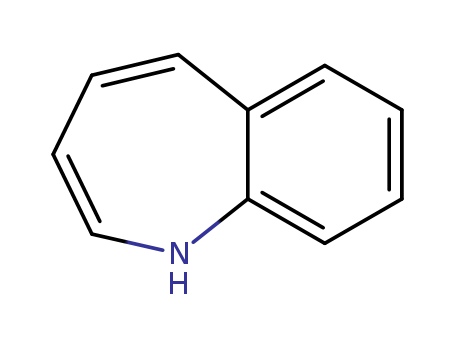
The study presents a novel asymmetric synthesis route for the creation of various 1-alkylbenzo[c]azepin-3-ones and benzazepines. The key steps involve a highly diastereoselective 1,2-addition process using chiral aromatic hydrazones and ring-closing metathesis (RCM) to form the seven-membered azaheterocycle ring system. The researchers utilized diastereopure aromatic hydrazones as substrates, which were reacted with organometallic reagents to introduce the stereogenic center at the benzylic α position. The study also includes the synthesis of styrenic enehydrazides and the subsequent RCM reaction to form the desired benzazepinones and benzazepines. The absolute configurations of the stereogenic centers were confirmed through comparison with authentic samples. This method allows for the asymmetric synthesis of these compounds in high enantiomeric excess, addressing a gap in the field of asymmetric synthesis for 1-alkylbenzazepines.
10.1016/S0040-4039(01)91108-6
The study investigates the anodic intramolecular arylation of enaminones to produce isoquinolines and benzazepines. Enaminones, which are prepared by condensation of various benzylamines, phenethylamines, and anilines with 1,3-diketones, serve as the key substrates. The anodic oxidation potentials of these enaminones are measured and listed in Table 1. The preparative electrolyses of enaminones 1, 3 - 5 lead to the formation of isoquinolines and benzazepines in fair yields, as shown in Table 2. The anode potentials for these reactions range from +0.8 to +1.6 V vs. s.c.e. The study also notes that enaminone k does not cyclize under the given conditions but forms the iminoquinone ketal 11 instead. The anode reaction described provides a convenient one-step preparation of isoquinolines and benzazepines, which are suitable intermediates for the synthesis of various alkaloids such as lycorane, Cephalotaxus, and erythrina alkaloids.