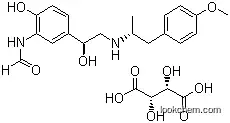
200815-49-2 Usage
Uses
Used in Pharmaceutical Industry:
Arformoterol tartrate is used as an active pharmaceutical ingredient for the development of anti-asthmatic and bronchodilator medications. It is utilized in the synthesis of Omeprazole (O635000), a proton pump inhibitor that inhibits gastric secretion and is used in the treatment of dyspepsia, peptic ulcer disease, and other gastrointestinal conditions. Additionally, it is an impurity in Esomeprazole Magnesium (E668300), the S-form of Omeprazole, which is also a gastric proton-pump inhibitor.
Used in Respiratory Medicine:
Arformoterol tartrate is used as a long-acting bronchodilator for the twice-daily, long-term maintenance treatment of bronchoconstriction in patients with chronic obstructive pulmonary disease (COPD), including chronic bronchitis and emphysema. It is a key component in the formulation of Sepracor’s Brovana?, the first long-acting nebulized bronchodilator approved by the FDA for this indication.
Used in the Preparation of Olodaterol:
Arformoterol tartrate is used in the preparation of olodaterol, a novel inhaled β2-adrenoceptor agonist with a 24-hour bronchodilatory efficacy. This application aids in the management of respiratory conditions by providing extended relief and improved lung function.
Synthesis
There are several reports on the synthesis
of arformoterol. A large-scale synthesis of
enantio/diastereomerically pure (R,R)-formoterol is cited
here. Bromoalcohol 22 was synthesized in
84% yield with 94% e.e. through the catalytic enantioselective
reduction of bromo ketone 21. The nitro functional
group in 22 was reduced in quantitative yield by hydrogena-tion in the presence of Adams catalyst and the resulting aniline
was isolated by filtration of the catalyst and removal of
the solvent. In order to avoid auto-oxidation, the aniline was
treated with a mixture of formic acid and acetic anhydride
immediately after the removal of the platinum catalyst. Upon
concentrating the reaction mixture, bromohydrin 23 crystallized
and could be isolated in 75% yield with 98.6% e.e. It
was further enriched to >99.5% e.e. by a single re-crystallization
from ethylacetate. Next, a mixture of bromohydrin
23 and amine salt (R)-26-(S)-mandelic acid was treated with
K2CO3 resulting in generation of the corresponding epoxide
of 23 and liberation of the free base of (R)-26. After an
aqueous work up to remove salts and mandelic acid, the reaction
mixture was heated to 120°C to affect epoxide opening
with the amine of 26. Removal of the benzyl protecting
groups of the resulting crude product via catalytic hydrogenation
followed by salt formation with tartaric acid afforded
arformoterol tartrate (III) in 70% yield upon crystallization.
Check Digit Verification of cas no
The CAS Registry Mumber 200815-49-2 includes 9 digits separated into 3 groups by hyphens. The first part of the number,starting from the left, has 6 digits, 2,0,0,8,1 and 5 respectively; the second part has 2 digits, 4 and 9 respectively.
Calculate Digit Verification of CAS Registry Number 200815-49:
(8*2)+(7*0)+(6*0)+(5*8)+(4*1)+(3*5)+(2*4)+(1*9)=92
92 % 10 = 2
So 200815-49-2 is a valid CAS Registry Number.
InChI:InChI=1/C19H24N2O4.C4H6O6/c1-13(9-14-3-6-16(25-2)7-4-14)20-11-19(24)15-5-8-18(23)17(10-15)21-12-22;5-1(3(7)8)2(6)4(9)10/h3-8,10,12-13,19-20,23-24H,9,11H2,1-2H3,(H,21,22);1-2,5-6H,(H,7,8)(H,9,10)/t13-,19+;1-,2-/m11/s1