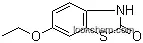
72680-01-4Relevant academic research and scientific papers
Hydroxylamine as an oxygen nucleophile: Substitution of sulfonamide by a hydroxyl group in benzothiazole-2-sulfonamides
Kamps, Jos J. A. G.,Belle, Roman,Mecinovi?, Jasmin
, p. 1103 - 1108 (2013/03/28)
Benzothiazole-2-sulfonamides react with an excess of hydroxylamine in aqueous solutions to form 2-hydroxybenzothiazole, sulfur dioxide, and the corresponding amine. Mechanistic studies that employ a combination of structure-reactivity relationships, oxygen labeling experiments, and (in)direct detection of intermediates and products reveal that the reaction proceeds via oxygen attack, and that oxygen incorporated in the 2-hydroxybenzothiazole product derives from hydroxylamine. The reaction, which is performed under mild conditions, can be used as a deprotection method for cleavage of benzothiazole-2-sulfonyl-protected amino acids.
Synthesis of 2-Oxo and 2-Thioxo-3(2H)-benzothiazoleethanimic Acid Anhydride with Acetic Acid and Related Products
D'Amico, John J.,Bollinger, Frederic G.,Freeman, John J.
, p. 1503 - 1509 (2007/10/02)
The reaction of the appropriate 2-benzothiazolinone with 2-chloroacetamide under basic conditions afforded the 2-oxo-3(2H)-benzothiazolineacetamides 6-9.The 2-thioxo-3(2H)-benzothiazolineacetamide (10) was prepared by the reaction of 3-(carbethoxymethyl)benzothiazoline-2-thione with ammonium hydroxide.The reaction of acetamides 6-10 with the appropriate anhydride containing a catalytic amount of the sodium salt of the acid corresponding to the anhydride afforded the titled compounds 11-18 in excellent yields.The omission of the catalyst in the same reaction furnished a mixture containing 57percent of the titled compound, 37percent of the nitrile and 6percent of an unknown.Possible mechanism and supporting nmr, ir and mass spectral data are discussed.
Suppressing pain with benzothiazol-2(3H)-ones
-
, (2008/06/13)
There are described pharmaceutical compositions containing as active substances benzothiazol-2(3H)-ones of the general formula STR1 wherein R represents a hydrogen atom or a methyl, methoxy, or ethoxy group. The pharmaceutical compositions serve as analgesics and antipyretics and possess little or no methemoglobin-forming activity.


