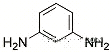
1,3-Benzenediamine, coupled with diazotized m-phenylenediamine, p-toluenesulfonates is a chemical with a specific purpose. Lookchem provides you with multiple data and supplier information of this chemical.
84281-75-4
Post Buying Request-
-
Basic information
- Product Name: 1,3-Benzenediamine, coupled with diazotized m-phenylenediamine, p-toluenesulfonates
- Synonyms: 1,3-Benzenediamine, coupled with diazotized m-phenylenediamine, p-toluenesulfonates;Einecs 282-618-2
- CAS NO:84281-75-4
- Molecular Formula: C6H8N2
- Molecular Weight: 108.14112
- EINECS: 282-618-2
- Product Categories: N/A
- Mol File: 84281-75-4.mol
-
Chemical Properties
- Melting Point: N/A
- Boiling Point: N/A
- Flash Point: N/A
- Appearance: /
- Density: N/A
- Refractive Index: N/A
- Storage Temp.: N/A
- Solubility: N/A
- CAS DataBase Reference: 1,3-Benzenediamine, coupled with diazotized m-phenylenediamine, p-toluenesulfonates(CAS DataBase Reference)
- NIST Chemistry Reference: 1,3-Benzenediamine, coupled with diazotized m-phenylenediamine, p-toluenesulfonates(84281-75-4)
- EPA Substance Registry System: 1,3-Benzenediamine, coupled with diazotized m-phenylenediamine, p-toluenesulfonates(84281-75-4)
-
Safety Data
- Hazard Codes: N/A
- Statements: N/A
- Safety Statements: N/A
- WGK Germany:
- RTECS:
- HazardClass: N/A
- PackingGroup: N/A
- Hazardous Substances Data: 84281-75-4(Hazardous Substances Data)
84281-75-4 Suppliers
Recommended suppliers
84281-75-4 Hazards Identification
Pictogram(s):


Signal:
DangerGHS Hazard Statements:
H301: Toxic if swallowed [Danger Acute toxicity, oral]H311: Toxic in contact with skin [Danger Acute toxicity, dermal]
H317: May cause an allergic skin reaction [Warning Sensitization, Skin]
H319: Causes serious eye irritation [Warning Serious eye damage/eye irritation]
H331: Toxic if inhaled [Danger Acute toxicity, inhalation]
H341: Suspected of causing genetic defects [Warning Germ cell mutagenicity]
H400: Very toxic to aquatic life [Warning Hazardous to the aquatic environment, acute hazard]
H410: Very toxic to aquatic life with long lasting effects [Warning Hazardous to the aquatic environment, long-term hazard]
Precautionary Statement Codes:
P203, P261, P264, P264+P265, P270, P271, P272, P273, P280, P281, P301+P316, P302+P352, P304+P340, P305+P351+P338, P316, P318, P321, P330, P333+P313, P337+P317, P361+P364, P362+P364, P391, P403+P233, P405, and P501Hazard Classes and Categories:
Muta. 2Acute Tox. 3 *
Eye Irrit. 2
Skin Sens. 1
Aquatic Acute 1
Aquatic Chronic 1
Acute Tox. 3 (100%)
Skin Sens. 1 (100%)
Eye Irrit. 2A (100%)
Muta. 2 (99.72%)
Aquatic Acute 1 (96.34%)
Aquatic Chronic 1 (100%)
Germ cell mutagenicity - category 2
Acute toxicity - category 3
Skin sensitisation - category 1
Hazardous to the aquatic environment (acute) - category 1
Hazardous to the aquatic environment (chronic) - category 1
Eye irritation - category 2A
Acute toxicity (Oral) - Category 3
Acute toxicity (Dermal) - Category 4
Serious eye damage/eye irritation - Category 2
Skin sensitization - Category 1
Germ cell mutagenicity - Category 2
Reproductive toxicity - Category 2
Specific target organ toxicity - Single exposure - Category 1 (central nervous system, blood)
Specific target organ toxicity - Repeated exposure - Category 1 (nervous system, liver, kidney, urinary bladder), Category 2 (blood)
Hazardous to the aquatic environment (Acute) - Category 2
Hazardous to the aquatic environment (Long-term) - Category 2
Skin corrosion/irritation - Category 2
Serious eye damage/eye irritation - Category 2A-2B
Specific target organ toxicity - Single exposure - Category 2 (central nervous system, respiratory system)
Specific target organ toxicity - Repeated exposure - Category 1 (nervous system, liver, kidney, urinary bladder), Category 2 (cardiovascular system, blood system, respiratory system)
Serious eye damage/eye irritation - Category 2B
Skin sensitization - Category 1A
Specific target organ toxicity - Single exposure - Category 1 (central nervous system, haemal system)
Specific target organ toxicity - Repeated exposure - Category 1 (urinary bladder), Category 2 (heart, kidney, muscle, haemal system)
Hazardous to the aquatic environment (Long-term) - Category 1
Hazards Summary:
In acute studies at lethal doses (650 mg/kg), animals have tremors, convulsions, cyanosis, and methemoglobinemia. In subchronic studies, rats have increased liver weights. Critical Effects are irritation; liver; Confirmed Animal Carcinogen with Unknown Relevance to Humans; [ACGIH] Danger of skin sensitization; [MAK]84281-75-4 Usage
Purpose
Used in the production of dyes and pigmentsPurpose
The primary function or use of the compound in various industries.Creation Process
Coupling reaction between 1,3-benzenediamine and diazotized m-phenylenediamine, followed by combination with p-toluenesulfonatesCreation Process
The method by which the compound is synthesized or produced.Textile Industry
Dyeing fabricsTextile Industry
The use of the compound in the dyeing and coloring of fabrics and textiles.Colored Products
Inks and paintsColored Products
The use of the compound in the production of inks and paints for various purposes.Chemical Processes
Reagent or catalystChemical Processes
The use of the compound as a reagent or catalyst in chemical reactions and processes.Importance
Key component in manufacturing and production of various productsImportance
The significance of the compound in the manufacturing and production of a wide range of products, highlighting its versatility and usefulness.Check Digit Verification of cas no
The CAS Registry Mumber 84281-75-4 includes 8 digits separated into 3 groups by hyphens. The first part of the number,starting from the left, has 5 digits, 8,4,2,8 and 1 respectively; the second part has 2 digits, 7 and 5 respectively.Calculate Digit Verification of CAS Registry Number 84281-75:
(7*8)+(6*4)+(5*2)+(4*8)+(3*1)+(2*7)+(1*5)=144
144 % 10 = 4
So 84281-75-4 is a valid CAS Registry Number.
84281-75-4Upstream product
84281-75-4Downstream Products
Post a RFQ
1


What can I do for you?
Get Best Price
Get Best Price for 84281-75-4
1,3-Benzenediamine, coupled with diazotized m-phenylenediamine, p-toluenesulfonates

