



Relevant articles and documents
Gas-phase SN2 and E2 reactions of alkyl halides
DePuy, Charles H. Gronert, Scott Mullin, Amy Bierbaum, Veronica M.
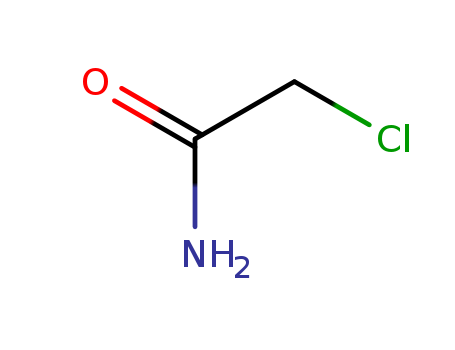
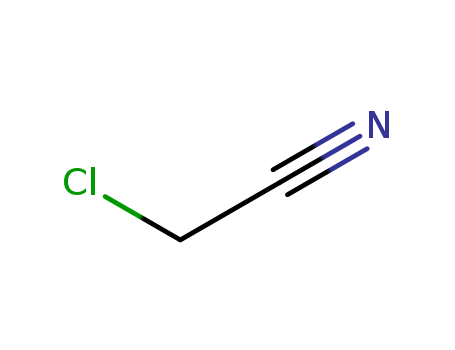
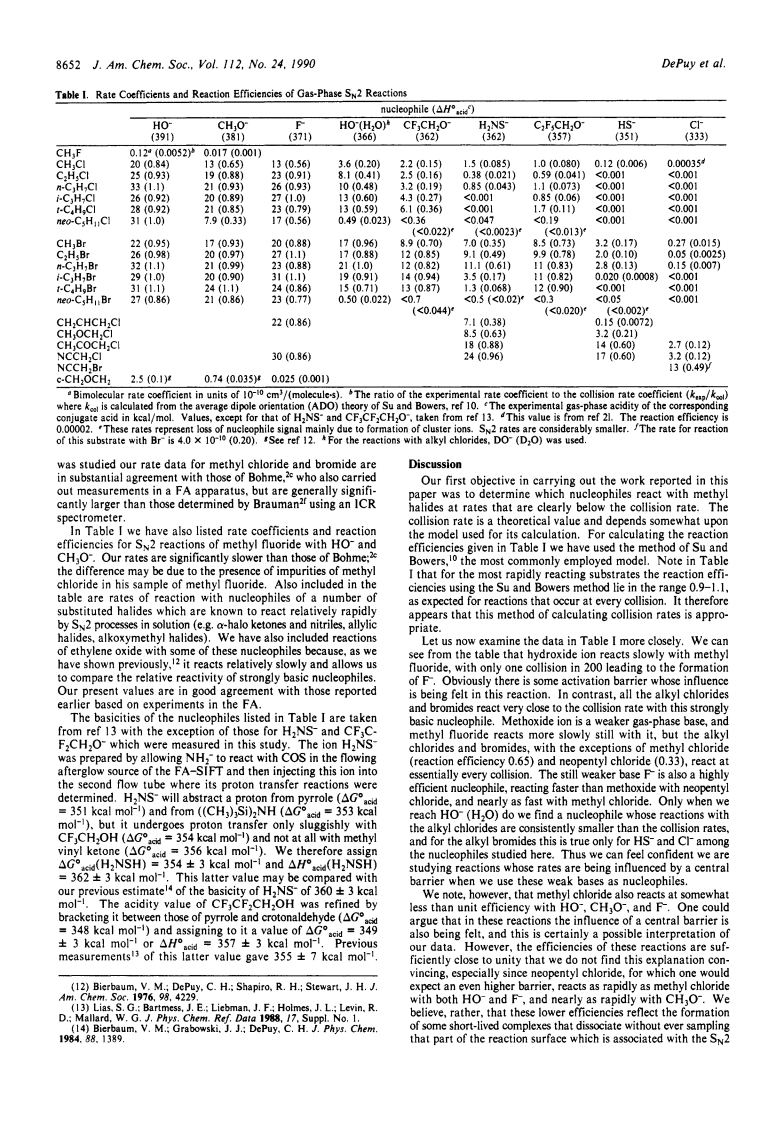
Rate coefficients have been measured for the gas-phase reactions of methyl, ethyl, n-propyl, isopropyl, tert-butyl, and neopentyl chlorides and bromides with the following set of nucleophiles, listed in order of decreasing basicity: HO-, CH3O-, F-, HO- (H2O), CF3CH2O-, H2NS-, C2F5CH2O-, HS-, and Cl-. For methyl chloride the reaction efficiency first falls significantly below unity with HO- (H2O) as the nucleophile and for methyl bromide with HS- as the nucleophile; in both cases the overall reaction exothermicity is about 30 kcal mol-1. Earlier conclusions that these halides react slowly with stronger bases are shown to be in error. In the region where the rates are slow oxygen anions react with the alkyl chlorides and bromides by elimination while sulfur anions of the same basicity react by substitution. This difference is due to a slowing down of elimination with the sulfur bases; sulfur anions show no increased nucleophilicity as compared to oxy anions of the same basicity. Rate coefficients have also been measured for reaction of methyl fluoride with HO- and CH3O- and ethylene oxide with HO-, CH3O-, and F-. All of these rates are slow but measurable; combining the results of these experiments with those of the alkyl chlorides and bromides suggests that the gas-phase barrier to the symmetrical SN2 reaction of F- with methyl fluoride is lower than previous estimates. We have also measured rates for reaction of allyl chloride with F-, H2NS-, and HS-, chloromethyl ether with H2NS- and HS-, chloroacetonitrile with F-, H2NS-, HS-, and 37Cl-, bromoacetonitrile with Cl- and 81Br-, and α-chloroacetone with H2NS-, HS-, and 37Cl-. Our results also imply that the gas-phase SN2 barrier for Br- reacting with methyl bromide is nearly equal to the ion-dipole attraction energy of the reactants, in agreement with previous estimates.
Photocatalytic C-H activation and the subtle role of chlorine radical complexation in reactivity
Yang, Qiaomu Wang, Yu-Heng Qiao, Yusen Gau, Michael Carroll, Patrick J. Walsh, Patrick J. Schelter, Eric J.
The functionalization of methane, ethane, and other alkanes derived from fossil fuels is a central goal in the chemical enterprise. Recently, a photocatalytic system comprising [CeIVCl5(OR)]2- [CeIV, cerium(IV); OR, -OCH3 or -OCCl2CH3] was disclosed. The system was reportedly capable of alkane activation by alkoxy radicals (RO·) formed by CeIV-OR bond photolysis. In this work, we present evidence that the reported carbon-hydrogen (C-H) activation of alkanes is instead mediated by the photocatalyst [NEt4]2[CeCl6] (NEt4+, tetraethylammonium), and RO· are not intermediates. Spectroscopic analyses and kinetics were investigated for C-H activation to identify chlorine radical (Cl·) generation as the ratelimiting step. Density functional theory calculations support the formation of [Cl·][alcohol] adducts when alcohols are present, which can manifest a masked RO· character. This result serves as an important cautionary note for interpretation of radical trapping experiments.
 Japan | Contact:Sir
 India | Contact:sir
 Germany | Contact:Werner Schellewald