




Relevant articles and documents
An insight into the controllable synthesis of Cd(ii) complexes with a new multifunctional ligand and its application in dye-sensitized solar cells and luminescence properties
Gao, Song Fan, Rui Qing Wang, Xin Ming Qiang, Liang Sheng Wei, Li Guo Wang, Ping Zhang, Hui Jie Yang, Yu Lin Wang, Yu Lei
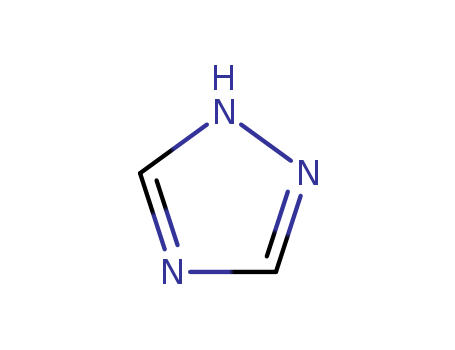
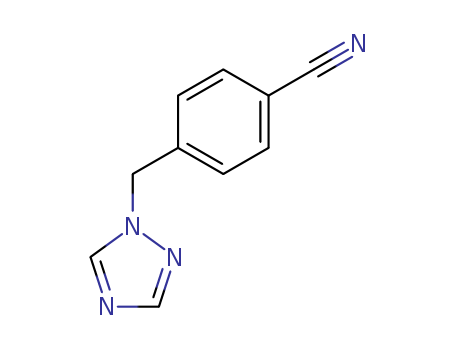
Based on a new design of 4-cyanobenzyl-based 1,2,4-triazole ligand 4-(1,2,4-triazolylmethyl) cyanobenzene (TMCB), a series of cadmium complexes 1-5′ from a mononuclear to three-dimensional (3D) structure have been synthesized through hydro(solvo)thermal reactions; they were generally formulated as [Cd(TMCBA)2]n (1), [Cd(TMCB)(1,4-bda)(H2O)]n (2), {[Cd2(TMCB)4(1,4-bda)2(H2O)2]n·3H2O}n (3), {[Cd(TMCB)4(H2O)2]·(NO3)2·(H2O)2}n (4), [Cd1.5(1,4-bda)1.5(DMF)2]2n (5) and [Cd1.5(1,4-bda)1.5(DMF)2]2n (5′) (TMCBA = 4-(1,2,4-triazolylmethyl) benzoic acid, which is formed from the hydrolysis of TMCB; 1,4-H2bda = 1,4-benzenedicarboxylic acid; the difference between two genuine supramolecular isomers of 5 and 5′ is the use of TMCB as the additive agent for the reaction). Complexes 1-5′ exhibit tunable luminescence with emission maxima containing deep blue, blue, light blue, green and deep green region at 298 K or 77 K in both different solvents (polarity: DMSO > CH3OH > CHCl3) and solid state. Interestingly, the good thermal stability accompanied by their compensated adsorption to ruthenium complex N719 in the region of low wavelength, enabled 1 and 4 to serve as co-sensitizers in combination with N719 in dye sensitized solar cells (DSSCs). After co-sensitization with N719, the overall conversion efficiency of 1 and 4 were found to be 7.68% and 6.85%, which are 40.40% and 25.23% higher than that for DSSCs only sensitized by N719 (5.47%) under the same conditions, respectively. The improvement in efficiency is attributed to the fact that complexes 1 and 4 overcome the deficiency of N719 absorption in the low wavelength region of ultraviolet and blue-violet, offset competitive visible light absorption of I3- and reduce charge recombination due to the formation of an effective cover layer of the dye molecules on the TiO2 surface. As a result, the synthesized complexes are promising candidates as co-adsorbents and co-sensitizers for highly efficient DSSCs.


Kinetics of hydrolysis in aqueous solution of 1-benzoyl-1,2,4-triazole; the role of pairwise and triplet Gibbs energy interaction parameters in describing the effects of added salts and added alcohols
Noordman, Wouter H. Blokzijl, Wilfried Engberts, Jan B. F. N. Blandamer, Michael J.
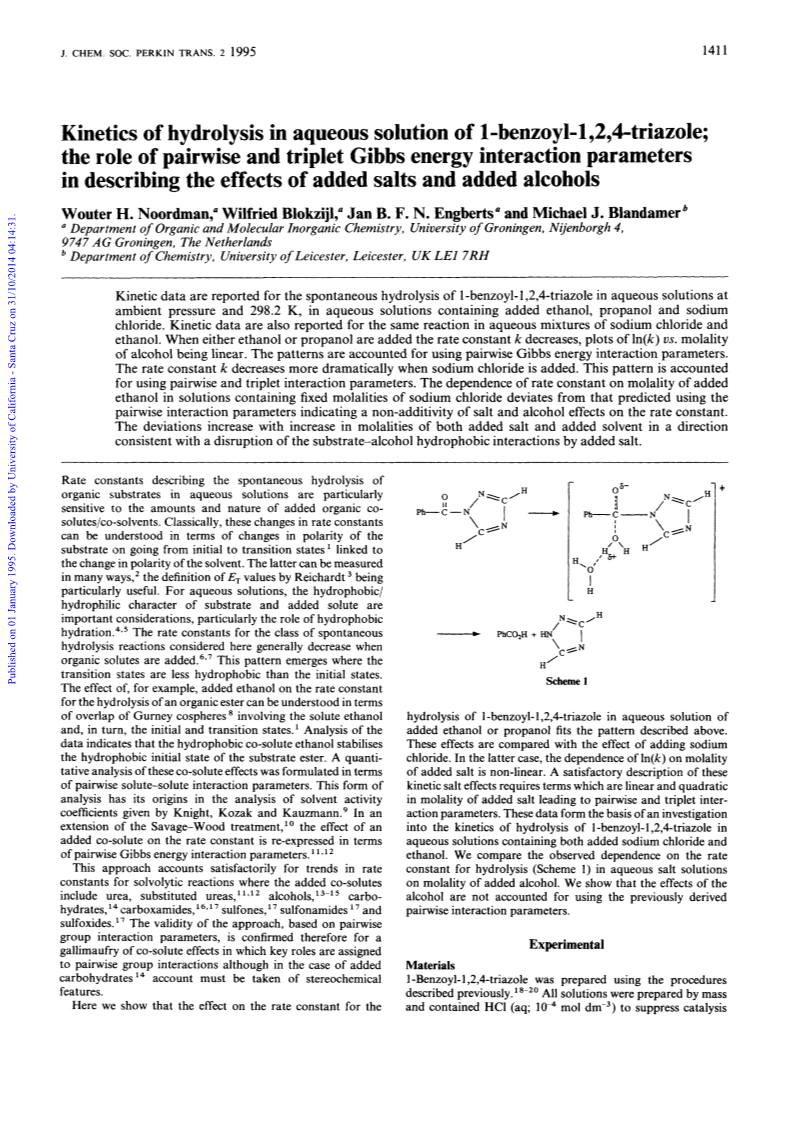
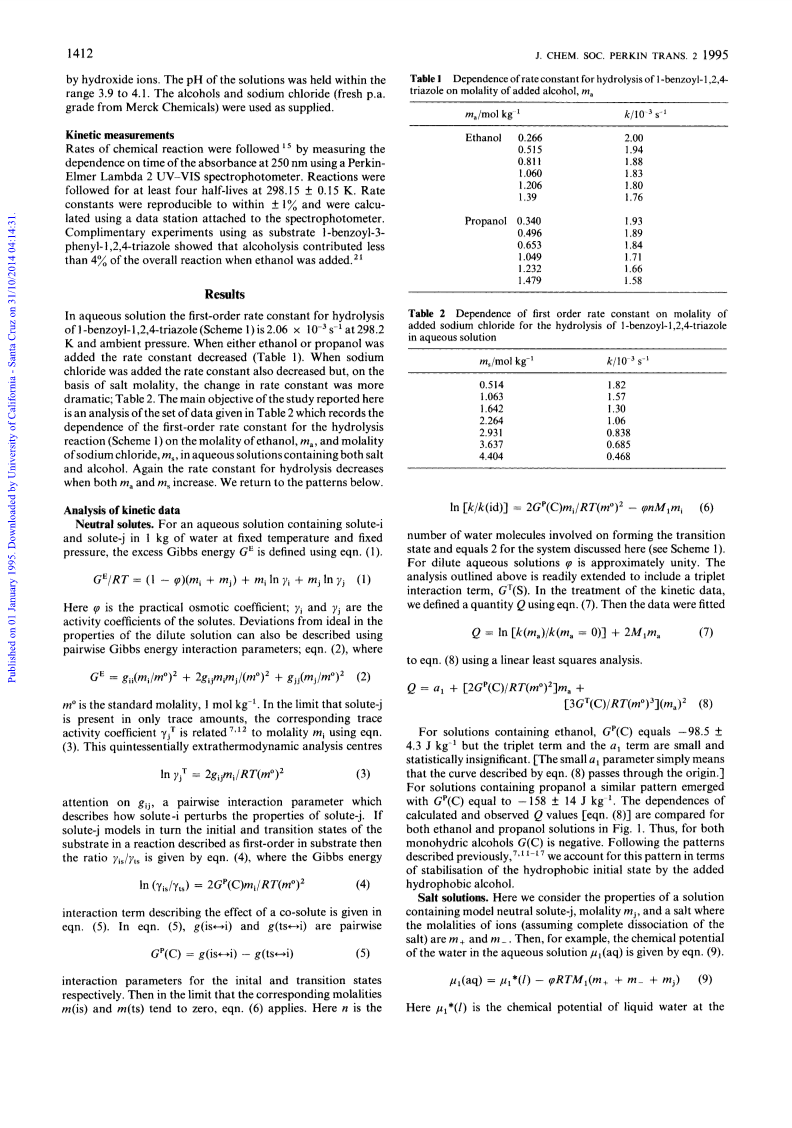
Kinetic data are reported for the spontaneous hydrolysis of 1-benzoyl-1,2,4-triazole in aqueous solutions at ambient pressure and 298.2 K, in aqueous solutions containing added ethanol, propanol and sodium chloride.Kinetic data are also reported for the same reaction in aqueous mixtures of sodium chloride and ethanol.When either ethanol or propanol are added the rate constant k decreases, plotes of ln(k) vs. molality of alcohol being linear.The patterns are accounted for using pairwise Gibbs energy interaction parameters.The rate constant k decrease more dramatically when sodium chloride is added.This pattern is accounted for using pairwise and triplet interaction parameters.The dependence of rate constant on molality of added ethanol in solutions containing fixed molalities of sodium chloride deviaties from that predicted using the pairwise interaction parameters indicating a non-additivity of salt and alcohol effects on the rate constant.The deviations increase wirh increase in molalities of both added salt and added solvent in a direction consistent with a disruption of the substrate-alcohol hydrophobic interactions by added salt.

 Sweden | Contact:sir
 South Africa | Contact:AAron Thomas
 India | Contact:Rishi Bhatia