



Relevant articles and documents
Role of hydrogenolysis and nucleophilic substitution in hydrodenitrogenation over sulfided NiMo/γ-Al2O3
Prins Rota
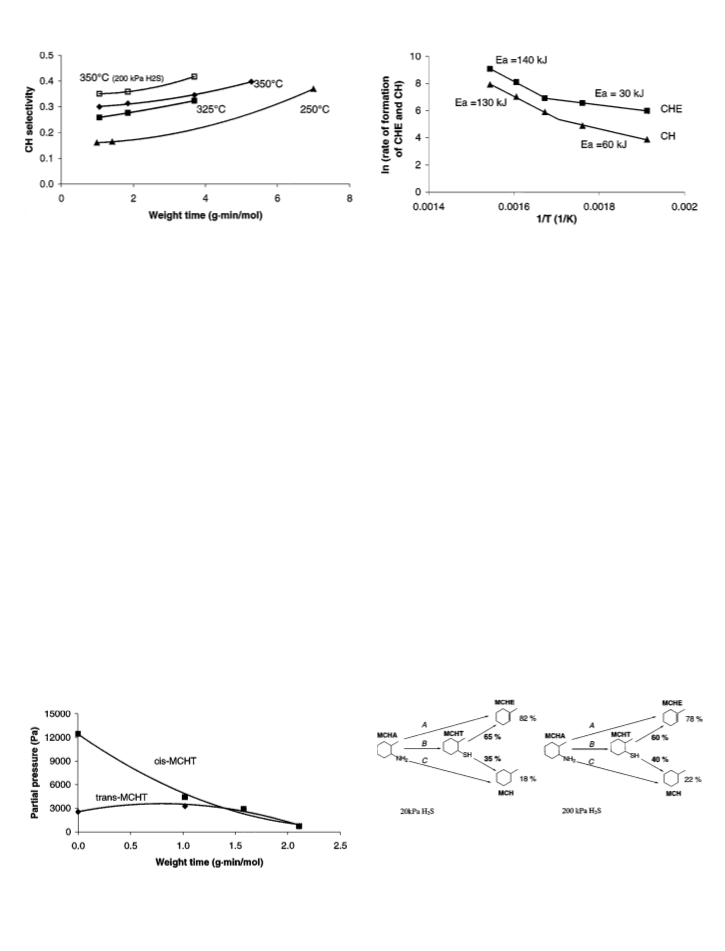
The HDS of cyclohexanethiol and 2-methylcyclohexanethiol was studied over a sulfided NiMO/γ-Al2O3 catalyst. About 66% of the thiols reacted by elimination to (methyl)cyclohexene and 33% by hydrogenolysis of the C-S bond to (methyl)cyclohexane. These values were slightly lower than those for the selectivity to methylcyclohexene and slightly higher than those for the selectivity to methylcyclohexane in the HDN of 2-methylcyclohexylamine. HDN occurred predominantly in aliphatic molecules that contained H atoms in the β position relative to the nitrogen atom by elimination of ammonia. Part of the remaining HDN occurred by nucleophilic substitution of the amine by H2S, followed by elimination of H2S from the resulting thiol and, to a lesser extent, by C-S bond hydrogenolysis, the rest of the remaining HDN occurred by direct hydrogenolysis of the C-N bond.


Influence of noble metals (Pd, Pt) on the performance of Ru/Al2O3 based catalysts for toluene hydrogenation in liquid phase
Suppino, Raphael Soeiro Landers, Richard Cobo, Antonio José Gomez
Catalytic hydrogenation of aromatic compounds is of great interest due to environmental aspects and the wide range of industrial processes involving such reaction. In this context, the present work aims to study the influence of Pd or Pt addition on the performance of Ru/Al2O3 based catalysts for toluene hydrogenation in liquid phase. For this, catalysts were prepared by wet impregnation from chlorinated precursors and reduced in liquid phase by formaldehyde (H2CO). After impregnation, a part of the catalysts were activated ex situ at 573?K or in situ at 523?K under H2. The studied solids were characterized by N2 physisorption, SEM?+?EDX, TEM, XPS and TPR techniques. Catalytic tests were conducted in a slurry Parr reactor at 373?K under constant H2 pressure of 5?MPa. Results show that solids reduction by H2CO led to metallic species, while the activation treatments form oxides and decrease the catalytic activity. The initial reaction rate of non-activated monometallic catalysts follows the order: Ru/Al2O3???Pd/Al2O3?≈?Pt/Al2O3. A synergistic effect on the activity of Ru/Al2O3 based catalysts is induced by the Pt addition.


 India | Contact:balasaheb
 Germany | Contact:Romesh
  Austria | Contact:sir
 United States | Contact:PDM
 United Kingdom | Contact:Elsa Young
 China (Mainland) | Contact:Allen Wang