




Relevant articles and documents
Oxidant-free dehydrogenation of alcohols heterogeneously catalyzed by cooperation of silver clusters and acid-base sites on alumina
Shimizu, Ken-Ichi Sugino, Kenji Sawabe, Kyoichi Satsuma, Atsushi
A γ-alumina-supported silver cluster catalyst - Ag/Al 2O3-has been shown to act as an efficient heterogeneous catalyst for oxidant-free alcohol dehydrogenation to carbonyl compounds at 373 K. The catalyst shows higher activity than conventional heterogeneous catalysts based on platinum group metals (PGMs) and can be recycled. A systematic study on the influence of the particle size and oxidation state of silver species, combined with characterization by Ag K-edge XAFS (X-ray absorption fine structure) has established that silver clusters of sizes below 1 nm are responsible for the higher specific rate. The reaction mechanism has been investigated by kinetic studies (Hammett correlation, kinetic isotope effect) and by in situ FTIR (kinetic isotope effect for hydride elimination reaction from surface alkoxide species), and the following mechanism is proposed: 1) reaction between the alcohol and a basic OH group on the alumina to yield alkoxide on alumina and an adsorbed water molecule, 2) CH activation of the alkoxide species by the silver cluster to form a silver hydride species and a carbonyl compound, and 3) H2 desorption promoted by an acid site in the alumina. The proposed mechanism provides fundamental reasons for the higher activities of silver clusters on acid-base bifunctional support (Al 2O3) than on basic (MgO and CeO2) and acidic to neutral (SiO2) ones. This example demonstrates that catalysts analogous to those based on of platinum group metals can be designed with use of a less expensive d10 element - silver - through optimization of metal particle size and the acid-base natures of inorganic supports.



Highly selective, economical and efficient oxidation of alcohols to aldehydes and ketones by air and sunlight or visible light in the presence of porphyrins sensitizers
Hajimohammadi, Mahdi Safari, Nasser Mofakham, Hamid Deyhimi, Farzad
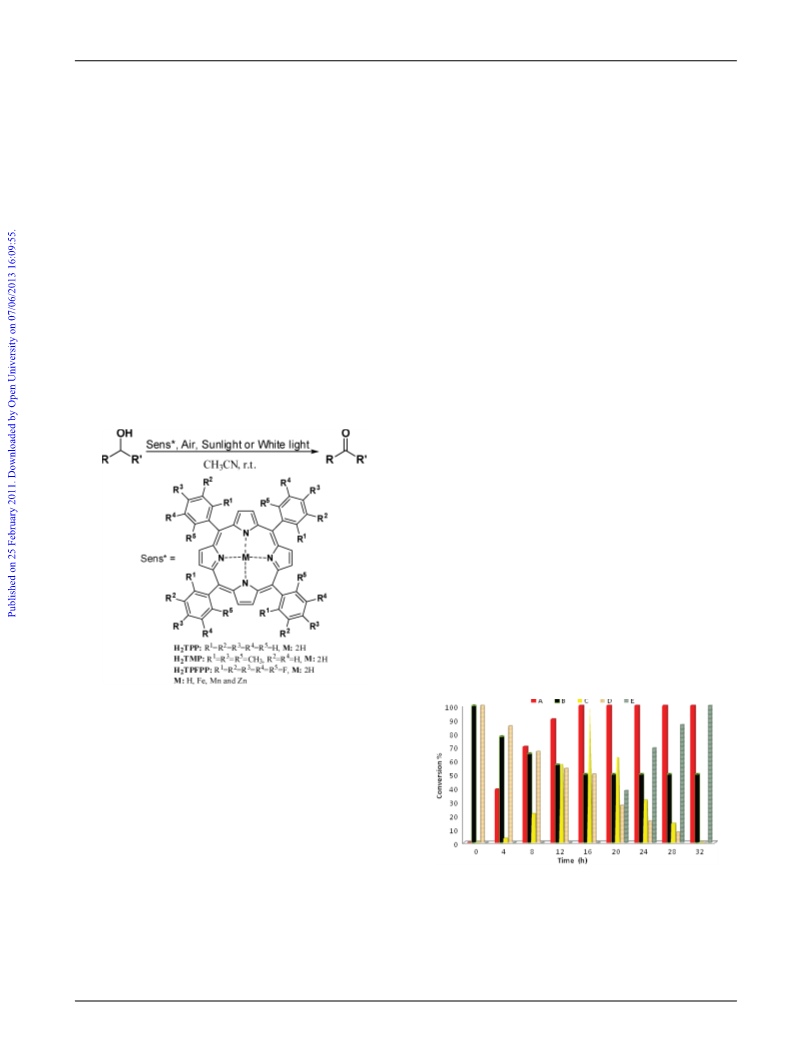
In this work, a new aerobic route is introduced for the selective oxidation of a variety of aromatic and aliphatic alcohols to the corresponding aldehyde and ketone derivatives by molecular oxygen in the presence of free base porphyrins and metalloporphyrins as sensitizers using white light or sunlight in an organic solvent. The method shows a wide scope, exhibits chemoselectivity and proceeds under mild reaction conditions. The resulting products are obtained in good conversions in a reasonable time. The Royal Society of Chemistry.


 Germany | Contact:Amin Hacene
 China (Mainland) | Contact:Qin