
Relevant articles and documents
Inverse-Electron-Demand Palladium-Catalyzed Asymmetric [4+2] Cycloadditions Enabled by Chiral P,S-Ligand and Hydrogen Bonding
Wang, Ya-Ni Xiong, Qin Lu, Liang-Qiu Zhang, Qun-Liang Wang, Ying Lan, Yu Xiao, Wen-Jing
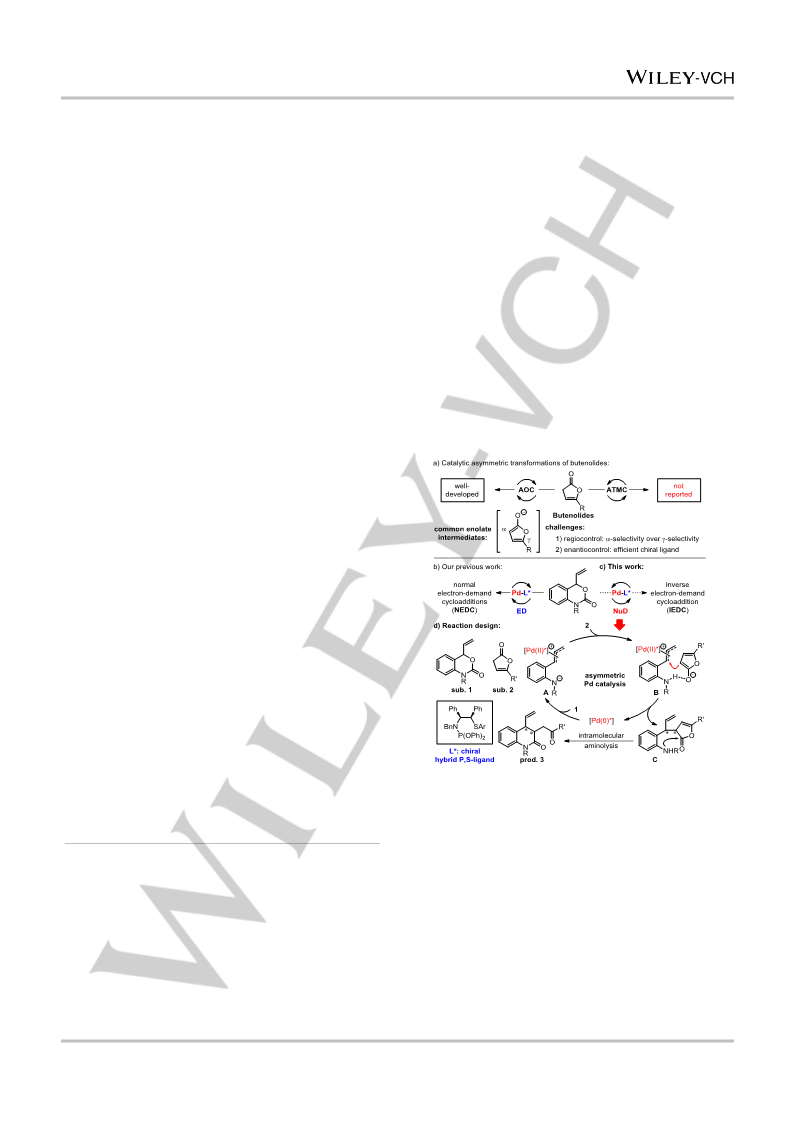
Catalytic asymmetric cycloadditions of ambident Pd-containing dipolar species with nucleophilic dipolarophiles, namely, inverse-electron-demand cycloadditions, are challenging and underdeveloped. Possibly, the inherent linear selectivity of Pd-catalyzed intermolecular allylations and the lack of efficient chiral ligands are responsible for this limitation. Herein, two cycloadditions of such intermediates with deconjugated butenolides and azlactones were accomplished by using a novel chiral hybrid P,S-ligand and hydrogen bonding. By doing so, highly functionalized, optically active dihydroquinol-2-ones were produced with generally high reaction efficiencies and selectivities. Preliminary DFT calculations were performed to explain the high enantio- and diastereoselectivities.


Thermogravimetric Analyzer(TG)-Gas Chromatography(GC)/Mass Spectrometry(MS) and Pyrolytic Studies of 1,6-Bis(2-oxooxazolidin-3-ylcarbonylamino)hexane
Shimasaki, Choichiro Murai, Atsuko Sakai, Yukiko Tsukumirichi, Eiichi
1,6-Bis(2-oxooxazolidin-3-ylcarbonylamino)hexane (1) was prepared from 2-oxazolidinone and hexamethylenediisocyanurate using triethylenediamine as a catalyst in benzene.A TG effluent gas is collected in a cold trap and then directly injected into a GC for separation, the MS for unequivocal identification.The 13 effluent compounds from the thermal degradation of 1 were identified.