



Relevant articles and documents
Probing Microbiome Genotoxicity: A Stable Colibactin Provides Insight into Structure-Activity Relationships and Facilitates Mechanism of Action Studies
Herzon, Seth B. Menges, Fabian S. Surovtseva, Yulia V. Tirla, Alina Wernke, Kevin M. Xue, Mengzhao
Colibactin is a genotoxic metabolite produced by commensal-pathogenic members of the human microbiome that possess the clb (aka pks) biosynthetic gene cluster. clb+ bacteria induce tumorigenesis in models of intestinal inflammation and have been causally
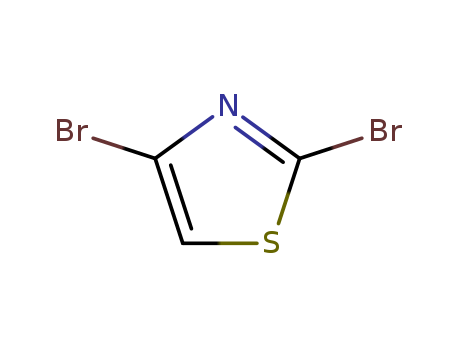
The X-ray Structures of 2,4-Dibromothiazole and 2,4-Diacetyl-5-bromothiazole
Aitken, Kati M. Aitken, R. Alan MacGregor, Callum I. Traore, Mohamed D. M. Slawin, Alexandra M. Z.
2,4-Dibromothiazole [orthorhombic, a = 6.700 (10), b = 16.21 (3), c = 5.516 (8) ?, space group Fmm2] shows a disordered crystal structure with molecules randomly oriented with respect to the direction of the Br-C(2)-N-C(2)-Br unit and the remaining ring atoms S(3) and C(3)H showing mixed occupancy. 2,4-Diacetyl-5-bromothiazole [triclinic, a = 4.040 (2), b = 8.254 (5), c = 13.208 (8) ?, α = 96.191 (17), β = 93.865 (16), γ = 94.067 (11)°, space group P-1] shows a structure dominated by halogen bonding, intramolecular between 4-COMe and 5-Br and intermolecular between 2-COMe of one molecule and 5-Br of the next. Graphical Abstract: 2,4-Dibromothiazole is disordered in the crystal structure with molecules randomly oriented either way round as shown. There is evidence for unusual intramolecular, and perhaps also intermolecular, halogen bonding between Br and C = O in the structure of 2,4-diacetyl-5-bromothiazole.[Figure not available: see fulltext.]


 India | Contact:Sir
 Germany | Contact:activate
 United States | Contact:BIOFINE