




Relevant articles and documents
Synthesis, characterization, X-ray crystallography analysis and cell viability study of (η6-p-cymene)Ru(NH2R)X2 (X = Cl, Br) derivatives
McDarmont, Sarah L. Jones, Meredith H. McMillen, Colin D. Smith, Everett Clinton Pienkos, Jared A. Joslin, Evan E.
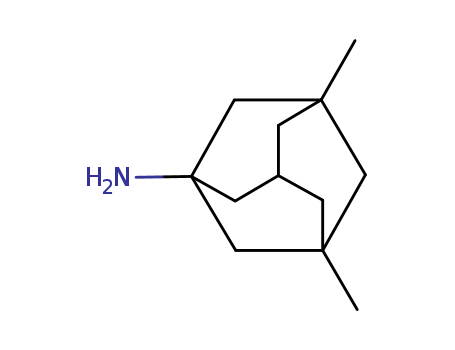
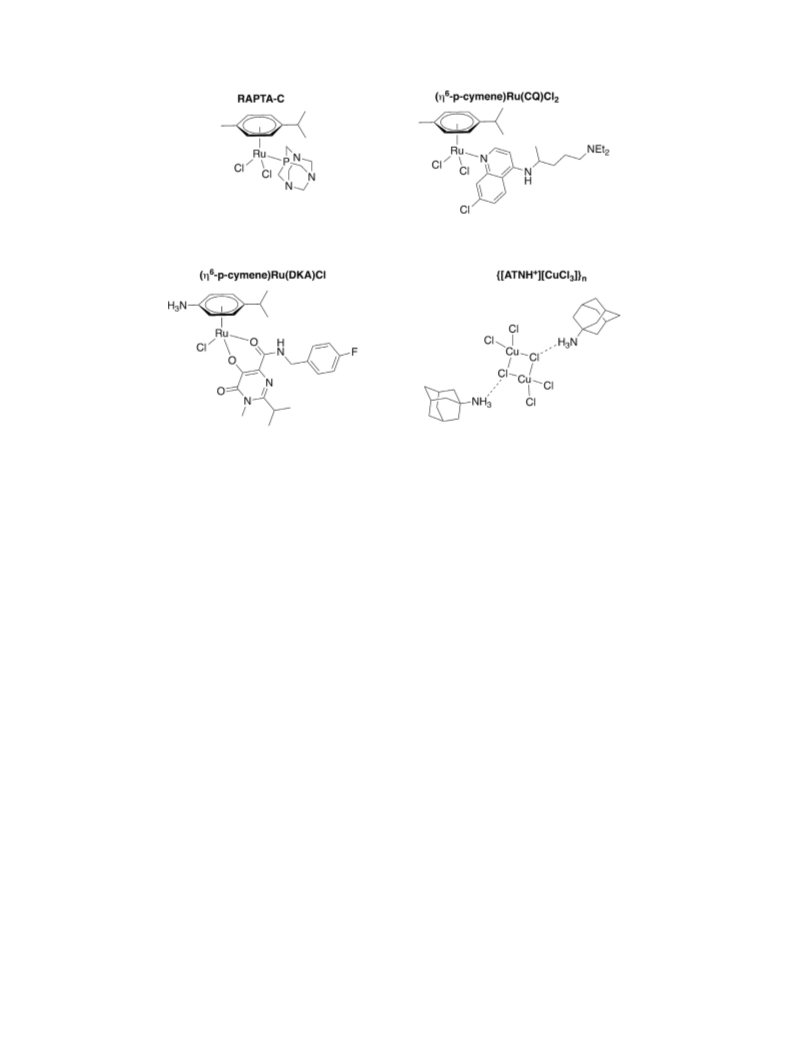
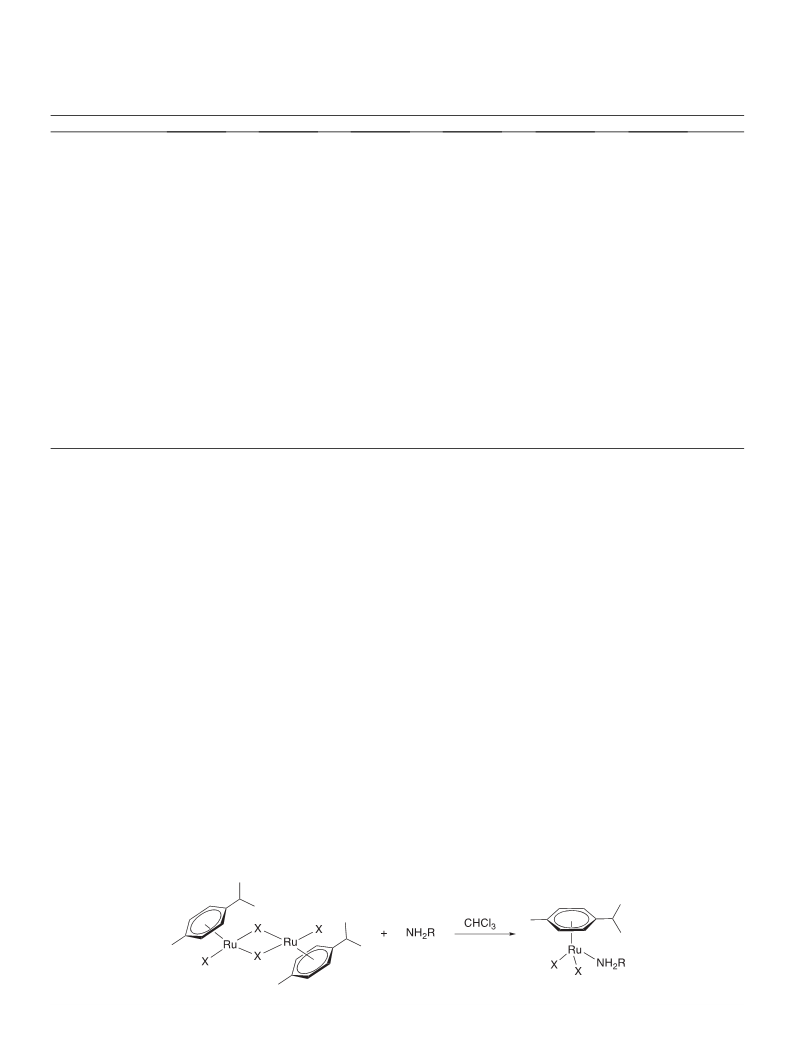
Studies over the past few decades demonstrate the potential for metallodrugs as bioactive therapeutics. Here, we describe six new ruthenium(II) complexes with the general motif of (η6-p-cymene)Ru(NH2R)X2, where NH2R is either the influenza A antiviral drugs rimantadine or amantadine or the N-methyl-D-aspartate [NMDA] receptor antagonist, memantine and X = Cl or Br. All complexes were synthesized in high yield and purity and characterized by NMR spectroscopy and X-ray crystallography. Both the chlorine and bromine ruthenium(II) p-cymene complexes demonstrated cellular toxicity profiles similar to their respective free ligand, indicating that complexation to ruthenium(II) centers does not significantly increase toxicity of the bioactive ligand.

Synthesis, crystallographic studies, molecular modeling and in vitro biological studies of silver(I) complexes with aminoadamantane ligands
dos Santos Pereira, Anna Karla Nakahata, Douglas Hideki Manzano, Carlos Marrote de Alencar Simoni, Déborah Pereira, Douglas Henrique Lustri, Wilton Rogério Formiga, André Luiz Barboza Corbi, Pedro Paulo
Silver(I) complexes with amantadine (atd) and memantine (mtn) were synthesized and characterized. Elemental, thermogravimetric and mass spectrometric analyses indicated a 1:2 metal/ligand ratio, with the molecular composition AgC20H34N2·NO3 for Ag–atd and AgC24H42N2·NO3·H2O for Ag–mtn. The crystal structures of the silver(I) complexes were determined by single crystal X-ray diffractometric studies and show the coordination of amantadine and memantine to the Ag(I) ion by the nitrogen atom of the NH2 group. The spectral analysis by infrared and 1H, 13C and {15N,1H} nuclear magnetic resonance (NMR) spectroscopies confirmed the coordination sites of the ligands to the silver ions. Computational studies revealed modes of vibration and bond lengths similar to those found experimentally. The in vitro antibacterial activity assays showed that amantadine is not active over the tested strains while memantine showed a low activity against Staphylococcus aureus and Pseudomonas aeruginosa. On the other hand, the complexes had a pronounced antibacterial activity over the same strains with minimum inhibitory concentration (MIC) values in the micromolar range. Biophysical assays based on fluorescence spectroscopy indicated that the silver(I) complexes interact weakly with bovine serum albumin, while agarose gel electrophoresis and competitive binding experiments revealed that the compounds interact with DNA by non-covalent interactions.


 Ukraine | Contact:peter
 Poland | Contact:sir
 Latvia | Contact:Didzis Skards
 India | Contact:Chandrakant Thakkar
 Czech Republic | Contact:Libor Pachta
 Cameroon | Contact:hamanpitt
 United States | Contact:Brenda