


Relevant articles and documents
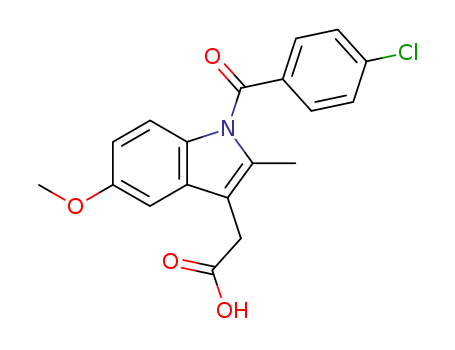
New indomethacin analogs as selective COX-2 inhibitors: Synthesis, COX-1/2 inhibitory activity, anti-inflammatory, ulcerogenicity, histopathological, and docking studies
Abdellatif, Khaled R. A. Abdelall, Eman K. A. Elshemy, Heba A. H. El-Nahass, El-Shaymaa Abdel-Fattah, Maha M. Abdelgawad, Yasmin Y. M.
New indomethacin analogs 4a–g, 5, 6, 8a, and 8b were synthesized to overcome the nonselectivity and ulcer liability of indomethacin. All newly synthesized compounds were more potent against cyclooxygenase 2 (COX-2; IC50 value range: 0.09–0.4 μМ) as?compared with celecoxib (IC50 = 0.89 μМ). Compounds 4a, 4b, 4d, 5, and 6 showed the highest COX-2 selectivity index (SI range = 4.07–6.33) as compared with indomethacin (SI = 1.14) and celecoxib (SI = 3.52). Additionally, 4a, 4b, 4d, 5, and 7 showed good anti-inflammatory activity with edema inhibition (79.36–88.8%), relative to celecoxib (78.96%) and indomethacin (90.43%), after 5 h. Also, ulcerogenic effects and histopathological examination were assessed for the most potent analogs,?4b, 4d, 5, and 6, to determine their safety. The results can shed light on indomethacin analog?5 as a remarkable anti-inflammatory lead compound with a good safety profile (ulcer index = 10.62) close to the nonulcerogenic drug celecoxib (ulcer index = 10.53) and better than indomethacin (ulcer index = 18.50). Docking studies were performed in the COX-2 active site for the most active compounds, to test their selectivity and to confirm their mechanism of action.


Effects of novel hybrids of caffeic acid phenethyl ester and NSAIDs on experimental ocular inflammation
Pittalà, Valeria Salerno, Loredana Romeo, Giuseppe Siracusa, Maria Angela Modica, Maria Nunziata Romano, Giovanni Luca Salomone, Salvatore Drago, Filippo Bucolo, Claudio
In this study, we report the design and synthesis of novel hybrids of caffeic acid phenetyl ester (CAPE) and non-steroidal anti-inflammatory drugs (NSAIDs). We assessed their effects on an experimental ocular inflammation in New Zealand rabbits. The formulations of CAPE-aspirin and CAPE-indomethacin hybrids were topical instilled in the rabbit's eye. Afterwards, the anti-inflammatory activity was evaluated by grading the clinical signs and by assessing the inflammatory cell count, protein, PGE2 and TNFα levels in the aqueous humor. Furthermore, ocular tolerability of hybrids formulations was evaluated in a separate set of animals by using a modified Draize test. The ocular inflammation in the control group was significantly higher than in both the hybrid-treated groups, as indicated by clinical grading and biomarkers assessment. However, only the CAPE-aspirin hybrid reduced, in a significant dose-dependent manner, the ocular inflammation elicited by paracentesis. CAPE-indomethacin hybrid was able to significantly attenuate the clinical grading and the PGE2 aqueous levels only at the highest dose (0.1%). CAPE-aspirin significantly reduced PGE2 and TNFα levels in the aqueous humor as well as proteins and PMNs. Finally, all formulations showed no ocular irritation compared with vehicle-treated group. In conclusion, CAPE-aspirin shows full anti-inflammatory efficacy in experimental model of ocular inflammation demonstrating an optimal pharmacological and safety profile. Taken together these data indicate that CAPE-aspirin hybrid represents a valid and safe new chemical entity potentially useful for the treatment of ocular inflammation.


 United Arab Emirates | Contact:sir
 Romania | Contact:sir
 Poland | Contact:Sklodowski
 Latvia | Contact:Sir
 Japan | Contact:sir
 Italy | Contact:sir
 Iran (Islamic Republic of) | Contact:roxana
 India | Contact:Shailendra