



Relevant articles and documents
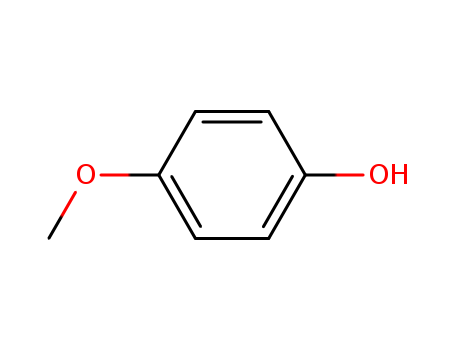
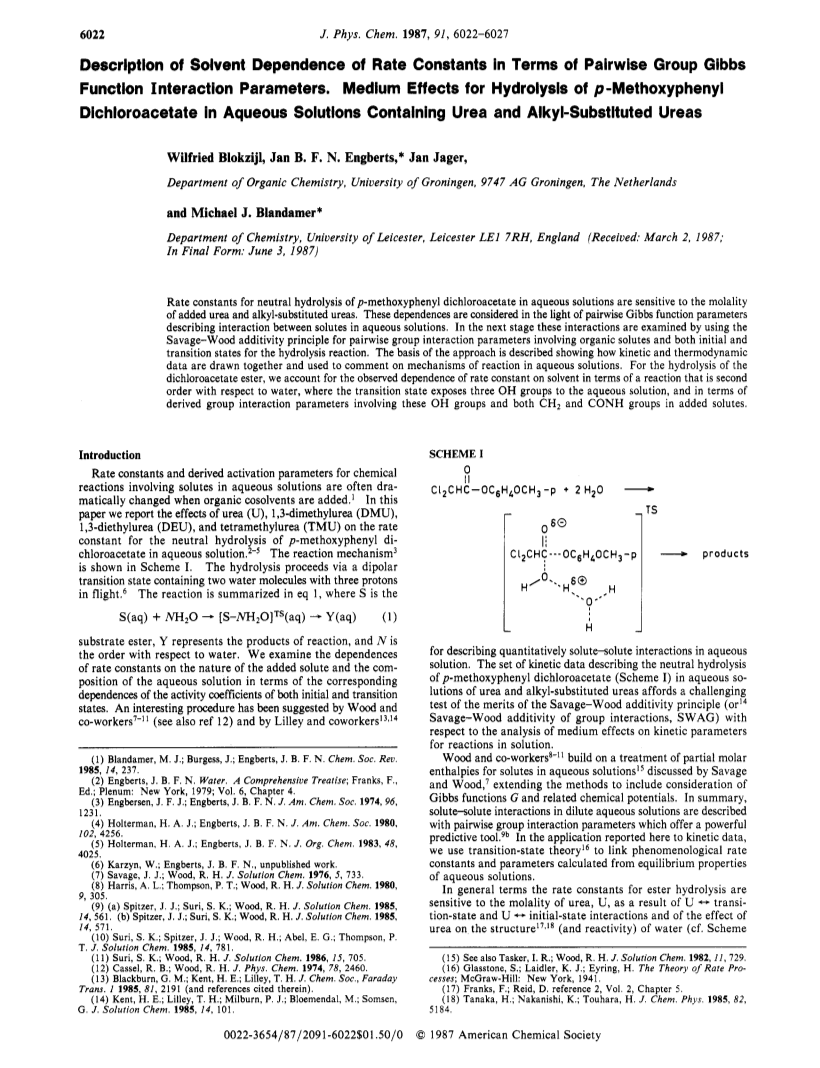
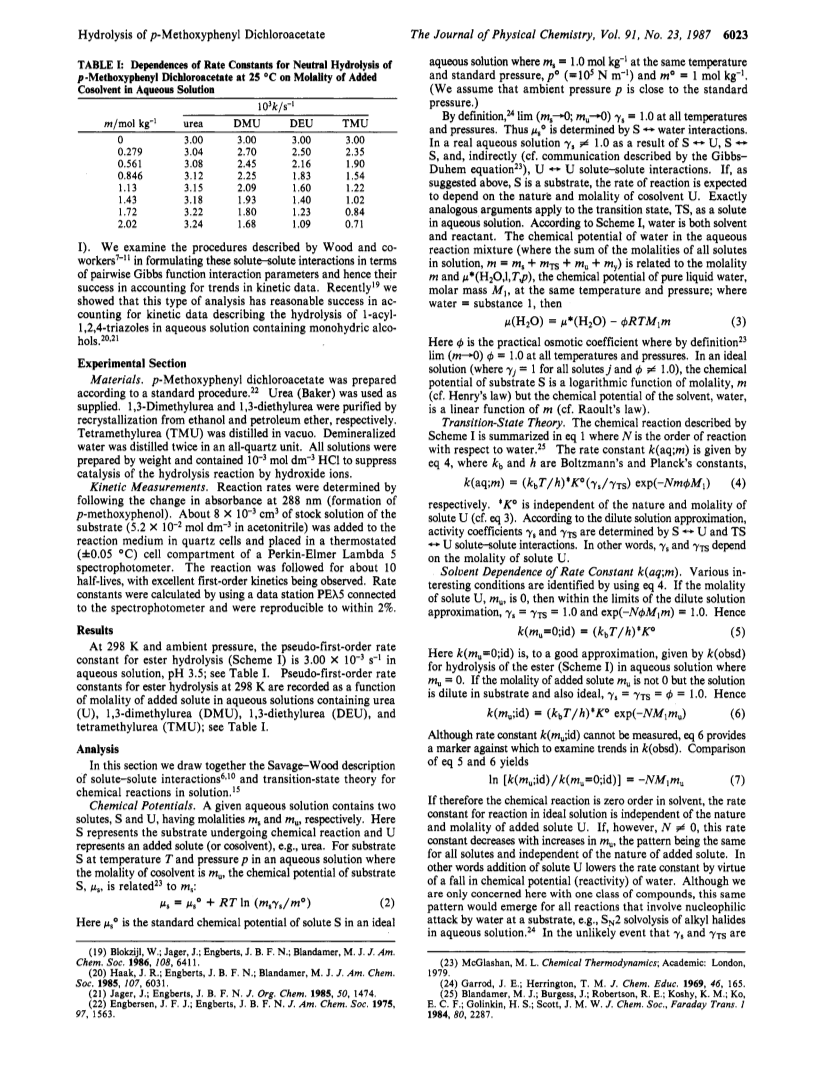
Description of Solvent Dependence of Rate Constants in Terms of Pairwise Group Gibbs Function Interaction Parameters. Medium Effects for Hydrolysis of p-Methoxyphenyl Dichloroacetate in Aqueous Solutions Containing Urea and Alkyl-Substituted Ureas
Blokzijl, Wilfried Engberts, Jan B. F. N. Jager, Jan Blandamer, Michael J.
Rate constants for neutral hydrolysis of p-methoxyphenyl dichloroacetate in aqueous solutions are sensitive to the molarity of added urea and alkyl-substituted ureas.These dependences are considered in the light of pairwise Gibbs function parameters describing interaction between solutes in aqueous solutions.In the next stage these interactions are examined by using the Savage-Wood additivity principle for pairwise group interaction parameters involving organic solutes and both initial and transition states for the hydrolysis reaction.The basis of the approach is described showing how kinetic and thermodynamic data are drawn together and used to comment on mechanisms of reaction in aqueous solutions.For the hydrolysis of the dichloroacetate ester, we account for the observed dependence of rate constant on solvent in terms of a reaction that is second order with respect to water, where the transition state exposes three OH groups to the aqueous solution, and in terms of derived group interaction parameters involving these OH groups and both CH2 and CONH groups in added solutes.

Inhibition of Water-Catalyzed Ester Hydrilysis in Hydrophobic Microdomains of Poly(methacrylic acid) Hypercoils
Jager, Jan Engberts, Jan B. F. N.
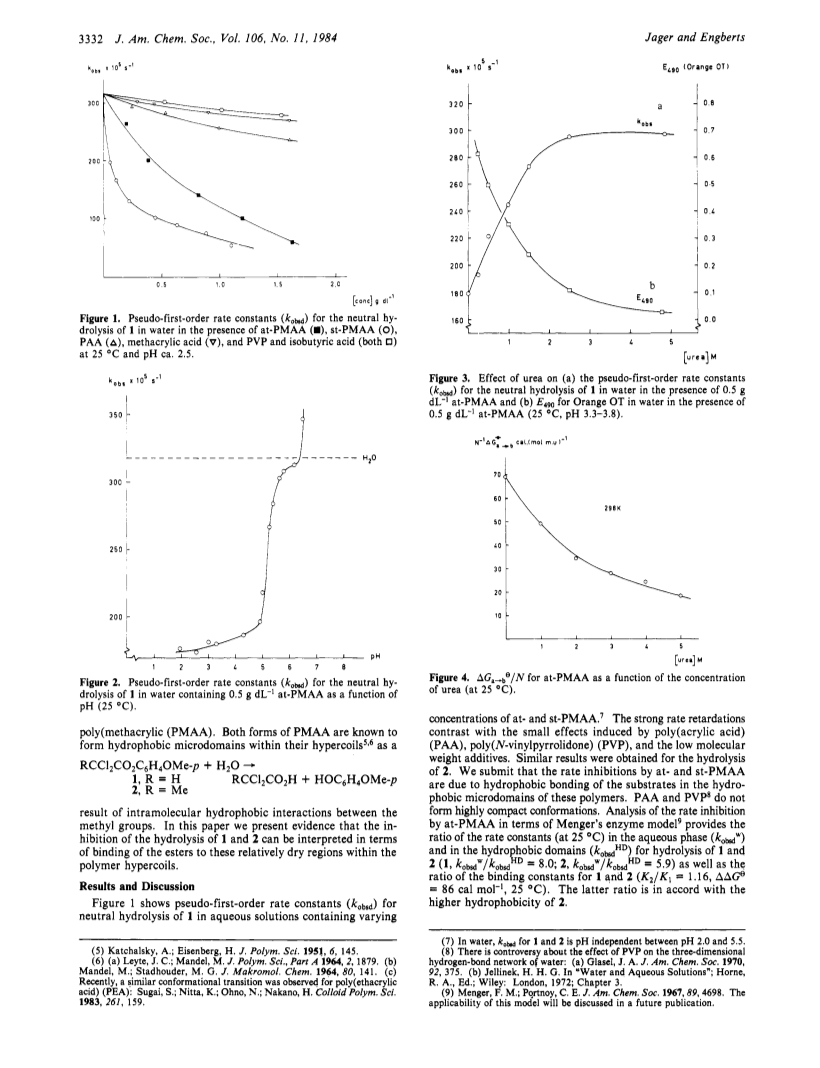
The water-catalyzed hydrolysis of p-methoxyphenyl dichloroacetate (1) and 2,2-dichloropropionate (2) in aqueous solution at 25 deg C is strongly retarded by neutral atactic (at) and syndiotactic (st) poly(methacrylic acid) (PMAA), but not by poly(acrylic acid) and poly(N-vinylpyrrolidone).The rates and thermodynamic activation parameters are consistent with binding of the substrates to hydrophobic microdomains within the PMAA hypercoil.A conformational transition of PMAA to an extended coil leads to disappearance of the rate inhibition.This transition is induced either by ionization of PMAA or, at constant pH (ca. 3), by addition of urea and can be monitored by potentiometric titrations.Solubility measurements employing the water-insoluble dye Orange OT further established hydrophobic bonding to neutral at-PMAA.Whereas inhibition of the hydrolysis of 1 and 2 in water in the presence of hydrophobic cosolvents or micelles is characterized by initial-state stabilization, it appears that the inhibition by at- and st-PMAA primarily involves destabilization of the transition state.The effect of PMAA may be explained in terms of a lack of water penetration into the hydrophobic microdomains.


 United Arab Emirates | Contact:sir
 Thailand | Contact:Wassana Chaipa
 South Africa | Contact:Hans Dominik
 Norway | Contact:Sir
 Netherlands | Contact:ecem
 Mexico | Contact:Sir
 Japan | Contact:sir
 India | Contact:N. A. Shah