


Relevant articles and documents
Synthesis, structure and catalytic activity of an oxo-bridged dinuclear oxovanadium complex of an isonicotinohydrazide ligand
Hosseini-Monfared, Hassan Farrokhi, Afsaneh Alavi, Sohaila Mayer, Peter
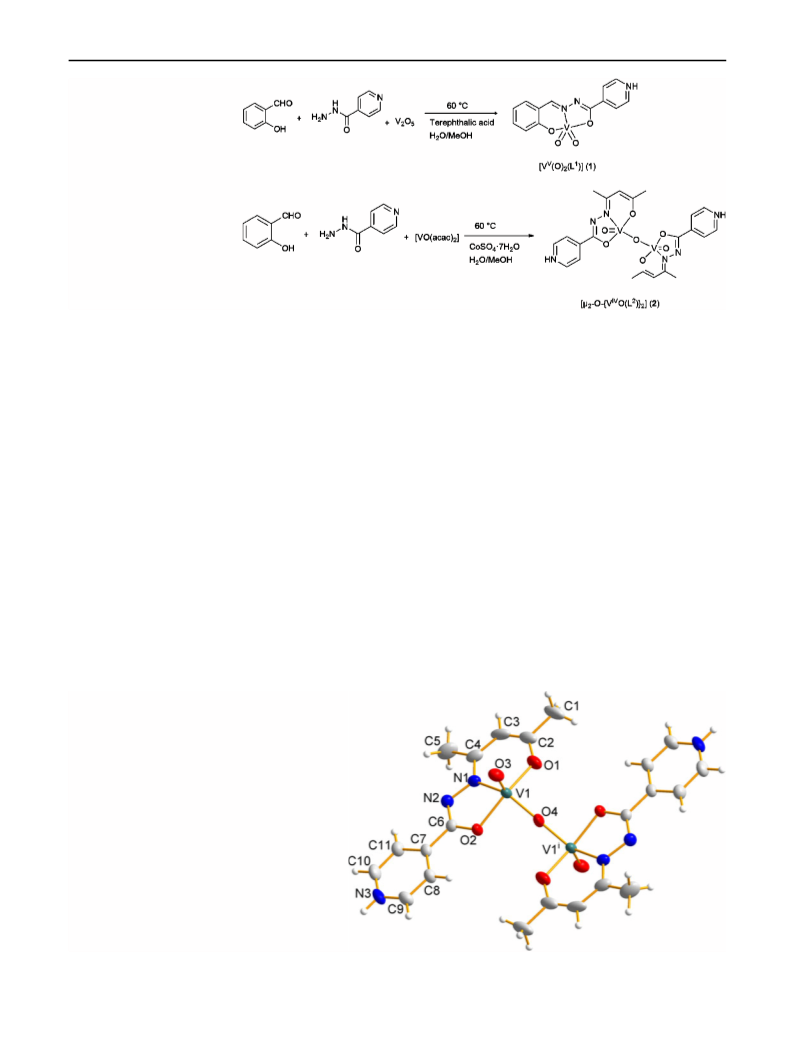
A mononuclear dioxo vanadium(V) complex of a hydrazone ONO donor ligand, [VVO2(L1)] (1), was synthesized by the reaction of V2O5 and terephthalic acid with H2L 1 in 1:1:1 mol ratio, while an oxo-bridged bis(vanadium(IV)oxo) complex, [μ 2-O-{VIVO(L2)}2] (2), was synthesized by the treatment of isonicotinic acid hydrazide, salicylaldehyde and CoSO4·7H2O with bis(acetylacetonato)oxovanadium(IV) (H2L1 = isonicotinic acid(2-hydroxy-benzylidene)-hydrazide, H2L2 = isonicotinic acid (1-methyl-3-oxo-butylidene)-hydrazide). The complexes were characterized by elemental analyses and spectroscopic methods. The crystal structure of complex 2 was determined by X-ray analysis. The complexes were tested as catalysts for the oxidation of cycloalkenes and benzyl alcohol using H 2O2 as terminal oxidant. Excellent selectivity was achieved in the oxidation of cyclohexene.


Oxidation of alkenes with hydrogen peroxide, catalyzed by boron trifluoride. Synthesis of vicinal methoxyalkanols
Terent'ev Boyarinova Nikishin
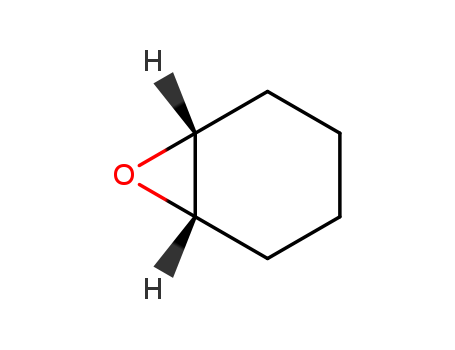
In oxidation of alkenes with the BF3-H2O2 system, boron trifluoride induces transfer of available oxygen from hydrogen peroxide, accompanied by the formation of epoxides. The oxidation in methanol occurs as a one-pot two-step process involving epoxidation of the C=C bond followed by opening of the oxirane ring, with the formation of methoxyalkanols.



 Germany | Contact:Romesh
  United Kingdom | Contact:Elsa Young
 China (Mainland) | Contact:Allen Wang