
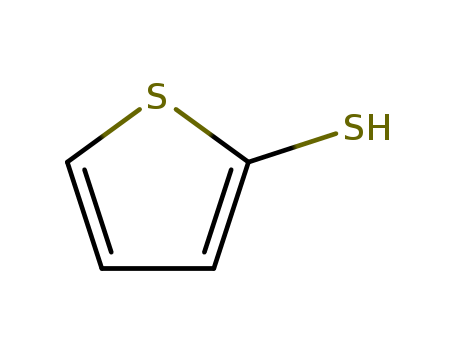

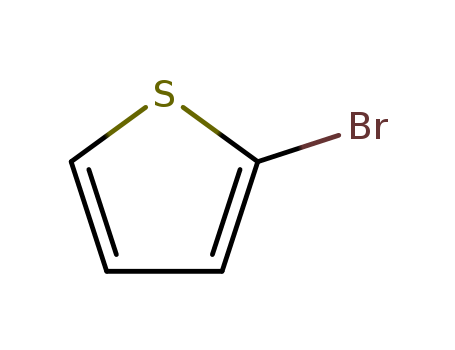

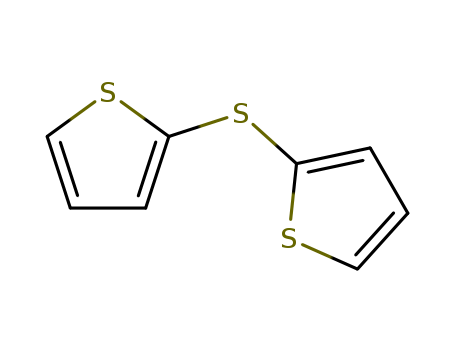


Relevant articles and documents
PROTIODESILYLATION OF SUBSTITUTED 2-TRIMETHYLSILYLTHIOPHENS
Seconi, Giancarlo Eaborn, Colin
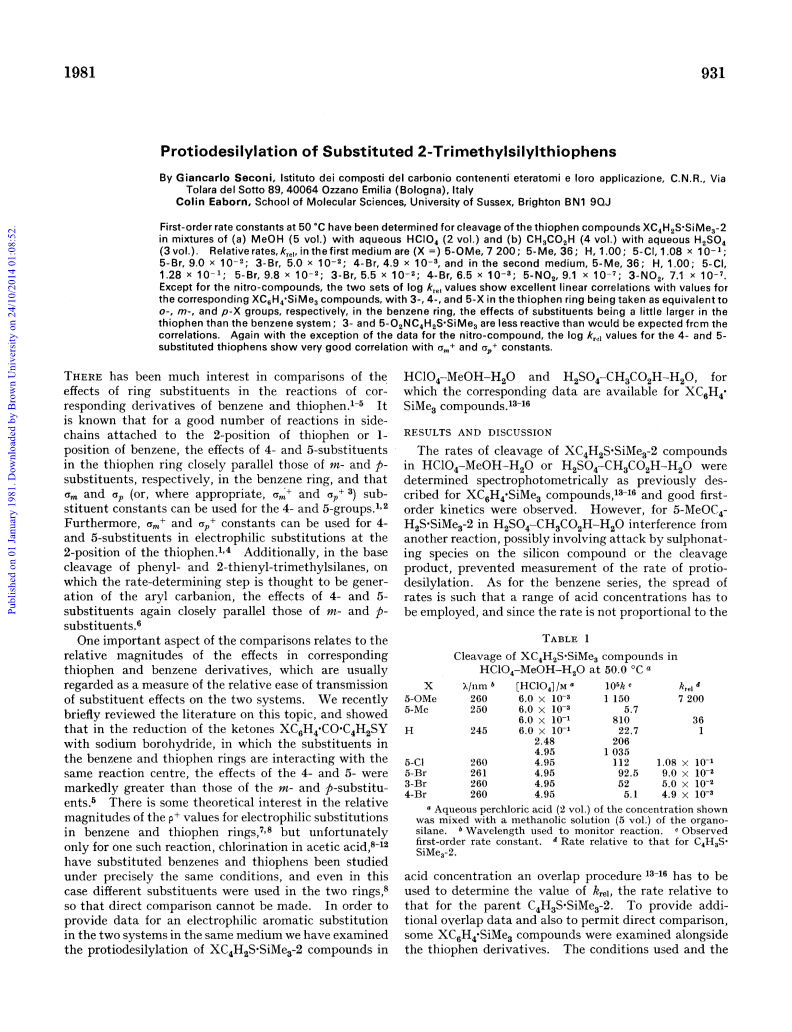
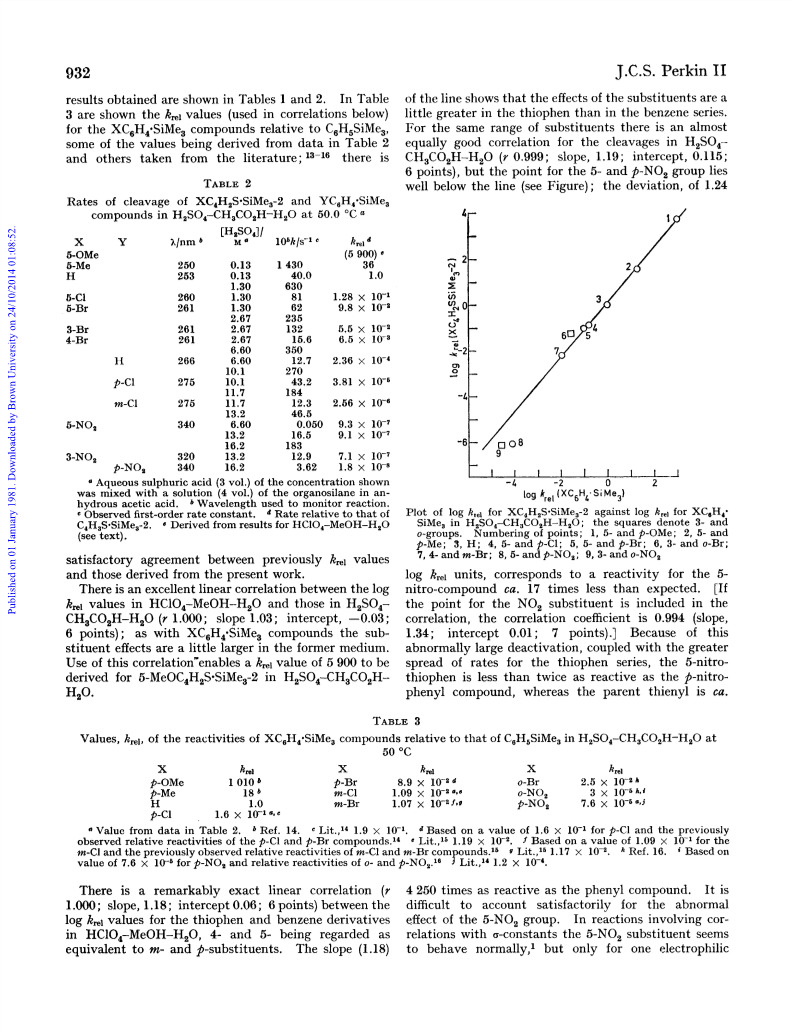
First-order rate constats at 50 deg C have been determined for cleavage of the thiophen compounds XC4H2S<*>SiMe3-2 in mixtures of (a) MeOH (5 vol.) with aqueous HClO4 (2 vol.) and (b) CH3CO2H (4 vol.) with aqueous H2SO4 (3 vol.) Relative rates krel, in the first medium are (X =) 5-OMe, 7 200; 5-Me, 36; H, 1.00; 5-Cl, 1.08E-1; 5-Br, 9.0E-2; 3-Br, 5.0E-2; 4-Br, 4.9E-3, and in the second medium 5-Me, 36; H, 1.00; 5-Cl, 1.28E-1; 5-Br, 9.8E-2; 3-Br, 5.5E-2; 4-Br, 6.5E-3; 5-NO2, 9.1E-7; 3-NO2, 7.1E-7.Except for the nitro-compounds, the two sets of log krel values show excellent linear correlations with values for the corresponding XC6H4<*>SiMe3 compounds, with 3-, 4-, and 5-X in the thiophen ring being taken as equivalent to o-, m-, and p-X groups, respectively, in the benzene ring, the effects of substituents being a litle larger in the thiophen than the benzene system; 3- and 5-O2NC4H2S<*>SiMe3 are less reactive than would be expected from the correlations.Again with the exception of the data for the nitro-compound, the krel values for the 4- and 5- substituted thiophens show very good correlation with ?m+ and ?p+ constants.

Cu3(BTC)2 as heterogeneous catalyst for the room temperature oxidative hydroxylation of arylboronic acids
Dhakshinamoorthy, Amarajothi Asiri, Abdullah M. Garcia, Hermenegildo
A well known copper based-metal organic framework (MOF), namely Cu3(BTC)2, is a suitable heterogeneous catalyst to promote the oxidative room-temperature hydroxylation of arylboronic acids to the corresponding phenols by H2O2. Using 0.5 equiv of H2O2, Cu3(BTC)2 exhibits 80% conversion in 60 min that is higher than 70% conversion achieved with Fe(BTC) under the same conditions and reaction time. Cu3(BTC)2 is reusable with no significant drop in the activity. Furthermore, powder XRD of the reused Cu3(BTC)2 shows no changes in crystallinity compared to the fresh Cu3(BTC)2, indicating catalyst stability is maintained under reaction conditions. The scope of Cu3(BTC)2 as heterogeneous catalyst for the oxidative hydroxylation was studied for various phenylboronic acids.



 Switzerland | Contact:sir
 Japan | Contact:KEIZOUTOYOTA
 Israel | Contact:Chemada
 India | Contact:S. M. Singh
 Germany | Contact:sir