



Relevant articles and documents
Selective defunctionalization of citric acid to tricarballylic acid as a precursor for the production of high-value plasticizers
De Vos, Dirk E. Krajnc, Andra? Mali, Gregor Stuyck, Wouter Verduyckt, Jasper
Strong concerns about the toxicity and endocrine disrupting properties of widespread phthalate plasticizers stimulate the demand for safe and preferably biobased alternatives. Citric acid forms in this respect an excellent and abundant platform chemical for the production of valuable plasticizers. Here, we report a new and direct synthesis route for propane-1,2,3-tricarboxylic acid (PTA) from citric acid via a sequential one pot dehydration-hydrogenation process. This saturated triacid can serve as a basis for the production of tricarballylate esters via esterification, which have been shown to possess excellent plasticizing properties in vinyl resins. In the presence of a solid acid H-Beta zeolite and Pd/C hydrogenation catalyst, yields up to 85% of PTA were obtained under mild reaction conditions and in water as a green solvent. Partial dealumination of the H-Beta zeolite by citric acid could be counteracted by reincorporating aluminium into the framework of the recycled H-Beta zeolite through realumination, regenerating a significant fraction of the initial activity of the catalytic system. The success of the realumination procedure was verified via MAS NMR spectroscopy.


Electrocatalytic upgrading of itaconic acid to methylsuccinic acid using fermentation broth as a substrate solution
Holzh?user, F. Joschka Artz, Jens Palkovits, Stefan Kreyenschulte, Dirk Büchs, Jochen Palkovits, Regina
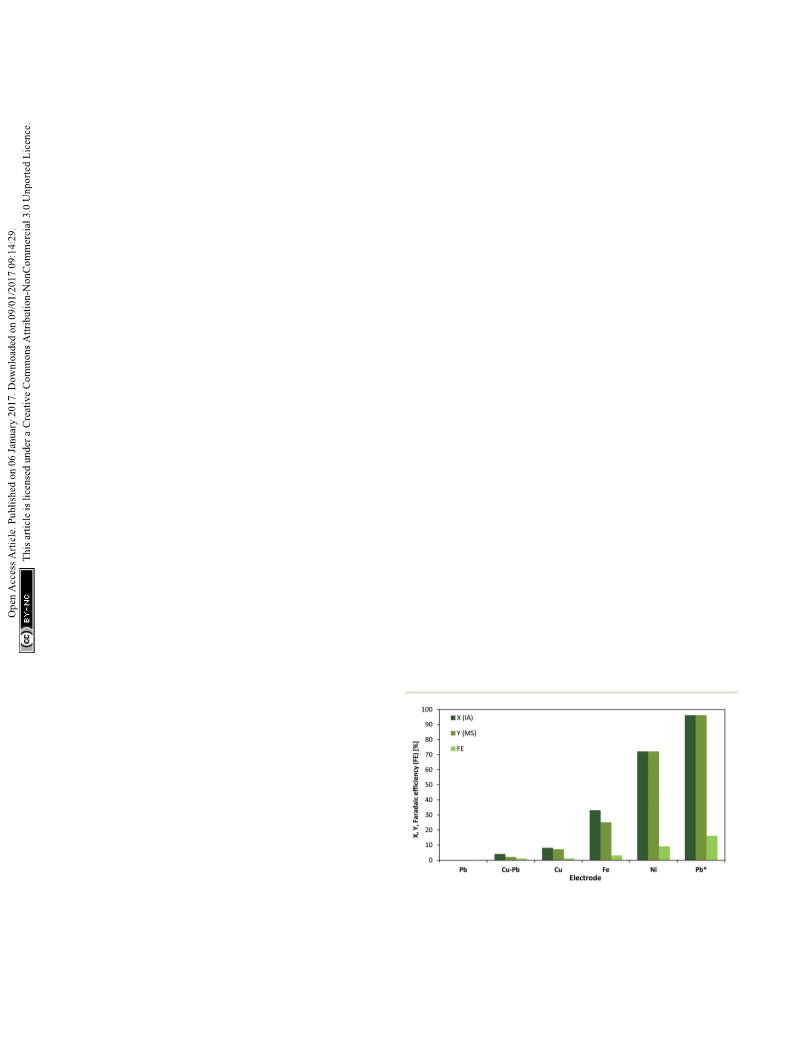
Biomass presents a promising renewable feedstock allowing access to valuable platform chemicals. In particular, biotechnological processes enable a highly selective product formation but are carried out in aqueous electrolyte-containing solutions. Consequently, the separation of usually polar products poses severe challenges on product separation associated with a high energy demand of product purification. A direct further catalytic transformation within fermentation broth reduces the number of unit operations and the need for an energy intensive separation. We herein study the potential of a chemo- and electrochemical reduction of itaconic acid (IA) to methylsuccinic acid (MS) using acidic media or crude fermentation broth as a case study. Despite an efficient chemo-catalytic hydrogenation of neat IA over Ru/C or RANEY nickel, the presence of various salts as well as glucose prohibits a direct chemo-catalytic valorisation in fermentation broth. In contrast, the electrochemical hydrogenation enabled very benign conditions. The selection of the electrode material proved to be decisive and had, together with the voltage, a strong influence on the conversion and faradaic efficiency of electrolysis facilitating 99% faradaic efficiency. The conversion of IA only slightly declined for an IA fermentation broth instead of neat IA in a diluted sulfuric acid environment reaching 60 versus 64%. Moreover, a full conversion and yield could also be achieved by simple optimizations of the reaction period and the substrate concentration. The electrocatalytic valorisation of a crude biotechnological product stream reduces not only energy demand and unit operations but presents a promising approach to introduce renewable electrical energy in biomass utilization.


 Japan | Contact:mrc
 Germany | Contact:Romesh
  United States | Contact:Eric Stohler
 United Kingdom | Contact:sir
 China (Mainland) | Contact:Kemp