



Relevant articles and documents
Substituent and Solvent Effects in the Reactions of Diaryldiazomethanes with 2,3-Dichloro-5,6-dicyanobenzoquinone
Oshima, Takumi Nagai, Toshikazu
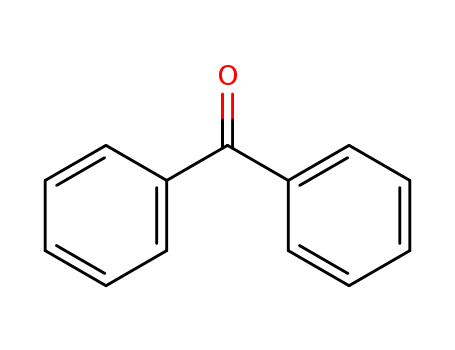
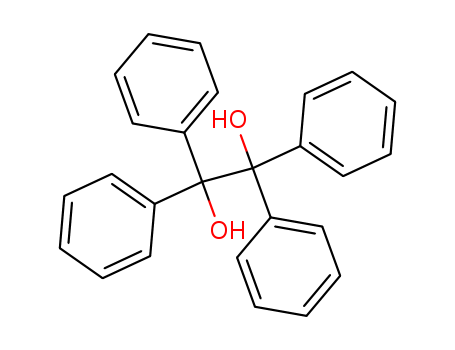
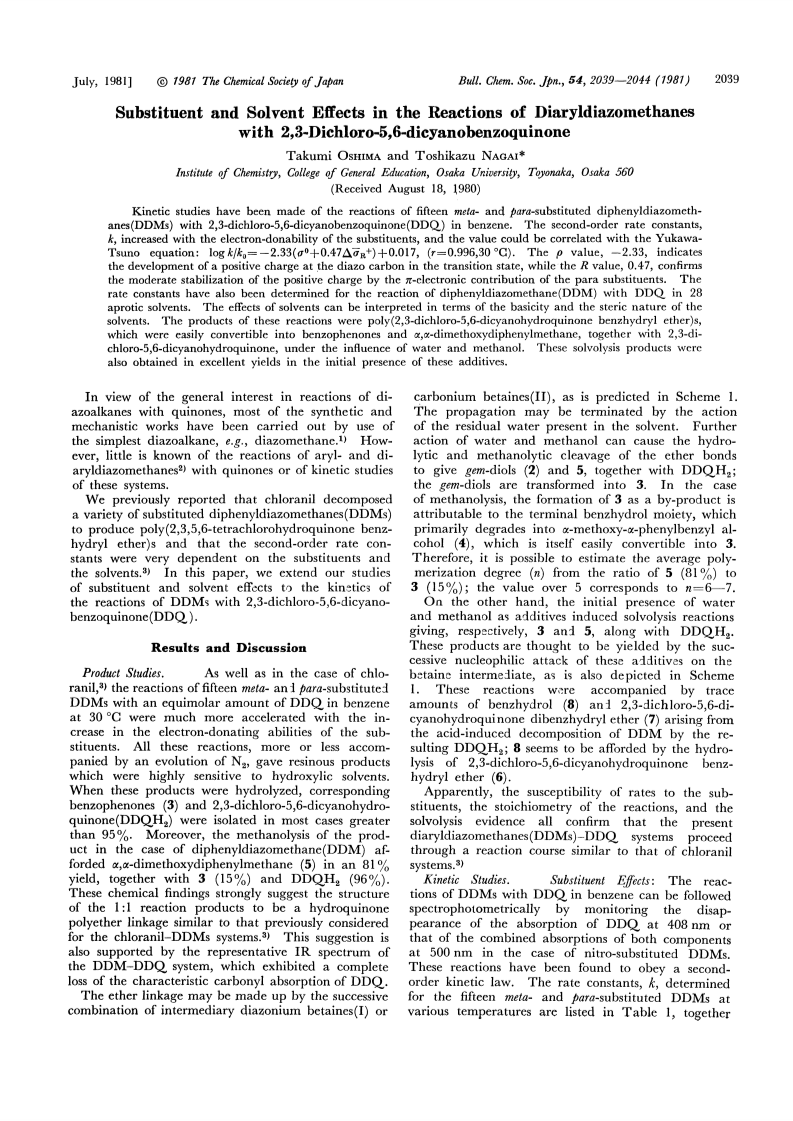
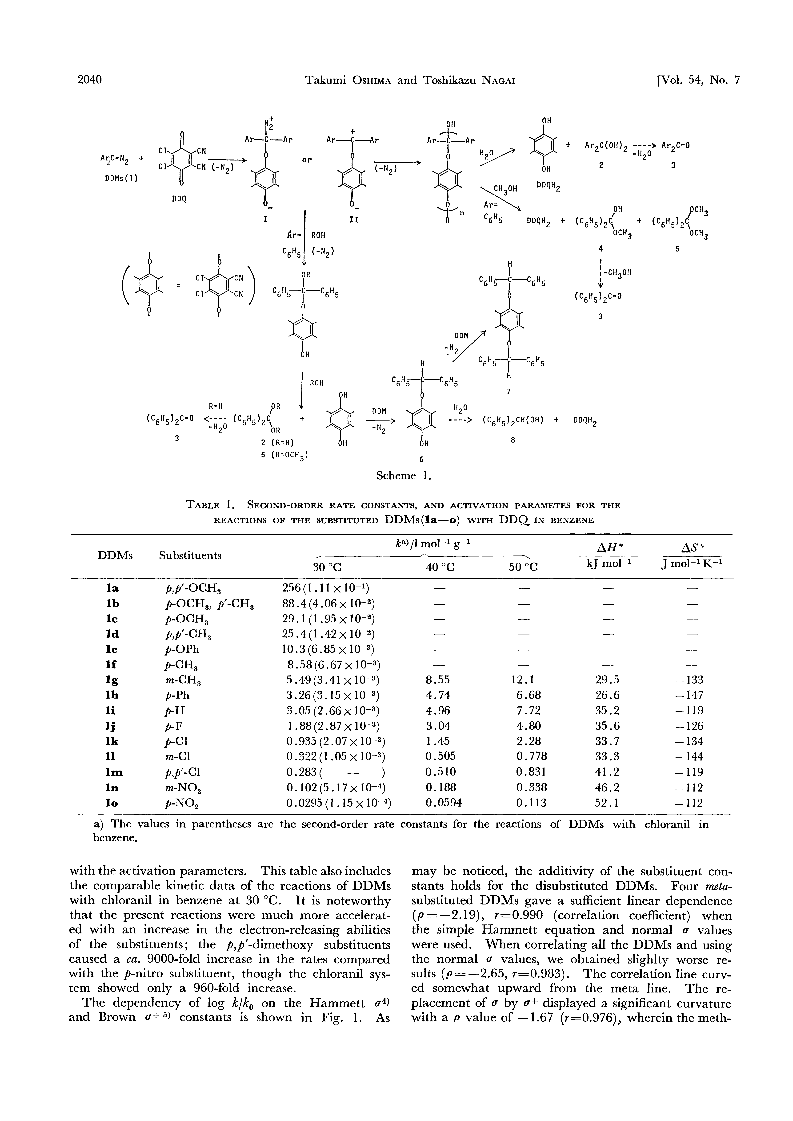
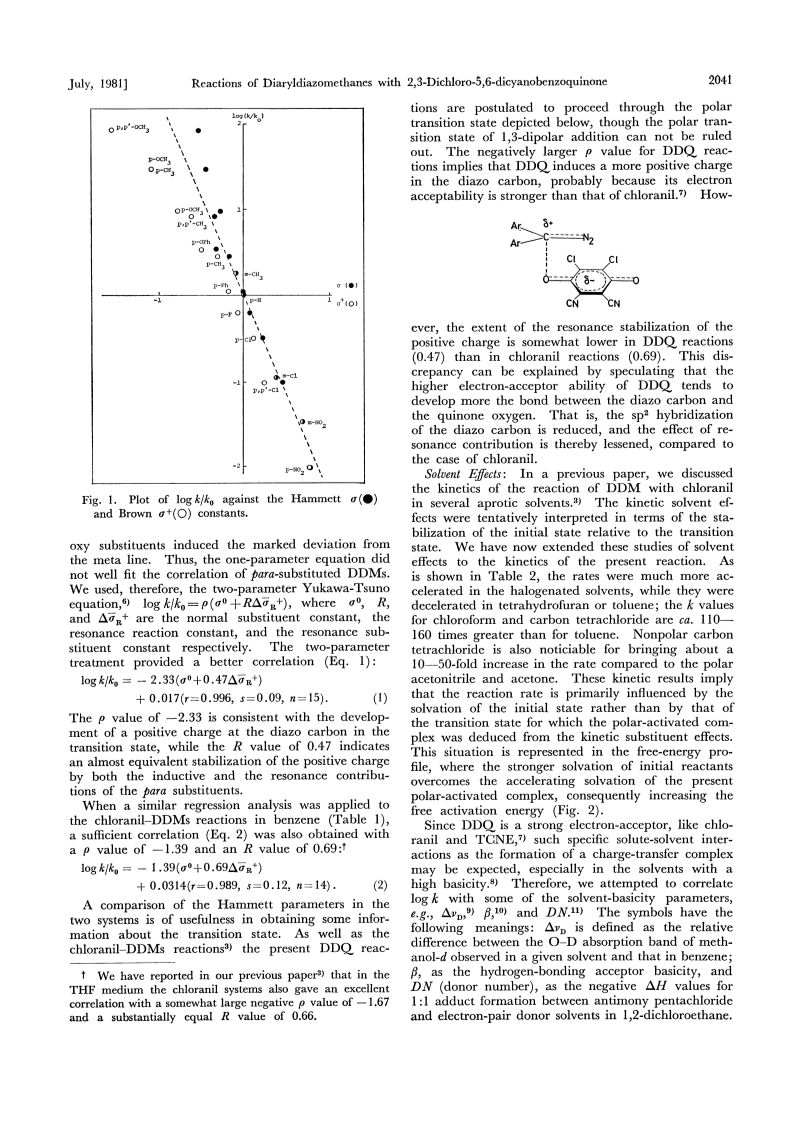
Kinetic studies have been made of the reactions of fifteen meta- and para-substituted diphenyldiazomethanes(DDMs) with 2,3-dichloro-5,6-dicyanobenzoquinone (DDQ) in benzene.The second order rate constants, k, increased with the electron-donability of the substituents, and the value could be correlated with the Yukawa-Tsuno equation: log k/k0 = -2.33(?0 + 0.47Δ<*>+) + 0.017, (r = 0.996, 30 deg C).The ρ value, -2.33, indicates the development of a positive charge at the diazo carbon in the transition state, while the R value, 0.47, confirms the moderate stabilization of the positive charge by the ?-electronic contribution of the para substituents.The rate constants have also been determined for the reaction of diphenyldiazomethane(DDM) with DDQ in 28 aprotic solvents.The effects of solvents can be interpreted in terms of the basicity and the steric nature of the solvents.The products of these reactions were poly(2,3-dichloro-5,6-dicyanohydroquinone benzhydryl ether)s, which were easily convertible into benzophenones and α,α-dimethoxydiphenylmethane, together with 2,3-dichloro,5,6-dicyanohydroquinone, under the influence of water and methanol.These solvolysis products were also obtained in excellent yields in the initial presence of these additives.
COMPARISON OF PHOTOINDUCED ELECTRON TRANSFER REACTIONS OF AROMATIC CARBONYL VS. CYANO COMPOUNDS WITH ELECTRON DONORS IN CONDENSED PHASE: THE IMPORTANCE OF THE SPIN STATE OF THE GEMINATE ION PAIR FOR OBTAINING HIGH ION YIELDS.
Haselbach, Edwin Vauthey, Eric Suppan, Paul
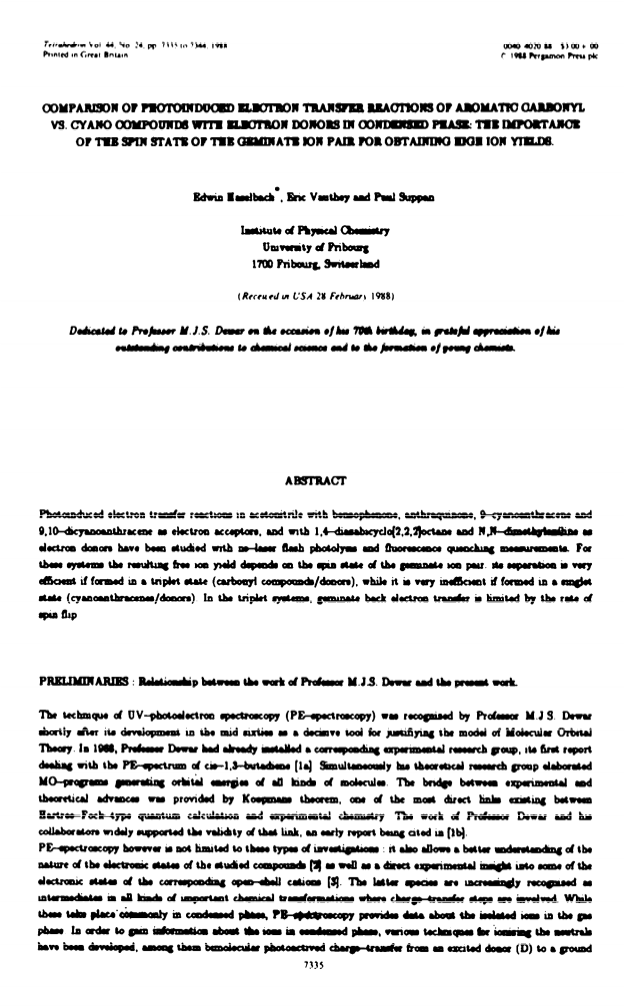
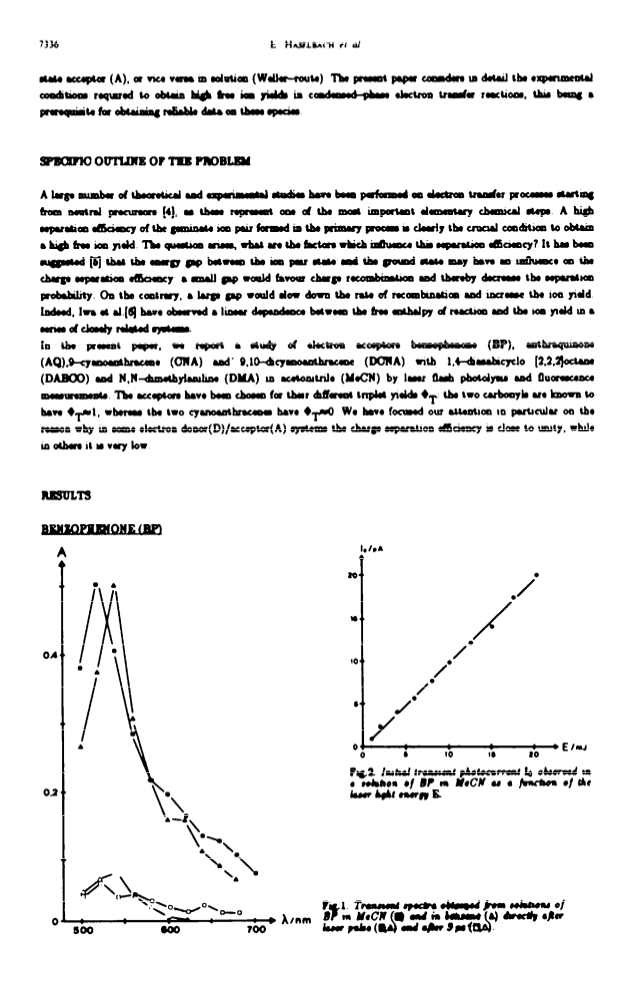
Photoinduced electron transfer reactions in acetonitrile with benzophenone, anthraquinone, 9-cyanoanthracene and 9,10-dicyanoanthracene as electron acceptors, and with 1,4-diazabicyclo<2,2,2>octane and N,N-dimethylaniline as electron donors have been studied with ns-laser flash photolysis and fluorescence quenching measurements.For these systems the resulting free ion yield depends on the spin state of the geminate ion pair: its separation is very efficient if formed in a triplet state (carbonyl compounds/donors), while it is very inefficient if formed in a singlet state (cyanoantracenes/donors).In the triplet systems, geminate back electron transfer is limited by the rate of spin flip.

 Ukraine | Contact:Gevorkyan Yurij Pari
 Switzerland | Contact:sir
 Spain | Contact:sir
 South Africa | Contact:sir
 Russian Federation | Contact:Chemiolux
 Netherlands | Contact:sir
 Japan | Contact:sir