
![6-(5-Chloro-2-pyridyl)-6,7-dihydro-7-hydroxy-5H-pyrrolo[3,4-b]pyrazin-5-one](http://file1.lookchem.com/cas/reactions/2021/05/25/754787.png)


![7-Chloromethyloxy-carbonyloxy-6-(5-chloropyridin-2-yl)-6,7-dihydro-5H-pyrrolo[3,4-b]pyrazin-5-one](http://file1.lookchem.com/cas/reactions/2021/06/28/9341908.png)


Relevant articles and documents
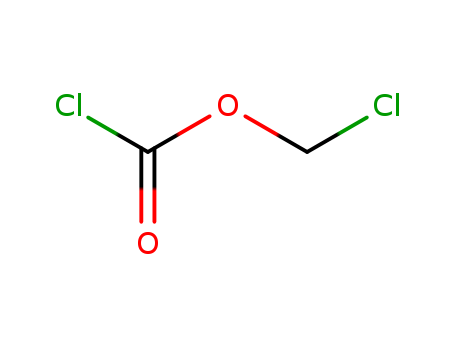
VIBRATIONAL SPECTRA AND CONFORMATIONAL ANALYSIS OF CHLOROMETHYCHLOROFORMATE
Daeyaert, F. Veken, B. J. van der
Infrared spectra of vapour and low temperature amorphous solid phases and Raman spectra of vapour, liquid and low temperature amorphous solid phases of ClCOOCH2Cl, ClCOOCD2Cl and ClCOOCDHCl are reported.The spectra indicate the presence of the same single conformer in each of these phases.Asymmetric top contour simulation of some vapour phase IR bands shows the conformer has s-cis orientation of the ester function and gauche orientation of the chloromethyl grouping.This conclusion is substantiated by the study of C-H and C-D stretches in mid-IR and near-IR spectra of ClCOOCHDCl in different phases.The assignments are augmented by a normal coordinate analysis using a transferable simplified valence force field.The latter is used to assign the splittings observed in the d1-derivative.


Water-mediated proton transfer: A mechanistic investigation on the example of the hydration of sulfur oxides
Loerting, Thomas Liedl, Klaus R.
We outline general mechanistic features of "water-mediated proton transfer" in the example of the isomerization reaction in hydrogen-bonded sulfur oxide-water supermolecules containing up to three water molecules. The nucleophilic attack of a water oxygen on the sulfur atom occurs concertedly with the (multiple) protontransfer event(s). The protons are transferred according to the well-known hydrogen-bond compression mechanism. However, contrary to "pure" multiple proton-transfer reactions, the protons are transferred asynchronously. These mechanistic features force the reaction to be classical rather than quantum-tunneling-dominated down to rather low temperatures. In the quantum-dominated temperature region, tunneling takes place only if all protons tunnel through the barrier. Straight line corner cutting (large curvature tunneling) does not dominate at any temperature, as the reduced mass corresponding to reaction coordinate motion does not drop to values low enough in the reaction barrier region. The asymmetric nature of the potential energy surface even allows different mechanisms involving transient H3O+ rotation termed "molecular swing" and a H2SO3 isomerization to be favorable compared to water-mediated triple proton transfer in the case of three participating water molecules.


 South Africa | Contact:AAron Thomas
 United States | Contact:Brenda
 United Kingdom | Contact:Sales
 China (Mainland) | Contact:gaoyan