



Relevant articles and documents
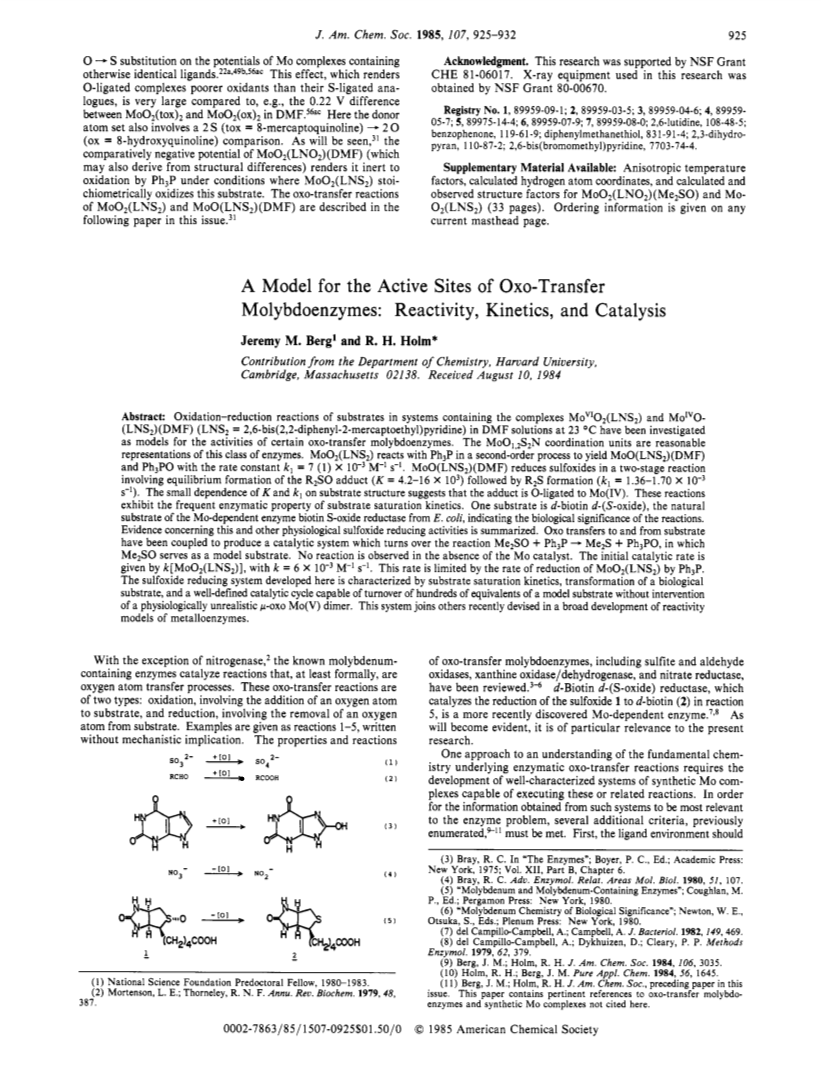
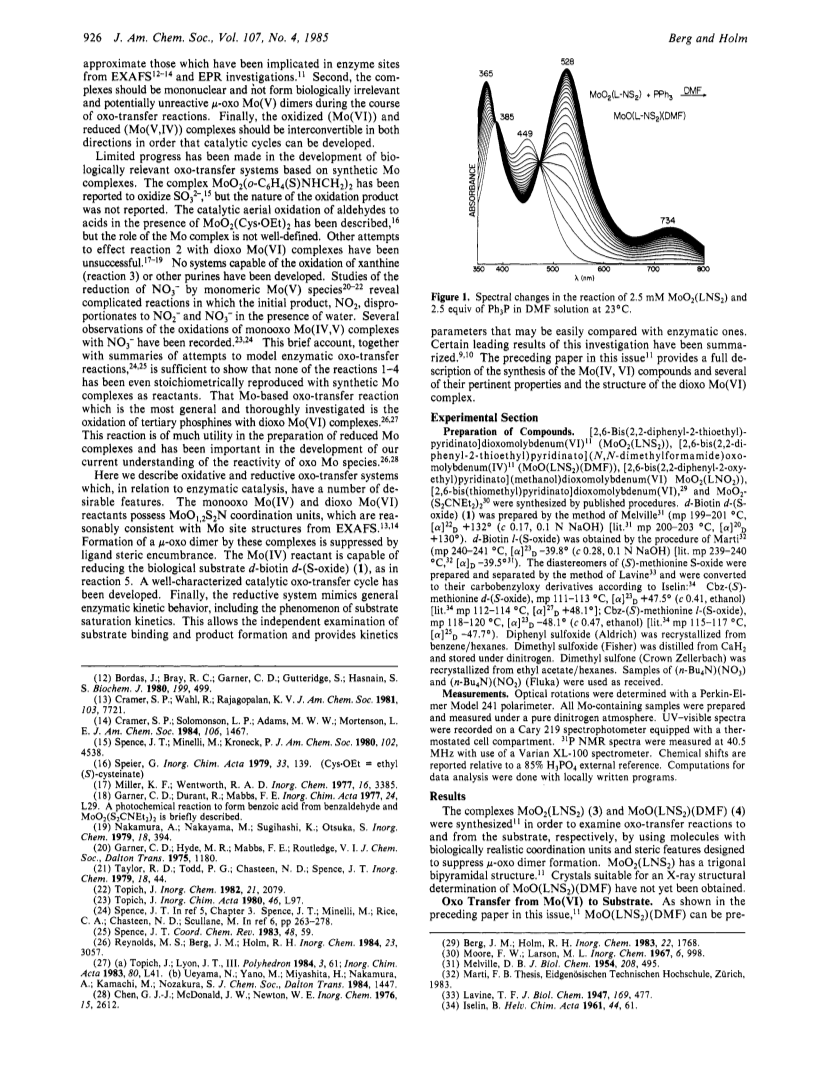
A Model for the Active Sites of Oxo-Transfer Molybdoenzymes: Reactivity, Kinetics, and Catalysis
Berg, Jeremy M. Holm, R. H.
Oxidation-reduction reactions of substrates in systems containing the complexes Mo(VI)O2(LNS2) and Mo(IV)O(LNS2)(DMF) (LNS2=2,6-bis(2,2-diphenyl-2-mercaptoethyl)pyridine) in DMF solutions at 23 deg C have been investigated as models for the activities of certain oxo-transfer molybdoenzymes.The MoO1,2S2N coordination units are resonable representations of this class of enzymes.MoO2(LNS2) reacts with Ph3P in a second-order process to yield MoO(LNS2)(DMF) and Ph3O with the rate constant k1=7(1)*10-3 M-1 s-1.MoO(LNS2)(DMF) reduces sulfoxides in a two-stage reaction involving equilibrium formation of the R2SO adduct (K=4.2-16*103) followed by R2S formation (k1=1.36-1.70*10-3 s-1).The small dependence of K and k1 on substrate structure suggests that the adduct is O-ligated to Mo(IV).These reactions exhibit the frequent enzymatic property of substrate saturation kinetics.One substrate is d-biotin d-(S-oxide), the natural substrate of the Mo-dependent enzyme biotin S-oxide reductase from E. coli, indicating the biological significance of the reactions.Evidence concerning this and other physiological sulfoxide reducing activities is summarized.Oxo transfers to and from substrate have been coupled to produce a catalytic system which turns over the reaction Me2SO+Ph3P->Me2S+Ph3PO, in which Me2SO serves as a model substrate.No reaction is observed in the absence of the Mo catalyst.The initial catalytic rate is given by k
 Thailand | Contact:Wassana Chaipa
 Switzerland | Contact:sir
 Russian Federation | Contact:sir
 Philippines | Contact:sir
 Netherlands | Contact:sir
 Japan | Contact:Sir
 Italy | Contact:sir