



Relevant articles and documents
Microwave-assisted synthesis of derivatives of khellinone under phase-transfer catalytic conditions
Hejchman, Elzbieta Maciejewska, Dorota Wolska, Irena
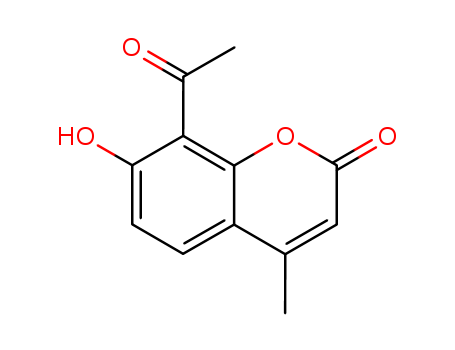
The microwave-assisted synthesis of four new 5-acetyl-4,7-dimethoxy-6- hydroxybenzofuran (khellinone) analogs is described. The structures of the obtained derivatives in the solid state are evaluated on the basis of 13C CP/MAS NMR spectra and theoretical calculations at DFT level. A single crystal X-ray diffraction structure is presented for 8-acetyl-7-hydroxy- 4-methylcoumarin. 1,4-Bis(5-acetyl-4,7-dimethoxybenzofuran-6-yloxy)butane was evaluated for potential anticancer activity in an in vitro screening panel of 60 human tumor cell lines. Selected leukemia, non-small cell lung cancer, CNS, melanoma, ovarian, and breast cancer cell lines were sensitive to this compound.


Antitumor and multikinase inhibition activities of some synthesized coumarin and benzofuran derivatives
Abd Elmageed, Zakaria Y. Abdelhafez, Omaima M. Ahmed, Eman Y. Ahmed, Yasmine H. Ali, Hamed I. El-Telbany, Rania Farag A. Serry, Aya M. Zaafar, Dalia
Two new series of coumarin and benzofuran derivatives were designed, synthesized, and assessed for their in vitro and in vivo antitumor activities against breast cancer. Compounds 8, 9, 14, 15, and 17 exhibited the best antiproliferative activities (IC50: 0.07?2.94 μM) against the MCF-7 cell line, compared with lapatinib (IC50: 4.69 μM). Compound 14, with the most potent cytotoxic activity against MCF-7 cells, was capable of enhancing preG1 apoptosis and triggering cell cycle arrest at the G2/M phase. The kinase inhibitory activity of compound 14 against a panel of 22 kinases was examined to reveal multikinase inhibition within ?39% to ?97%. Furthermore, compound 14 exhibited potent in vivo Ehrlich (mammary adenocarcinoma) tumor regression, positive caspase-3, and negative EGFR immunoreaction, and was capable of elevating the catalase level. The physicochemical properties and pharmacokinetic parameters of compound 14 were investigated in silico for its druglikeness.
 Switzerland | Contact:sir
 Italy | Contact:sir
 India | Contact:Sridhara Mishra
 Austria | Contact:sir
 United States | Contact:sir