
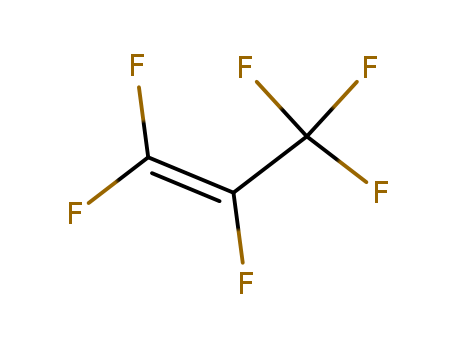


Relevant articles and documents
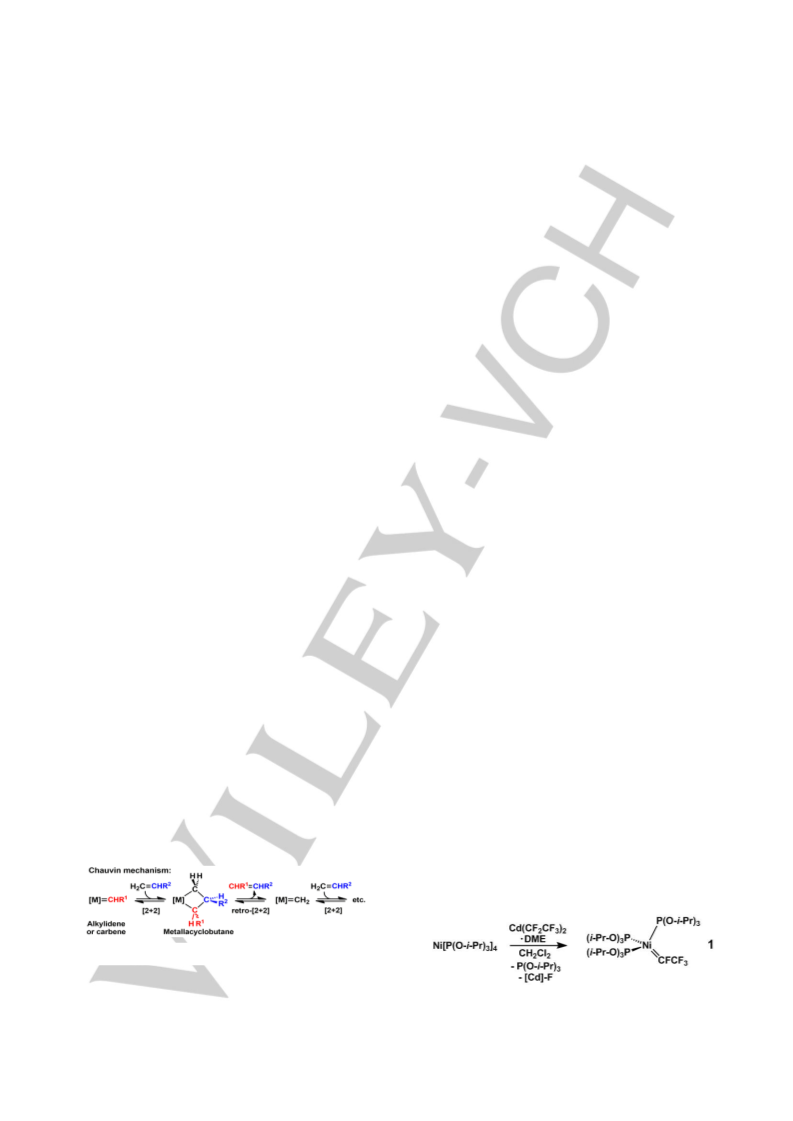
Nickel Fluorocarbene Metathesis with Fluoroalkenes
Harrison, Daniel J. Daniels, Alex L. Guan, Jia Gabidullin, Bulat M. Hall, Michael B. Baker, R. Tom
Alkene metathesis with directly fluorinated alkenes is challenging, limiting its application in the burgeoning field of fluoro-organic chemistry. A new nickel tris(phosphite) fluoro(trifluoromethyl)carbene complex ([P3Ni]=CFCF3) reacts with CF2=CF2 (TFE) or CF2=CH2 (VDF) to yield both metallacyclobutane and perfluorocarbene metathesis products, [P3Ni]=CF2 and CR2=CFCF3 (R=F, H). The reaction of [P3Ni]=CFCF3 with trifluoroethylene also yields metathesis products, [P3Ni]=CF2 and cis/trans-CFCF3=CFH. However, unlike reactions with TFE and VDF, this reaction forms metallacyclopropanes and fluoronickel alkenyl species, resulting presumably from instability of the expected metallacyclobutanes. DFT calculations and experimental evidence established that the observed metallacyclobutanes are not intermediates in the formation of the observed metathesis products, thus highlighting a novel variant of the Chauvin mechanism enabled by the disparate four-coordinate transition states.


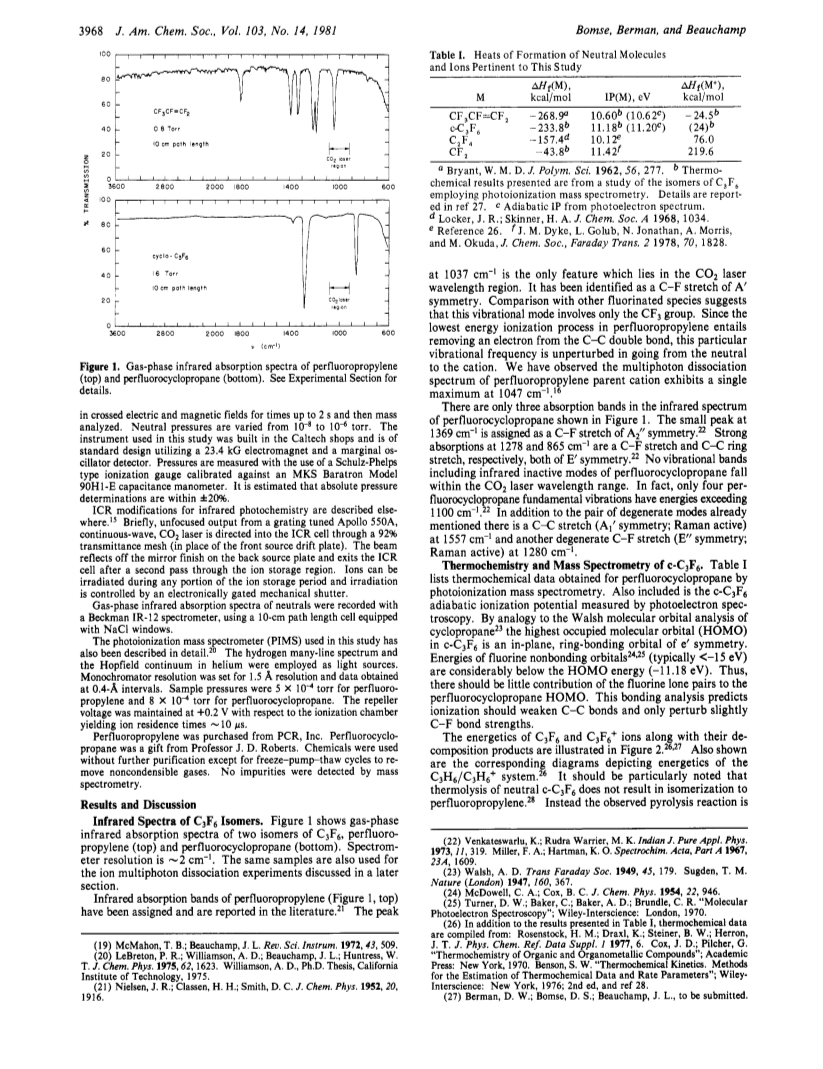
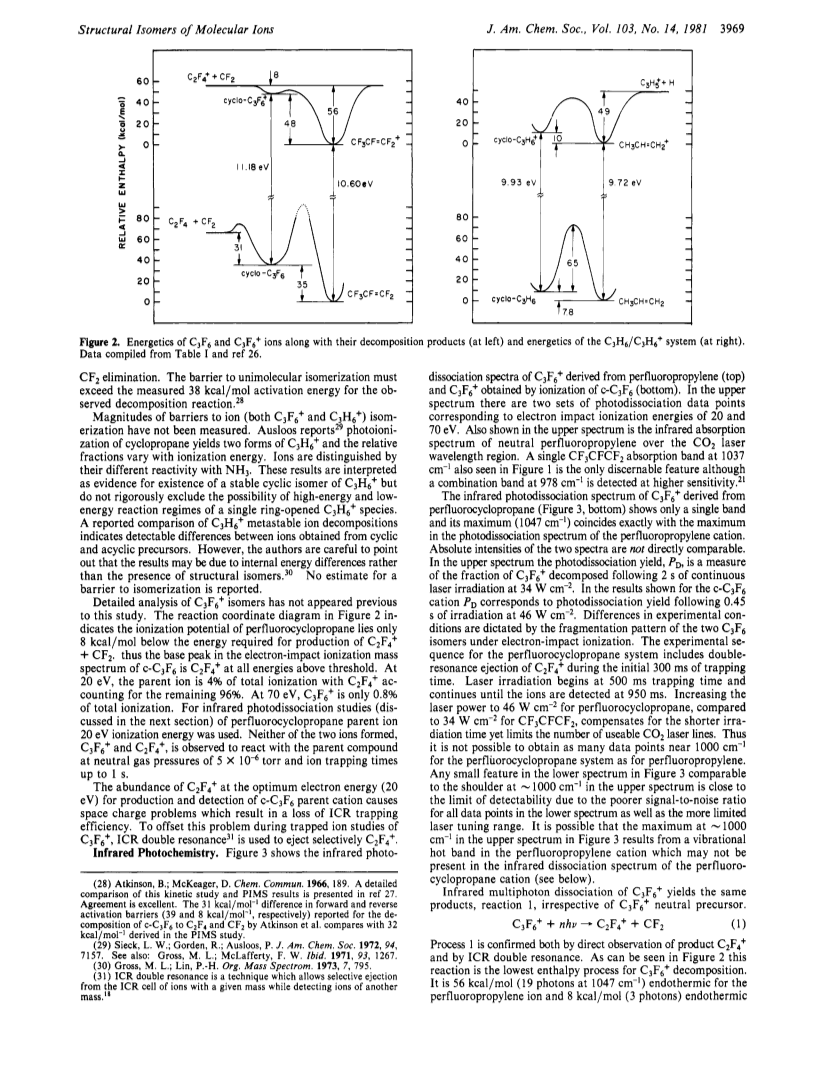
Energetics of the Rearrangement of Neutral and Ionized Perfluorocyclopropane to Perfluoropropylene. Use of Infrared Multiphoton Dissociation Spectra To Identify Structural Isomers of Molecular Ions
Bomse, D. S. Berman, D. Wayne Beauchamp, J. L.
Infrared photodissociation spectroscopy is used to compare the structure of gas-phase C3F6+ ions obtained by electron-impact ionization of two isomeric precursors: perfluoropropylene and perfluorocyclopropane.Photodissociation spectra are obtained by observing the extent of multiphoton dissociation as the CO2 laser is tuned across the 925-1080 cm-1 wavelength range.Ions are formed, stored, and detected with the use of techniques of ion cyclotron resonance spectroscopy.Infrared multiphoton exitation is effected by using low-power, continuous-wave laser radiation.The "fingerprint" spectrum of the molecular ion of pefluorocyclopropane is identical with that obtained from perfluoropropylidene, indicating rearrangement of the former to the latter.Photodissociation kinetics indicate that the entire perfluorocyclopropane molecular ion population isomerizes to the more stable perfluoropropylene structure.Thermochemistry of C3F6 and C3F6+ isomers is discussed.Comparisons are made with the analogous C3H6 system.Photoionization mass spectroscopy results yield ΔHf(c-C3F6) = -233.8 kcal/mol.
 China (Mainland) | Contact:Albert Chen