




Relevant articles and documents
Enhanced cytotoxicity of indenyl molybdenum(ii) compounds bearing a thiophene function
Mrózek, Ond?ej Melounková, Lucie Dostál, Libor Císa?ová, Ivana Eisner, Ale? Havelek, Radim Peterová, Eva Honzí?ek, Jan Vinklárek, Jaromír
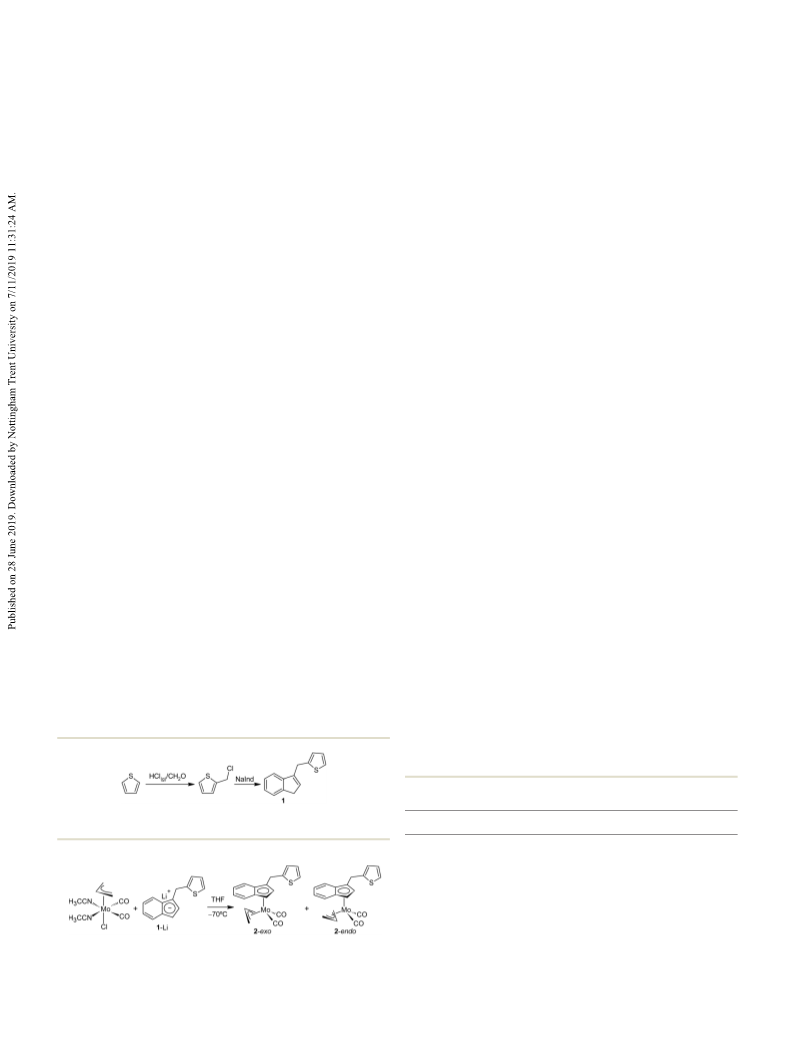
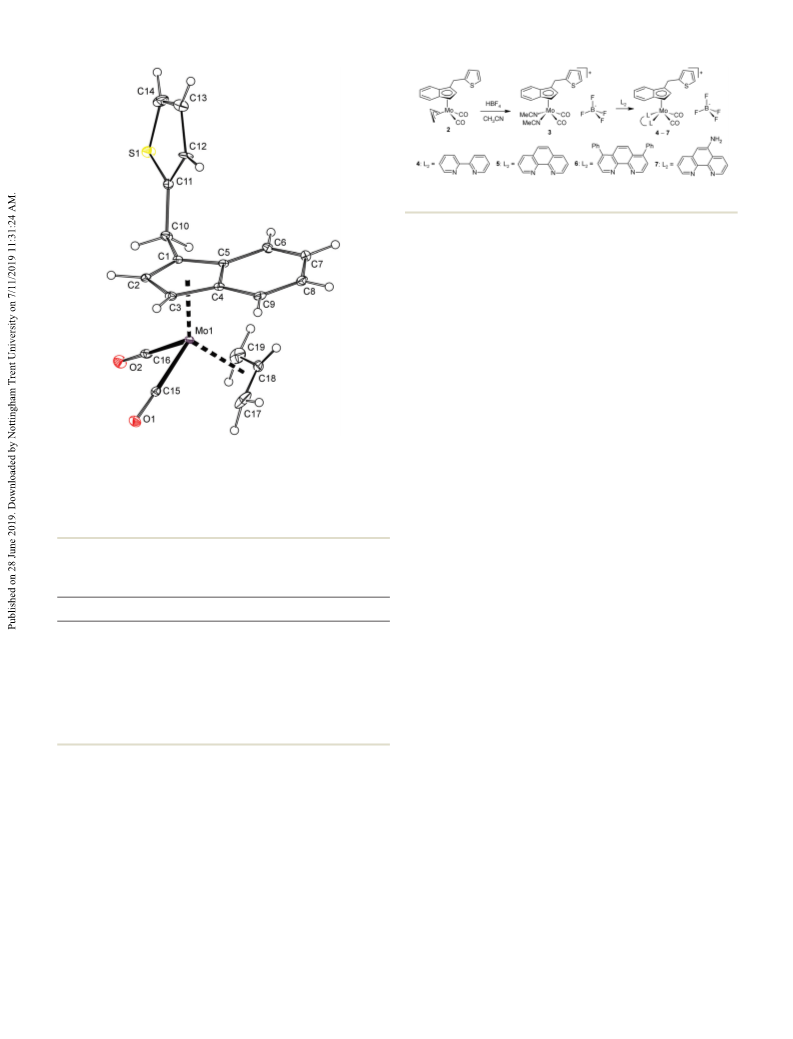
A series of six indenyl molybdenum compounds bearing a thiophenyl function in the side chain were prepared and characterized by analytical and spectroscopic methods. The structures of [(η5-C9H6CH2C4H3S)(η3-C3H5)Mo(CO)2] and [(η5-C9H6CH2C4H3S)Mo(CO)2(bpy)][BF4] were determined by single-crystal X-ray diffraction. The compounds bearing N,N-chelating ligands exhibit increased cytotoxic activity against human leukemia cell lines MOLT-4; up to two orders of magnitude lower IC50 values were observed compared to analogues with unsubstituted indenyl, which clearly demonstrates the strong effect of the indenyl ligand modification on the biological activity of the molybdenum(ii) compounds. The highest cytostatic potential was observed for the complex bearing 4,7-diphenyl-1,10-phenanthtoline [(η5-C9H6CH2C4H3S)Mo(CO)2(Ph2phen)][BF4] with IC50 (MOLT-4) = 0.19 ± 0.02 μM. Detailed regulation of the molecular and cellular mechanism by this derivative was investigated on the lung carcinoma cell line A549 and compared with the lung fibroblast cell line MRC-5. Rather unusual differences in the effects on tumor and non-tumor cell lines provide a unique insight into the cytostatic action of molybdenum(ii) complexes.

Diethyl(thiophen-2-ylmethyl)phosphonate: A novel multifunctional electrolyte additive for high voltage batteries
Zhu, Yunmin Luo, Xueyi Zhi, Huozhen Liao, Youhao Xing, Lidan Xu, Mengqing Liu, Xiang Xu, Kang Li, Weishan
Carbonate-based electrolytes used in Li-ion batteries encounter various challenges in extreme electrochemical environments, and hence their application requires various additives, especially when used with high voltage cathode materials. These additives are designed to form protective interphases that prevent parasitic carbonate oxidation, while in certain cases they stabilize electrolytes from reduction at anode surfaces or even serve as flame-retardants that postpone the thermal runaway during overcharge. However, most of these additives casts negative effects, lowering ionic conductivity of electrolyte or impairing the compatibility between cathode and electrolyte. An ideal solution of minimizing the presence of these inert molecules is to identify an additive that structurally integrates these multiple functions into a single compound. In this work, we report a novel additive, diethyl(thiophen-2-ylmethyl)phosphonate (DTYP). Its 0.5% presence in a base electrolyte dramatically improves the capacity retention of a high voltage Li-ion cell using LiNi0.5Mn1.5O4 from 18% to 85% after 280 cycles at 1C at 60 °C, increases the endothermic reaction onset temperature from 193 °C to 223 °C, and reduces the self-extinguishing time of the electrolyte from 88 s to 77 s. Thus, such a multifunctional additive presents a cost-efficient solution to the issues often faced in high voltage lithium-ion batteries.


 United States | Contact:Brenda
 United Kingdom | Contact:sir
 China(Hongkong) | Contact:Great Dragon
 China (Mainland) | Contact:shui