



Relevant articles and documents
Keto-salicylaldehyde azine: Asymmetric substituent effect on their optical properties via electron-donating group insertion
Tong, Jialin Zhang, Kexin Wang, Jing Li, Hui Zhou, Fan Wang, Zhiming Zhang, Xiaojuan Tang, Ben Zhong
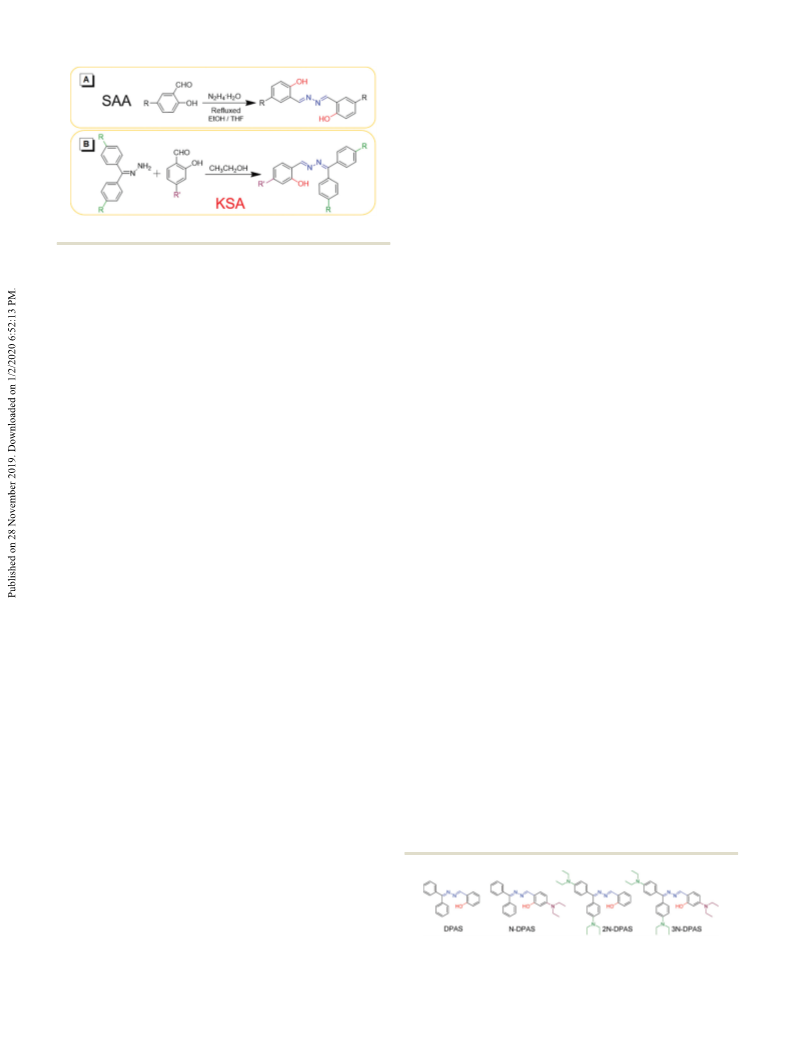
Organic fluorescent probes have attracted increasing attention owing to their high sensitivity and recognition ability, structurally adjustable flexibility and manifestation in the form of visualization. Salicylaldehyde azine (SAA) and its derivatives exhibit a great potential for practical applications, but the synthesis of SAA asymmetric compounds in low yields, serving multiple functions, is cumbersome. As an alternative building block, Keto-Salicylaldehyde Azine (KSA) was developed by our group for constructing various AIEgens via an excited state intramolecular proton transfer (ESIPT) process to detect some cellular organelles and specific metal ions. For illuminating the structure-property relationship of the two asymmetric sides in a KSA unit, DPAS was employed as a model and the N,N-diethyl group with electron-donating effects was introduced on its salicylaldehyde side (S-terminal) and diphenylketone side (K-terminal). Three new derivatives were obtained and showed different photophysical properties, particularly in AIE performance and metal ion responsiveness, implying that their intrinsic electronic structure can be easily affected by the asymmetric substitution effect. Therefore, this study is a meaningful and valuable reference for KSA modification on expanding fluorescent probes with various functions via the purposeful regulation of their chemical structure, by either modifying the K-terminal or the S-terminal.


Anti-glycemic potential of benzophenone thio/semicarbazone derivatives: synthesis, enzyme inhibition and ligand docking studies
Arshia Fayyaz, Sharmeen Shaikh, Muniza Khan, Khalid Mohammed Choudhary, M. Iqbal
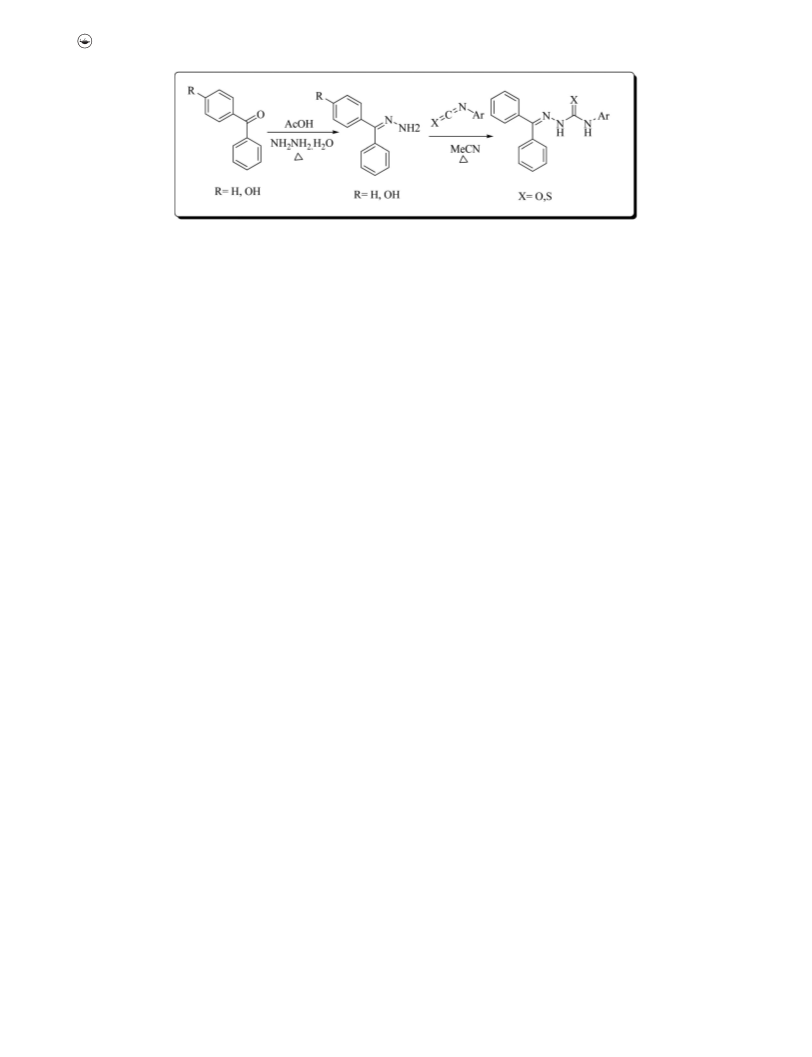
Inhibition of dipeptidyl peptidase-IV (DPP-IV) has been identified as a promising approach for the treatment of type 2 diabetes mellitus (T2DM). Therefore, development of DPP-IV inhibitors with new chemical scaffold is of utmost importance to medicinal chemistry. In the present study, we identified benzophenone thio- and semicarbazone scaffolds as novel DPP-IV inhibitors. For that purpose, benzophenone thio- and semicarbazone were synthesized through a 2-step reaction. These newly synthetic derivatives were characterized by different spectroscopic techniques, including HREI-MS and NMR. whereas stereochemistry of the iminic bond was predicted by NOESY experiments. Thio- and semicarbazones derivatives were evaluated for their DPP-IV inhibitory potential and found to exhibit a good to moderate enzyme inhibitory activity. Most active and non-cytotoxic derivatives were further evaluated for their DPP-IV inhibitory potential in in cellulo model. The binding sites as well as affinity of active compounds for DPP- IV enzyme were predicted by in silico studies, and compared to a standard drug, sitagliptin. Pharmacophore studies of thio- and semicarbazones derivatives 1–29 suggest that substitution of aryl group, particularly a lipophilic substituents at C-4″ of benzene ring, and a hydroxyl at C-4′ strongly influenced the DPP-IV inhibitory activity. Compound 9 showed the highest inhibitory activity (IC50 = 15.0 ± 0.6 μM), whereas compounds 10, 17, 12, 14 and 23 showed a moderate activity with IC50 values in the range of 28.9–39.2 μM. This study identifies thio- and semicarbazones as new classes of DPP-IV inhibitors which may translate into safe and effective therapeutics for a better management of type 2 diabetes. Communicated by Ramaswamy H. Sarma.


 Switzerland | Contact:sir
 South Africa | Contact:AAron Thomas
 Netherlands | Contact:Specs
 Japan | Contact:sir
 India | Contact:sir