



Relevant articles and documents
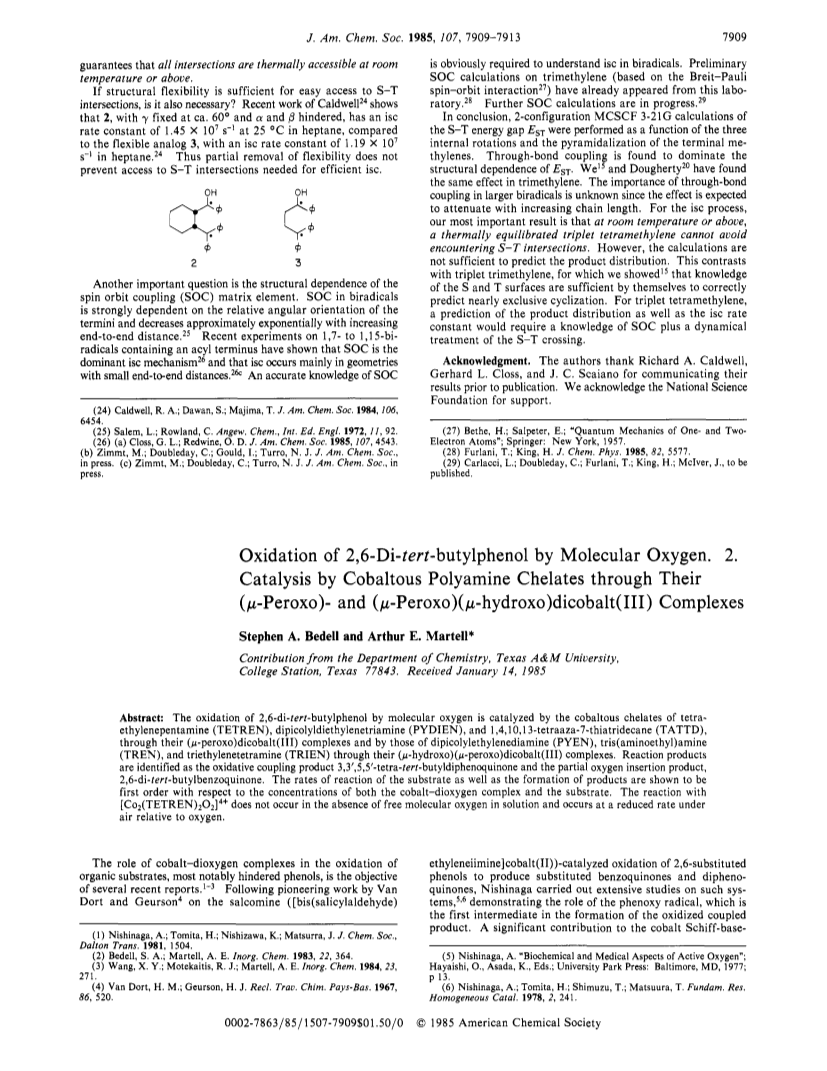
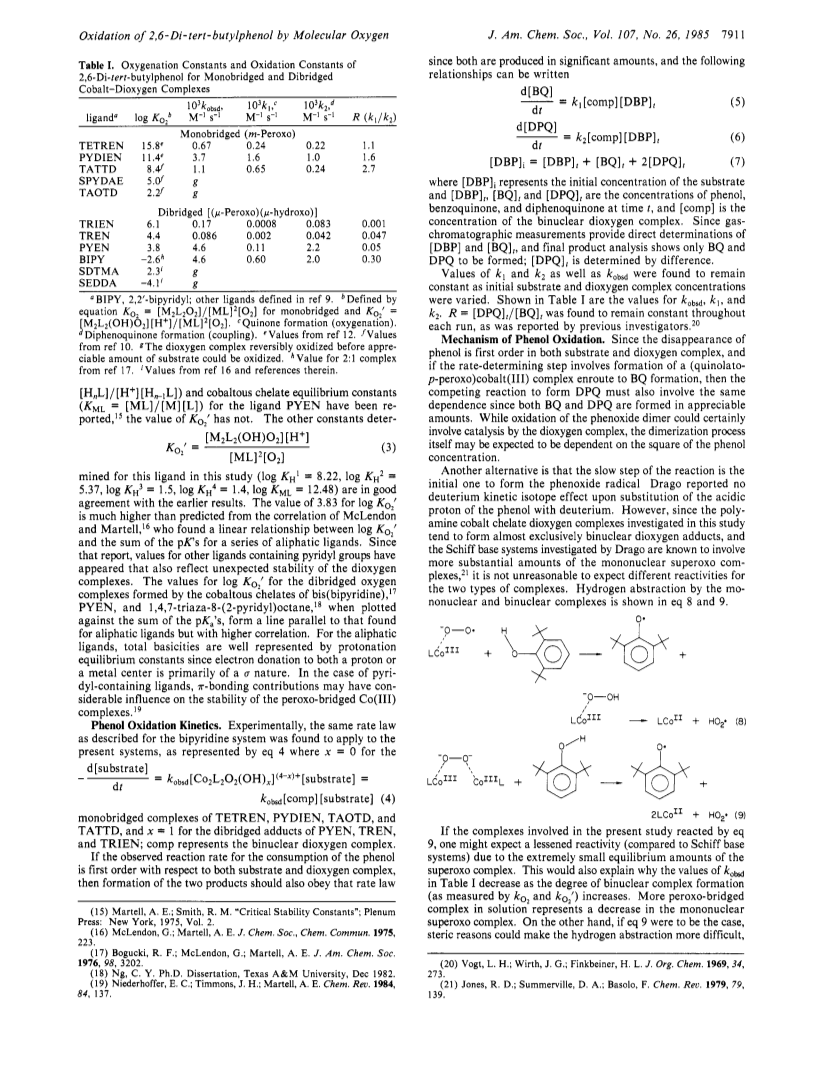
Oxidation of 2,6-Di-tert-butylphenol by Molecular Oxygen. 2. Catalysis by Cobaltous Polyamine Chelates through Their (μ-Peroxo)- and (μ-Peroxo)(μ-hydroxo)dicobalt(III) Complexes
Bedell, Stephen A. Martell, Arthur E.
The oxidation of 2,6-di-tert-butylphenol by molecular oxygen is catalyzed by the cobaltous chelates of tetraethylenepentamine (TETREN), dipicolyldiethylenetriamine (PYDIEN), and 1,4,10,13-tetraaza-7-thiatridecane (TATTD), through their (μ-peroxo)dicobalt(III) complexes and by those of dipicolylethylenediamine (PYEN), tris(aminoethyl)amine (TREN), and triethylenetetramine (TRIEN) through their (μ-hydroxo)(μ-peroxo)dicobalt(III) complexes.Reaction products are identified as the oxidative coupling product 3,3'5,5'-tetra-tert-butyldiphenoquinone and the partial oxygen insertion product, 2,6-di-tert-butylbenzoquinone.The rates of reaction of the substrate as well as the formation of products are shown to be first order with respect to the concentrations of both the cobalt-dioxygen complex and the substrate.The reaction with

Formation and properties of a catalyst based on sodium and potassium hydroxides in the reaction of 2,6-di-tert-butylphenol with methyl acrylate
Volod'kin Zaikov
The nature of the cation (K+ or Na+) in hydroxides affects the temperature plot of the equilibrium constant of the reaction of KOH and NaOH with 2,6-di-tert-butylphenol (ArOH) and the conversion of KOH and (or) NaOH to potassium or sodium 2,6-di-tert-butyl phenoxides, which are catalysts for the alkylation of ArOH by methyl acrylate. The kinetic method for determination of the composition of the catalyst formed from NaOH and ArOH was proposed. The nature of the cation in phenoxides ArOK or ArONa is a factor determining the kinetics of the reaction of ArOH with methyl acrylate. Two different kinetic schemes were proposed to describe the transformation of ArOH in the presence of ArONa or ArOK.


 South Africa | Contact:AAron Thomas
 Netherlands | Contact:Robert Peters
 Lithuania | Contact:Denis
 India | Contact:Jyoti
 Germany | Contact:Romesh
  Estonia | Contact:sir
 Andorra | Contact:SIR
 United States | Contact:SCHENECT