




Relevant articles and documents
KINETICS OF SUBSTITUTION OF 4-METHOXYPHENYLAZO GROUPS OF 2,6-DIOXO-5(3)-(4-METHOXYPHENYLAZO)-3(5)-(4-METHOXYPHENYLHYDRAZONO)-1,2,3,6-TETRAHYDROPYRIDINE-4-CARBOXYLIC ACID BY REACTION WITH 4-NITROBENZENEDIAZONIUM CATION
Horackova, Jaroslava Sterba, Vojeslav
Kinetics have been studied of gradual replacement of 4-methoxyphanylazo group in 2,6-dioxo-5(3)-(4-methoxyphenylazo)-3(5)-(4-methoxyphenylhydrazono)-1,2,3,6-tetrahydropyridine-4-carboxylic acid (IIIa) by 4-nitrobenzenediazonium cation (IIc) in acetate and phosphate buffers.The rate constant of replacement of the second methoxyphenylazo group is lower by a factor of ca.60.From the experimentally found pKa values of the corresponding azohydrazone compounds with methoxy, chloro, or nitro substituent at 4-position (IIIa-IIIf) it has been concluded that the 5(3)-(4-methoxyphenylazo)-3(5)-(4-nitrophenylhydrazono) derivative is formed in the first step.
Application of visible light photocatalysis with particle lithography to generate polynitrophenylene nanostructures
Verberne-Sutton, Susan D. Quarels, Rashanique D. Zhai, Xianglin Garno, Jayne C. Ragains, Justin R.
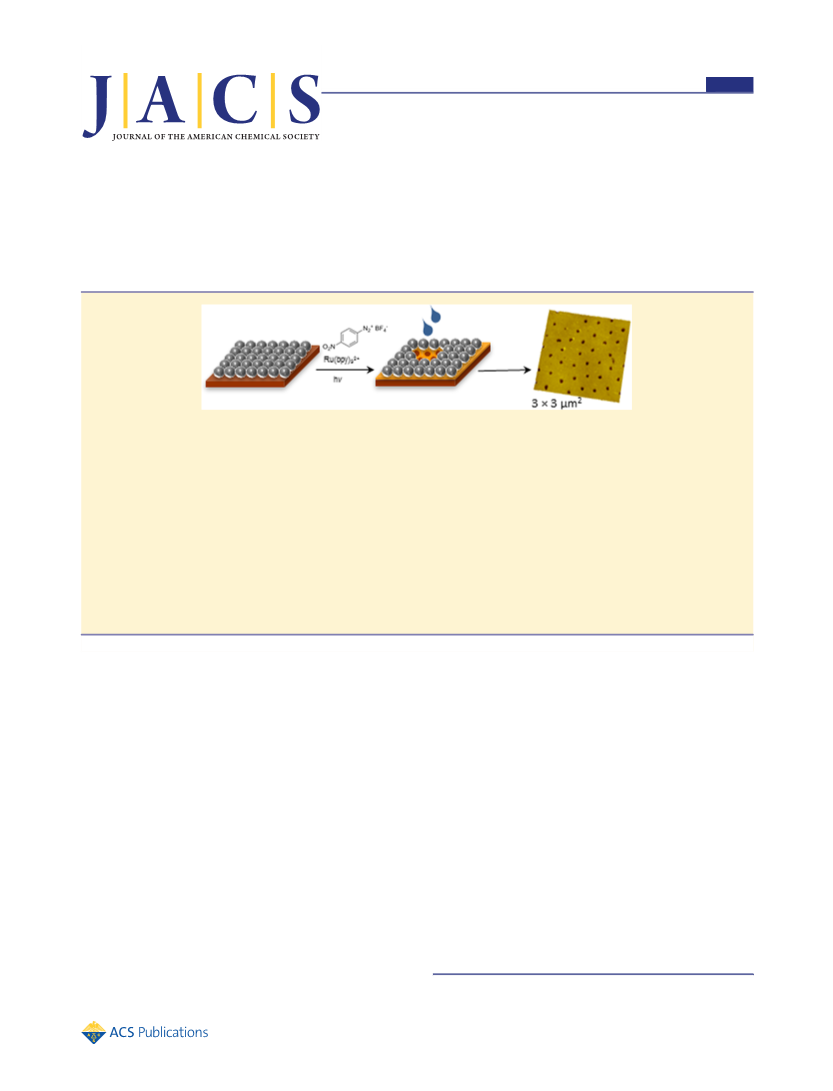
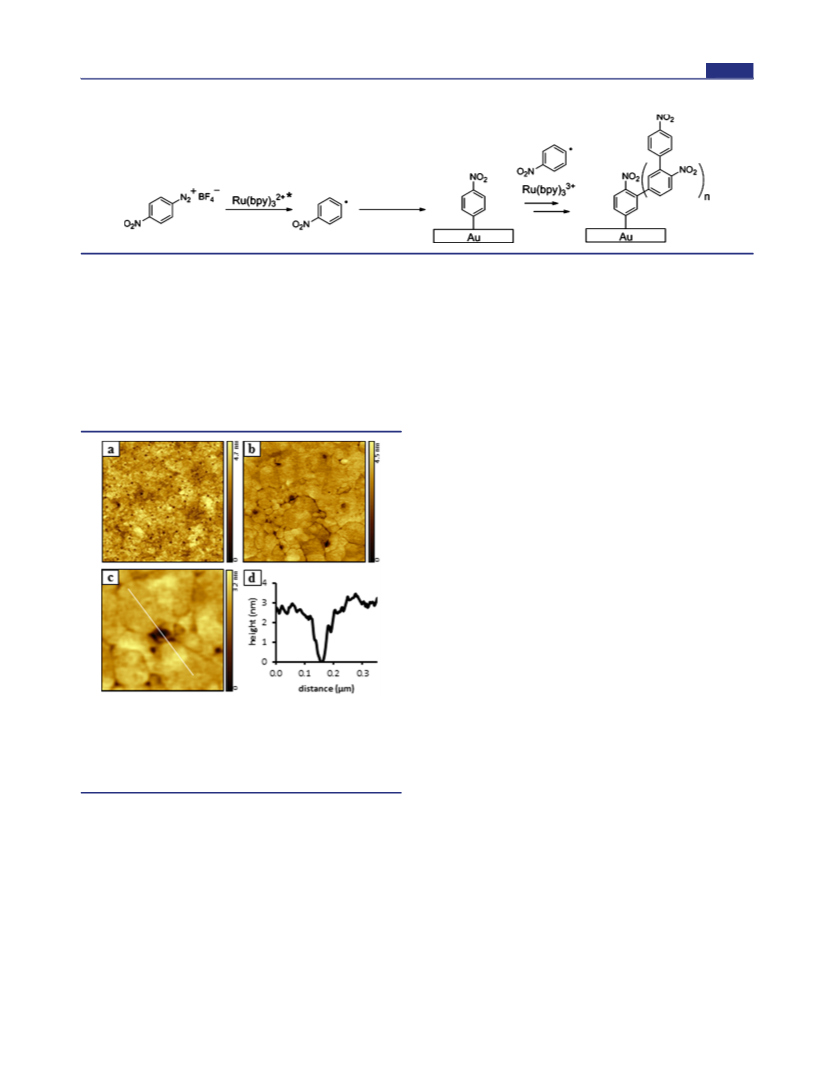
Visible light photoredox catalysis was combined with immersion particle lithography to prepare polynitrophenylene organic films on Au(111) surfaces, forming a periodic arrangement of nanopores. Surfaces masked with mesospheres were immersed in solutions of p-nitrobenzenediazonium tetrafluoroborate and irradiated with blue LEDs in the presence of the photoredox catalyst Ru(bpy)3(PF6)2 to produce p-nitrophenyl radicals that graft onto gold substrates. Surface masks of silica mesospheres were used to protect small, discrete regions of the Au(111) surface from grafting. Nanopores were formed where the silica mesospheres touched the surface; the mask effectively protected nanoscopic local areas from the photocatalysis grafting reaction. Further reaction of the grafted arenes with aryl radicals resulted in polymerization to form polynitrophenylene structures with thicknesses that were dependent on both the initial concentration of diazonium salt and the duration of irradiation. Photoredox catalysis with visible light provides mild, user-friendly conditions for the reproducible generation of multilayers with thicknesses ranging from 2 to 100 nm. Images acquired with atomic force microscopy (AFM) disclose the film morphology and periodicity of the polymer nanostructures. The exposed sites of the nanopores provide a baseline to enable local measurements of film thickness with AFM. The resulting films of polynitrophenylene punctuated with nanopores provide a robust foundation for further chemical steps. Spatially selective binding of mercaptoundecanoic acid to exposed sites of Au(111) was demonstrated, producing a periodic arrangement of thiol-based nanopatterns within a matrix of polynitrophenylene.

 India | Contact:Pharmachem
 Germany | Contact:Interchim S.A.
 China (Mainland) | Contact:Allen Wang