Cobalt
Cobalt General
| Name:Cobalt | Symbol:Co |
| Type:Transition Metal | Atomic weight:58.9332 |
| Density @ 293 K: 8.90 g/cm3 | Atomic volume:6.7 cm3/mol |
|
Discovered:
Since ancient times cobalt compounds have been used to produce blue glass and ceramics. The element was first isolated by George Brandt in 1735. The word cobalt is derived from the German 'kobold', meaning goblin or elf. |
|
Cobalt States
| State (s, l, g):solid | |
| Melting point:1768 K (1495 °C) | Boiling point:3203 K (2930 °C) |
Cobalt Energies
| Specific heat capacity: 0.42 J g-1 K-1 | Heat of atomization:426 kJ mol-1 |
| Heat of fusion:16.190 kJ mol-1 | Heat of vaporization :373.3 kJ mol-1 |
| 1st ionization energy:758.4 kJ mol-1 | 2nd ionization energy:1646 kJ mol-1 |
| 3rd ionization energy:3232.2 kJ mol-1 | Electron affinity:63.8 kJ mol-1 |
Cobalt Oxidation & Electrons
| Shells:2,8,15,2 | Electron configuration:[Ar] 3d7 4s2 |
| Minimum oxidation number:-1 | Maximum oxidation number:5 |
| Min. common oxidation no.:0 | Max. common oxidation no.:3 |
| Electronegativity (Pauling Scale):1.88 | Polarizability volume:7.5 Å3 |
Cobalt Appearance & Characteristics
| Structure:hcp: hexagonal close pkd | Color:bluish-white |
| Hardness:5.0 mohs | |
|
Harmful effects:
Cobalt and its compounds are considered to be slightly toxic. |
|
|
Characteristics:
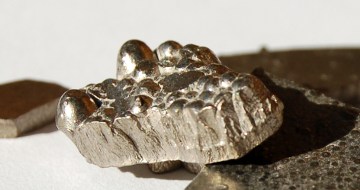
Cobalt is a bluish-white, lustrous, hard, brittle metal. It is ferromagnetic. Uses: Cobalt is used in alloys for aircraft engine parts and in alloys with corrosion/wear resistant uses. |
|
Cobalt Reactions
| Reaction with air:mild, w/ht ⇒ Co3O4 | Reaction with 6 M HCl:mild ⇒ H2, CoCl2 |
| Reaction with 15 M HNO3:vigorous, ⇒ Co(No3)2, Nox | Reaction with 6 M NaOH: |
Cobalt Compounds
| Oxide(s):CoO, Co3O4 | Chloride(s):CoCl2 |
| Hydride(s):None |
Cobalt Radius
| Atomic radius:135 pm | Ionic radius (1+ ion):pm |
| Ionic radius (2+ ion):83.8 pm | Ionic radius (3+ ion):71.8 pm |
| Ionic radius (2- ion):pm | Ionic radius (1- ion):pm |
Cobalt Conductivity
| Thermal conductivity: 100 W m-1 K-1 | Electrical conductivity:17.9 x 10⁶ S m-1 |
Cobalt Abundance & Isotopes
| Abundance earth's crust:25 parts per million by weight, 8 parts per million by moles | |
| Abundance solar system:4 parts per million by weight, 0.7 parts per million by moles | |
| Cost, pure:$21 per 100g | |
| Cost, bulk:$4.40 per 100g | |
|
Source:
Cobalt is not found as a free element in nature. It is found in mineral ores. The main ores of cobalt are cobaltite (CoAsS), erythrite (hydrated arsenate of cobalt), glaucodot (Co,Fe)AsS, and skutterudite (Co,Ni)As3. Cobalt is generally produced as a by-product of nickel and copper mining. |
|
|
Isotopes:
Cobalt has 22 isotopes whose half-lives are known, with mass numbers 50 to 72. Of these, only one is stable, 59Co. |
|
Cobalt Other
|
Other:
|
|
Prev: Iron Next: Nickel |