Welcome to LookChem.com Sign In|Join Free
  • or

Encyclopedia

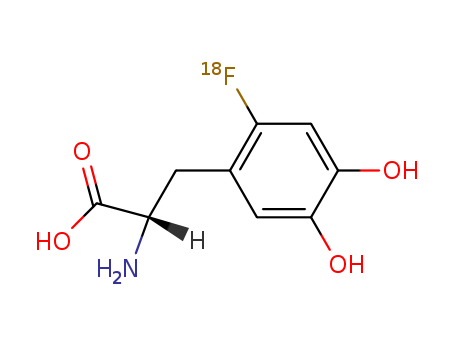
Fluorodopa (18F)

Base Information
  • Chemical Name:Fluorodopa (18F)
  • CAS No.:92812-82-3
  • Deprecated CAS:167569-09-7,97097-51-3,191087-23-7
  • Molecular Formula:C9H10 F N O4
  • Molecular Weight:214.183
  • Hs Code.:
  • UNII:2C598205QX
  • DSSTox Substance ID:DTXSID60239157
  • Wikidata:Q27121509
  • NCI Thesaurus Code:C95766
  • RXCUI:2571853
  • Metabolomics Workbench ID:154626
  • ChEMBL ID:CHEMBL3400972
  • Mol file:92812-82-3.mol
Fluorodopa (18F)

Synonyms:(18)F-dopa;18F-FDOPA;2-fluoro-5-hydroxytyrosine;3,4-dihydroxy-6-fluorophenylalanine;3-(2-fluoro-(18)F-4,5-dihydroxyphenyl)-L-alanine;6-(18F)fluoro-L-3,4-dihydroxyphenylalanine;6-(18F)fluoro-L-DOPA;6-fluoro-DOPA;6-fluorodopa;fluorodopa;fluorodopa F 18;fluorodopa F 18, (18)F-labeled cpd;fluorodopa F-18

Suppliers and Price of Fluorodopa (18F)
Supply Marketing:
Business phase:
The product has achieved commercial mass production*data from LookChem market partment
Manufacturers and distributors:
  • Manufacture/Brand
  • Chemicals and raw materials
  • Packaging
  • price
Total 6 raw suppliers
Chemical Property of Fluorodopa (18F)
Chemical Property:
  • Refractive Index:1.629 
  • Boiling Point:°Cat760mmHg 
  • Flash Point:°C 
  • PSA:103.78000 
  • Density:1.553g/cm3 
  • LogP:0.89160 
  • XLogP3:-2
  • Hydrogen Bond Donor Count:4
  • Hydrogen Bond Acceptor Count:6
  • Rotatable Bond Count:3
  • Exact Mass:214.061920
  • Heavy Atom Count:15
  • Complexity:238
Purity/Quality:

96% *data from raw suppliers

Safty Information:
  • Pictogram(s):  
  • Hazard Codes: 
MSDS Files:

SDS file from LookChem

Useful:
  • Canonical SMILES:C1=C(C(=CC(=C1O)O)F)CC(C(=O)O)N
  • Isomeric SMILES:C1=C(C(=CC(=C1O)O)[18F])C[C@@H](C(=O)O)N
  • Recent ClinicalTrials:Clinical Laboratory Evaluation of Chronic Autonomic Failure
  • Recent EU Clinical Trials:EVALUATION CLINIQUE DE LA 18 F-F DOPA EN TOMOGRAPHIE PAR EMISSION DE POSITONS
  • Uses Diagnostic aid (brain imaging); radioactive agent. Note—This radiopharmaceutical, labeled with a cyclotron-generated radionuclide, is prepared in individual nuclear medical centers .
Technology Process of Fluorodopa (18F)

There total 43 articles about Fluorodopa (18F) which guide to synthetic route it. The literature collected by LookChem mainly comes from the sharing of users and the free literature resources found by Internet computing technology. We keep the original model of the professional version of literature to make it easier and faster for users to retrieve and use. At the same time, we analyze and calculate the most feasible synthesis route with the highest yield for your reference as below:

synthetic route:
Guidance literature:
(S)-tert-butyl-(S)-2-(tritylamino)-3-(5-formyl-4-methoxymethoxy-2-nitro-phenyl)-propionate; In water; dimethyl sulfoxide; acetonitrile; at 100 - 110 ℃; for 0.133333h; Inert atmosphere; Sealed tube;
With 3-chloro-benzenecarboperoxoic acid; In acetonitrile; at 75 ℃; for 0.133333h;
With hydrogenchloride; at 50 ℃;
Guidance literature:
(18)F-2,5-dihydro-3,6-dimethoxy-2-isopropyl-5-(2'-fluoro-4'-methoxybenzyl)-(2R,5S)-pyrazine-5'-formate; With hydrogen iodide; In dichloromethane; at 130 ℃;
With sodium hydroxide; In dichloromethane; water;
Guidance literature:
C31H46(18)FNO12; With hydrogenchloride; water; at 125 ℃; for 0.25h;
With sodium hydroxide; In water;
Refernces

Use of SF6 for the production of electrophilic 18F-fluorination reagents

10.1016/j.jfluchem.2017.10.010

The research investigates a novel method for producing electrophilic 18F-fluorination reagents without using toxic F2 gas. The study explores the use of SF6 as an alternative, testing its efficacy in two different matrix gases, Ne and Xe. The results show that SF6 in Xe can effectively produce electrophilic [18F]F2 gas, which was successfully used to label model compounds like 6-[18F]fluoro-L-DOPA and [18F]Selectfluor bis(triflate). In contrast, using SF6 in Ne resulted in only trace amounts of [18F]F2. Spectrometric analysis revealed that atomic fluorine was not detected during discharge in Xe, suggesting the formation of excited Xe-F* intermediate species. The study concludes that SF6 in Xe is a viable alternative for producing electrophilic 18F-fluorination reagents, offering a safer and more practical method for PET tracer production. Future work should focus on optimizing the yield and molar activity of the reagents produced.

Post a RFQ

Enter 15 to 2000 letters.Word count: 0 letters

Attach files(File Format: Jpeg, Jpg, Gif, Png, PDF, PPT, Zip, Rar,Word or Excel Maximum File Size: 3MB)

1 Customer Service

What can I do for you?
Get Best Price

Get Best Price for 92812-82-3