Welcome to LookChem.com Sign In|Join Free
  • or

Encyclopedia

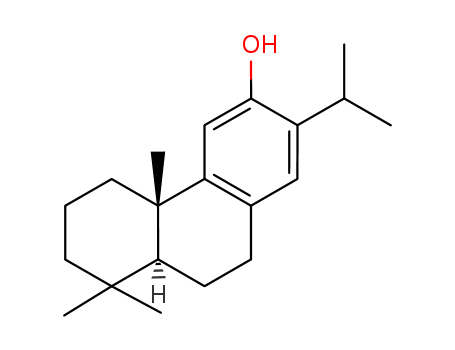
Ferruginol

Base Information
  • Chemical Name:Ferruginol
  • CAS No.:514-62-5
  • Molecular Formula:C20H30 O
  • Molecular Weight:286.458
  • Hs Code.:
  • UNII:N2CMM6X37M
  • DSSTox Substance ID:DTXSID20331722
  • Nikkaji Number:J17.558G
  • Wikipedia:Ferruginol
  • Wikidata:Q3743828
  • Metabolomics Workbench ID:69094
  • ChEMBL ID:CHEMBL197308
  • Mol file:514-62-5.mol
Ferruginol

Synonyms:ferruginol

Suppliers and Price of Ferruginol
Supply Marketing:
Business phase:
The product has achieved commercial mass production*data from LookChem market partment
Manufacturers and distributors:
  • Manufacture/Brand
  • Chemicals and raw materials
  • Packaging
  • price
  • Arctom
  • Ferruginol ≥98%
  • 5mg
  • $ 418.00
Total 37 raw suppliers
Chemical Property of Ferruginol
Chemical Property:
  • Vapor Pressure:1.41E-06mmHg at 25°C 
  • Melting Point:56-57℃ 
  • Boiling Point:388.1°Cat760mmHg 
  • PKA:10.89±0.60(Predicted) 
  • Flash Point:175.1°C 
  • PSA:20.23000 
  • Density:0.988g/cm3 
  • LogP:5.54580 
  • XLogP3:6.7
  • Hydrogen Bond Donor Count:1
  • Hydrogen Bond Acceptor Count:1
  • Rotatable Bond Count:1
  • Exact Mass:286.229665576
  • Heavy Atom Count:21
  • Complexity:385
Purity/Quality:

99%, *data from raw suppliers

Ferruginol ≥98% *data from reagent suppliers

Safty Information:
  • Pictogram(s):  
  • Hazard Codes: 
MSDS Files:
Useful:
  • Canonical SMILES:CC(C)C1=C(C=C2C(=C1)CCC3C2(CCCC3(C)C)C)O
  • Isomeric SMILES:CC(C)C1=C(C=C2C(=C1)CC[C@@H]3[C@@]2(CCCC3(C)C)C)O
  • Uses Ferruginol can be used for its antibacterial activities.
Technology Process of Ferruginol

There total 115 articles about Ferruginol which guide to synthetic route it. The literature collected by LookChem mainly comes from the sharing of users and the free literature resources found by Internet computing technology. We keep the original model of the professional version of literature to make it easier and faster for users to retrieve and use. At the same time, we analyze and calculate the most feasible synthesis route with the highest yield for your reference as below:

synthetic route:
Guidance literature:
With hydrogen; 5percent Pd/C; In ethyl acetate; at 20 ℃; for 24h;
DOI:10.1039/b003497p
Guidance literature:
With sodium methylate; In methanol; at 20 ℃; for 1h;
DOI:10.1021/ol4003652
Refernces

10.1246/bcsj.52.1459

Takashi Matsumoto and Shogo Harada details the total synthesis of several naturally occurring tricyclic diterpenes with an abietane skeleton. The authors describe the synthesis of (+)-taxoquinone, (-)-7a-acetoxyroyleanone, (-)-dehydroroyleanone, (-)-horminone, (-)-7-oxoroyleanone, and (+)-inuroyleanol, all starting from (+)-ferruginol. The synthesis involves various chemical transformations, including methylation, oxidation with chromium trioxide, reduction with sodium borohydride, acetylation, and other reactions. The structures of the synthesized compounds were confirmed through NMR spectroscopy and other analytical methods. The study represents a significant advancement in the field of natural product synthesis, providing detailed procedures and characterizations for these complex diterpenes.


Post a RFQ

Enter 15 to 2000 letters.Word count: 0 letters

Attach files(File Format: Jpeg, Jpg, Gif, Png, PDF, PPT, Zip, Rar,Word or Excel Maximum File Size: 3MB)

1 Customer Service

What can I do for you?
Get Best Price

Get Best Price for 514-62-5