10.1016/S0008-6215(00)81869-8
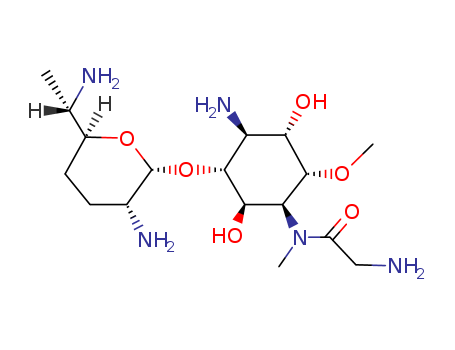
The research aimed to synthesize and evaluate 2-substituted fortimicins, a class of aminocyclitol antibiotics, through the ring-opening of 2-deoxy-1,2-epimino-2-epi-fortimicin B and nucleophilic displacements of 2-O-(methylsulfonyl)fortimicin derivatives. The study concluded that the stereochemistry of the azide displacements with different Zmethanesulfonates had a conformational basis, and several 2-substituted fortimicins were prepared and tested for antibacterial activity. Key chemicals used in the process included chloride, azide, cyanide, N-dimethylformamide, and various fortimicin derivatives, as well as reagents like Girard’s reagent T and N-(N-benzyloxycarbonylglycyloxy)succinimide.
10.1246/bcsj.60.2079
The research aimed to synthesize and investigate the biological activities of 7'-phenylfortimicin A and 7'-phenyl-6'-epifortimicin A, which are derivatives of the antibiotic fortimicin. The researchers synthesized these compounds by condensing newly prepared sugars with 2,5-di-O-benzoyl-1,4-bis[N-(methoxycarbonyl)]fortamine B, followed by deprotection. Key chemicals used in the synthesis included 1-O-acetyl-2,6-bis(2,4-dinitrophenylamino)-2,3,4,6,7-pentadeoxy-7-phenyl-L-lyxo-heptopyranose, -D-ribo-heptopyranose, and various reagents for acetylation, hydrogenation, and protection steps. The study found that 7'-phenylfortimicin A exhibited slightly weaker antibacterial activity compared to fortimicin A against many microorganisms, while 7'-phenyl-6'-epifortimicin A showed even weaker activity. The research concluded that modifications to the diamino sugar moiety of fortimicin, such as the introduction of a phenyl group, can influence its biological activity, providing insights into the structure-activity relationship of this class of antibiotics.