Welcome to LookChem.com Sign In|Join Free
  • or

Encyclopedia

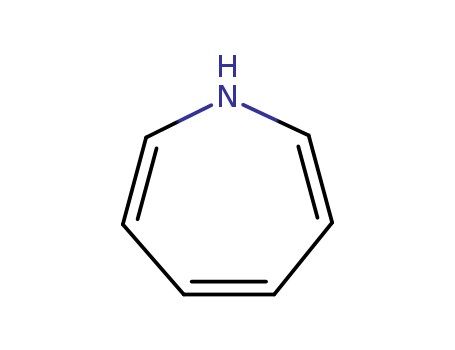
1H-Azepine

Base Information
  • Chemical Name:1H-Azepine
  • CAS No.:291-69-0
  • Molecular Formula:C6H7 N
  • Molecular Weight:93.1283
  • Hs Code.:
  • UNII:8324797PB4
  • DSSTox Substance ID:DTXSID50183352
  • Nikkaji Number:J79.580A
  • Wikipedia:Azepine
  • Wikidata:Q208942
  • Mol file:291-69-0.mol
1H-Azepine

Synonyms:1H-Azepine;azepine;291-69-0;8324797PB4;AZATROPILIDENE;DTXSID50183352;XYOVOXDWRFGKEX-UHFFFAOYSA-N;UNII-8324797PB4;AKOS006348095;FT-0778022;Q208942

Suppliers and Price of 1H-Azepine
Supply Marketing:
Business phase:
The product has achieved commercial mass production*data from LookChem market partment
Manufacturers and distributors:
  • Manufacture/Brand
  • Chemicals and raw materials
  • Packaging
  • price
Total 18 raw suppliers
Chemical Property of 1H-Azepine
Chemical Property:
  • Vapor Pressure:0.341mmHg at 25°C 
  • Boiling Point:199.5°Cat760mmHg 
  • Flash Point:79.9°C 
  • PSA:12.03000 
  • Density:0.93g/cm3 
  • LogP:1.50200 
  • XLogP3:1.7
  • Hydrogen Bond Donor Count:1
  • Hydrogen Bond Acceptor Count:1
  • Rotatable Bond Count:0
  • Exact Mass:93.057849228
  • Heavy Atom Count:7
  • Complexity:106
Purity/Quality:

99% *data from raw suppliers

Safty Information:
  • Pictogram(s):  
  • Hazard Codes: 
MSDS Files:

SDS file from LookChem

Useful:
  • Canonical SMILES:C1=CC=CNC=C1
Technology Process of 1H-Azepine

There total 6 articles about 1H-Azepine which guide to synthetic route it. The literature collected by LookChem mainly comes from the sharing of users and the free literature resources found by Internet computing technology. We keep the original model of the professional version of literature to make it easier and faster for users to retrieve and use. At the same time, we analyze and calculate the most feasible synthesis route with the highest yield for your reference as below:

synthetic route:
Guidance literature:
Multi-step reaction with 3 steps
1: 71 percent / CHCl3 / 24 h / Ambient temperature
2: 74 percent / CH3OH / pentane / 12 h / -78 °C
3: CDCl3 / -60 deg C to room temp. in 30 to 60 s
With methanol; In chloroform-d1; chloroform; pentane;
Guidance literature:
Multi-step reaction with 2 steps
1: 74 percent / CH3OH / pentane / 12 h / -78 °C
2: CDCl3 / -60 deg C to room temp. in 30 to 60 s
With methanol; In chloroform-d1; pentane;
Refernces

Galanthamine analogs: 6H-benzofuro[3a,3,2,-e,f][1]benzazepine and 6H-benzofuro[3a,3,2-e,f][3]benzazepine

10.1016/j.tet.2005.05.055

The study focuses on the synthesis and evaluation of galanthamine analogs, specifically 6H-benzofuro[3a,3,2-e,f][1]benzazepine and 6H-benzofuro[3a,3,2-e,f][3]benzazepine, which are derivatives of the Amarylidaceae alkaloid galanthamine. Galanthamine is known for its cholinesterase inhibitory properties and is used in the treatment of neuromuscular diseases and Alzheimer's dementia. The purpose of the study was to alter the position of the nitrogen within the azepine ring of galanthamine to create analogs that might have similar or improved therapeutic effects. The synthesis involved a variety of chemicals, including p-hydroxyphenylpropionic acid, benzyl chloride, thionyl chloride, and various other reagents and solvents, which were used to perform esterification, benzylation, saponification, formylation, bromination, and reduction reactions, among others. These chemicals served to construct the complex molecular structures of the analogs, with the ultimate goal of understanding how changes in the molecular structure affect the reactivity and potential therapeutic applications of these compounds.

Stereoselective synthesis of azepines through the conjugate addition of formamides to nitroalkenes and subsequent intramolecular nitrile oxide cycloaddition reaction

10.1016/j.tet.2008.09.070

The research aims to develop a concise and stereoselective method for synthesizing azepines, which are important heterocyclic compounds. The study employs the conjugate addition of formamides to nitroalkenes, followed by an intramolecular nitrile oxide cycloaddition (INOC) reaction to achieve this goal. Key chemicals used include formamides, nitroalkenes, tBuOK (potassium tert-butoxide), phenyl isocyanate, and ethyl formate. The researchers observed high cis-selectivity in the formation of azepines and successfully developed a one-pot procedure for the synthesis, achieving moderate yields. The formyl group in the synthesized compounds could be readily removed under acidic conditions without significant epimerization, yielding N–H azepines. The study concludes that this method provides a useful and stereoselective route for preparing azepines from readily available starting materials, with potential applications in the synthesis of aza-heterocyclic compounds.

Post a RFQ

Enter 15 to 2000 letters.Word count: 0 letters

Attach files(File Format: Jpeg, Jpg, Gif, Png, PDF, PPT, Zip, Rar,Word or Excel Maximum File Size: 3MB)

1 Customer Service

What can I do for you?
Get Best Price

Get Best Price for 291-69-0
