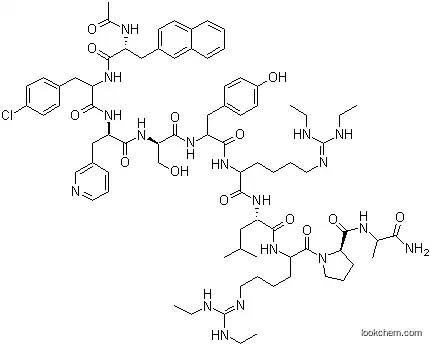
Chemical Property of Ganirelix
Chemical Property:
- Boiling Point:°Cat760mmHg
- PKA:4.2 (3-pyridinylalanine); 9.8 (tyrosine)
- Flash Point:°C
- PSA:526.09000
- Density:1.31g/cm3
- LogP:8.17440
- Storage Temp.:?20°C
- Purity/Quality:
-
99%, *data from raw suppliers
Ganirelix acetate salt ≥95% (HPLC) *data from reagent suppliers
Safty Information:
- Pictogram(s):
- Hazard Codes:Xi
- Statements:
36/37/38
- MSDS Files:
-
Useful:
-
Description
Ganirelix acetate was introduced in Germany as prefilled syringes for subcutaneous
injections that inhibit premature luteinizing hormone surges in women undergoing
controlled ovarian hyperstimulation. This decapeptide analog of luteinizing hormonereleasing
hormone (LH-RH) is the second third-generation LH-RH antagonist to be
launched after citrorelix (Asta Medica). This highly bioavailable compound immediately
blocks the endogenous release by the pituitary gland of luteinizing hormone (LH) and
follicle-stimulating hormone (FSH), the hormone that induces ovulation. After
discontinuation of the treatment, the pituitary-gonadal function is rapidly recovered due to
its short-half life. As a consequence, ganirelix at daily doses of 0.25 mg S.C. efficiently
prevented LH surges during clinical trials in infertile women under controlled ovarian
hyperstimulation with recombinant FSH before in vitro fertilization or similar reproductive
techniques. Unlike first and second-generation gonadotropin-releasing hormone
antagonists, ganirelix has minimal histamine-releasing effects thus avoiding the formation of edema of the face and extremities. Ganirelix is very resistant to hydrolysis and, in contrast to the already established cetrorelix, has good water solubility.
-
Uses
Decapeptide LH-RH antagonist. Used in treatment of infertility.